Scripture Focus
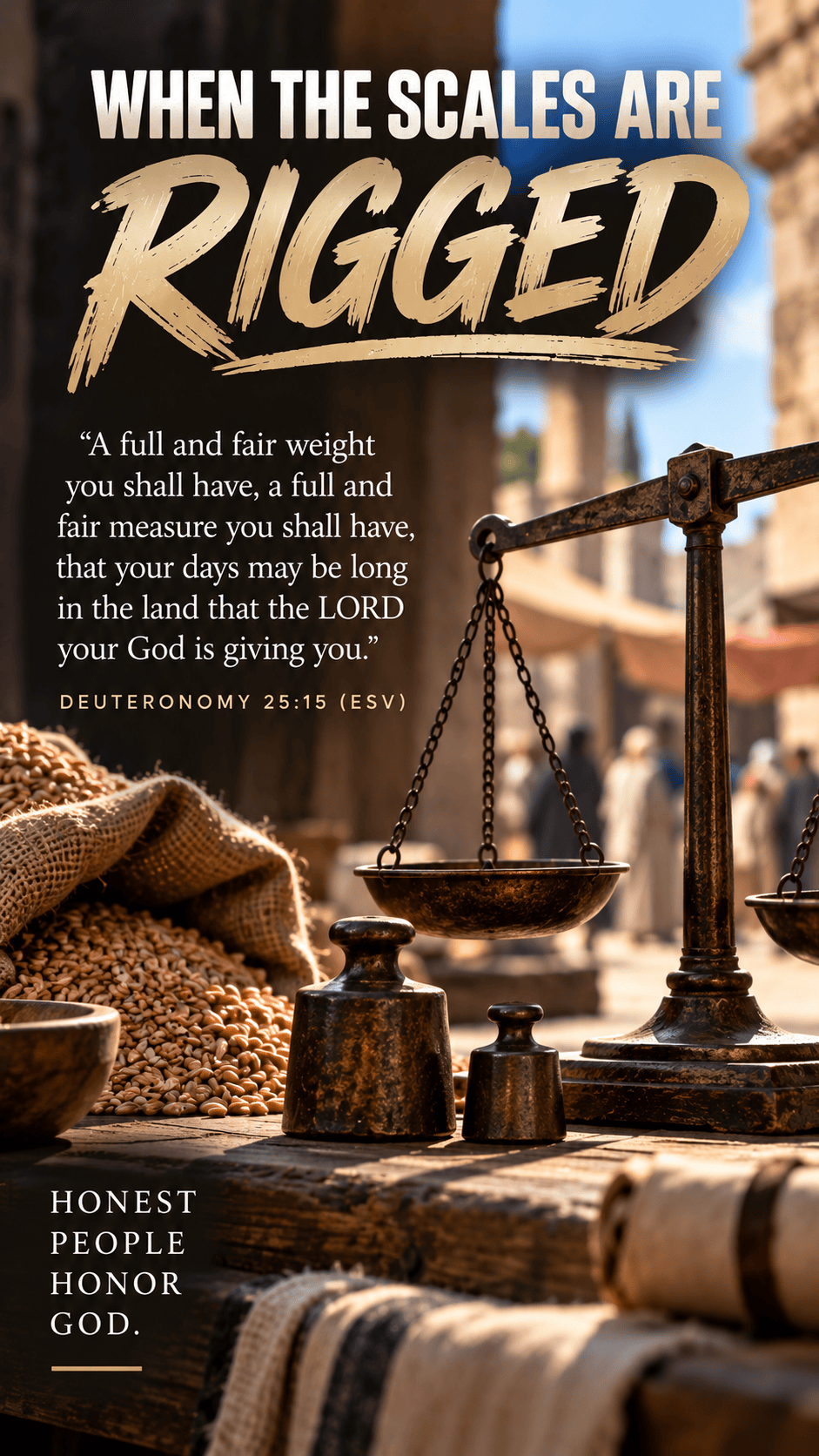
“You shall not have in your bag two kinds of weights, a large and a small. You shall not have in your house two kinds of measures, a large and a small. A full and fair weight you shall have, a full and fair measure you shall have, that your days may be long in the land that the LORD your God is giving you. For all who do such things, all who act dishonestly, are an abomination to the LORD your God.” — Deuteronomy 25:13–16 (ESV)
Devotional Thought
Here in Deuteronomy 25, Moses addresses something that might sound strange to those of us accustomed to modern cash registers, digital scales, and standardized measurements. In ancient Israel, merchants commonly used weights and measures when buying and selling goods. That system provided an opportunity for a dishonest person to manipulate a transaction in his own favor.
Matthew Henry explains the temptation well: “They must not have a great weight and measure to buy by and a small one to sell by, for that was to cheat both ways.” In other words, when the merchant was buying, he could use one weight to make sure he received more for his money. When he was selling, he could use another to give his customer less than what had been promised. Either way, the dishonest merchant came out ahead.
This was apparently a significant enough problem that Scripture repeatedly addresses it. Leviticus 19:35 forbids dishonest measurements. Proverbs 11:1 says, “A false balance is an abomination to the LORD, but a just weight is his delight.” Proverbs 20 repeats the warning twice, and the prophet Amos condemned merchants who manipulated their measurements and scales to increase their profits.
Why does God take something like this so seriously?
Part of the answer may connect with what we saw yesterday in Deuteronomy 24. God cares about people who are vulnerable to being taken advantage of. A dishonest merchant possessed knowledge his customer didn’t have. The customer looked at the scale and assumed he was receiving what he had paid for. He might have no way of knowing that the weight had been altered. The merchant was using his advantage to profit at someone else’s expense.
We see a similar concern when Jesus cleansed the temple. Worshipers traveled to Jerusalem needing animals for sacrifice, and money-changing and the sale of sacrificial animals had become part of the temple economy. Whatever combination of exploitation, commercialism, and corruption was occurring there, Jesus’ judgment was unmistakable. He overturned the tables and declared, “My house shall be called a house of prayer, but you make it a den of robbers” (Matthew 21:13).
But I think there is an even deeper reason dishonest scales matter so much to God.
Dishonesty contradicts the character of the God we represent.
God is just. God is truthful. God is faithful. He doesn’t have one standard for one person and another standard for someone else. Therefore, His people should be known for those same qualities.
Israel wasn’t simply another nation. They belonged to God and bore His name before the nations surrounding them. If they became known as people who cheated their customers, exploited the vulnerable, and manipulated transactions to make a little extra money, it didn’t merely damage their reputation. It reflected poorly upon the God they claimed to worship.
The same principle applies to Christians today.
We probably don’t carry two sets of stone weights around in our pockets, but dishonest scales haven’t disappeared. They simply look different. We can misrepresent something we’re selling, hide important information in a business transaction, charge someone for work we didn’t perform, pad an expense report, take advantage of someone’s lack of knowledge, or manipulate a situation because we know the other person has few alternatives.
And sometimes we can get away with it.
That’s where integrity is tested.
The real test of honesty isn’t what we do when everyone can see the scale. It’s what we do when we’re the only person who knows the scale is rigged.
As followers of Christ, our concern shouldn’t simply be whether something makes us a few extra dollars or whether we can technically get away with it. We should ask whether the way we conduct ourselves accurately represents the God whose name we bear.
There may even be times when doing the right thing costs us money. We may have to pass up an opportunity for additional profit because taking it would mean benefiting unfairly at someone else’s expense. From the world’s perspective, that might seem foolish.
But God sees the scales.
And according to Proverbs 11:1, while a false balance is an abomination to Him, “a just weight is his delight.”
There are some things worth far more than making an extra buck. One of them is living in such a way that our honesty brings honor to the God we represent.
Reflection Questions
- Why do you think God speaks so strongly against dishonest weights and measures?
- Are there areas of my business, finances, work, or everyday dealings where I might be tempted to benefit unfairly at someone else’s expense?
- Would the people who do business or work with me describe me as honest and trustworthy?
- Am I willing to lose a financial advantage when keeping it would require compromising my integrity?
Closing Prayer
Father, You are perfectly just, truthful, and faithful. Help me to reflect Your character in every area of my life, including the way I handle money and conduct business with others. Guard me from the temptation to take advantage of another person’s weakness, need, or lack of knowledge for my own benefit. Give me the integrity to do what is right even when no one else would know the difference and even when honesty costs me something. May my dealings with others bring honor rather than reproach to Your name. In Jesus’ name, Amen.
 Revcort's Ramblings
Leave a comment