Scripture Focus
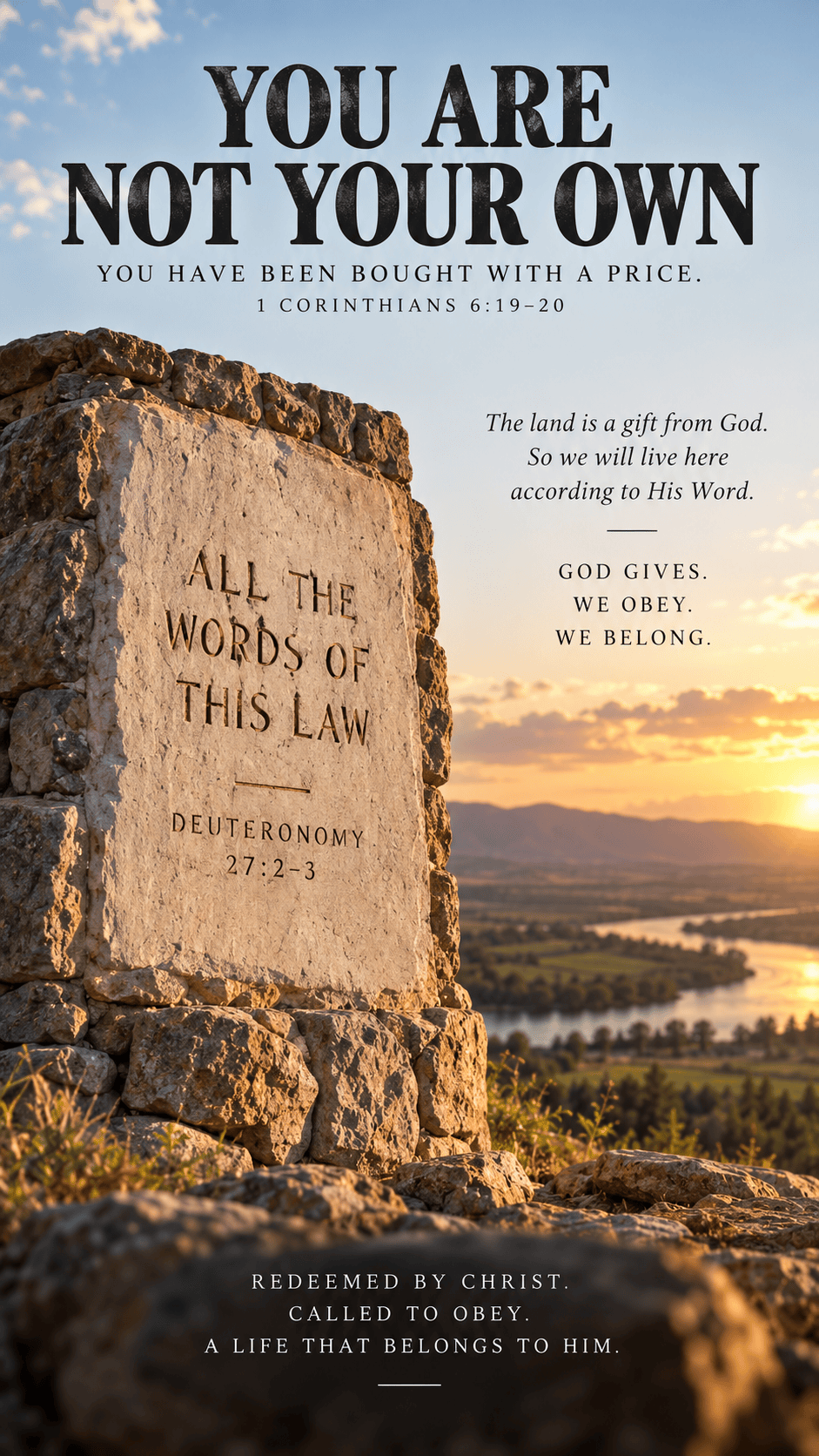
“And on the day you cross over the Jordan to the land that the LORD your God is giving you, you shall set up large stones and plaster them with plaster. And you shall write on them all the words of this law, when you cross over to enter the land that the LORD your God is giving you, a land flowing with milk and honey, as the LORD, the God of your fathers, has promised you.” — Deuteronomy 27:2–3 (ESV)
Devotional Thought
Here in Deuteronomy 27, Moses gives Israel some unusual instructions concerning what they were to do after crossing the Jordan River into the Promised Land. They were to set up large stones, cover them with plaster, and write the words of God’s law upon them. Later in the chapter, Moses specifies that the altar they built was to be made from uncut stones—ordinary stones that had not been shaped or dressed by human tools.
Matthew Henry makes an interesting observation about the simplicity of these stones: “The word of God needs not to be set off by the art of man, nor embellished with the enticing words of man’s wisdom.”
There was no need for polished marble, expensive metals, elaborate carvings, or impressive architecture. The importance of the monument wasn’t found in the stones themselves. What mattered was the Word written upon them. God’s Word didn’t need Israel to make it impressive. It carried its own authority because it came from God.
But there was another important reason for this monument. Israel was about to receive something they had not earned. God was giving them “a land flowing with milk and honey.” They had not conquered Egypt by their own strength. They had not survived the wilderness by their own resources. They had not brought themselves to the banks of the Jordan. God had rescued them, provided for them, protected them, and now He was giving them the land He had promised their fathers.
The monument reminded them that because the land was God’s gift, they could not simply enter it and live however they pleased. Matthew Henry describes the principle this way: “Write it that thou mayest go in.” In other words, Israel was entering the land acknowledging the terms upon which they were entering. Henry continues, “Since Canaan is given by promise, it must be held by obedience.”
The stones were a declaration: God gave us this land, and therefore we will live here according to His Word. They weren’t entering Canaan as people who were now free from God. They were entering as people who belonged to God.
There is an important lesson here for followers of Jesus. We sometimes talk about salvation almost entirely in terms of what we receive. We receive forgiveness. We receive eternal life. We receive grace. We receive the promise of heaven. All of those things are wonderfully true. But Scripture also reminds us that when Christ redeemed us, He purchased us for Himself.
Paul writes, “You are not your own, for you were bought with a price” (1 Corinthians 6:19–20). That means the Christian life cannot be, Jesus saved me, so now I can live however I want. Actually, the gospel tells us something very different. Jesus saved me, so now my life belongs to Him.
My time belongs to Him. My relationships belong to Him. My ambitions belong to Him. My body belongs to Him. My money belongs to Him. My choices belong to Him. Even the private parts of my life that nobody else sees belong to Him.
We don’t obey Christ in order to earn salvation. Salvation is God’s gift of grace through faith in Jesus Christ. But the person who has truly been redeemed should increasingly desire to live like someone who belongs to the Redeemer.
That doesn’t mean Christians never fail. We do. When we stumble, we repent. When we wander, we return. We seek the face of God continually and ask Him to help us walk in step with His Spirit.
But there should be something within us that desires to follow Jesus. After all, that is what a disciple is— a follower. Someone who has no desire to follow Christ, obey His Word, turn from sin, or become more like Him should seriously consider what it means to call himself or herself a Christian. We cannot claim to follow Jesus while insisting that Jesus has no authority over the way we live.
Israel crossed the Jordan into a land that had been given to them by God, and one of the first things they were commanded to do was establish a reminder that they belonged to Him and were called to live according to His Word.
Maybe we need that reminder too. You have been redeemed. You have been bought with a price. Your life is a gift from God—and it belongs to Him.
Reflection Questions
- Are there areas of my life where I tend to think, “This is mine, and I can do whatever I want with it”?
- How does knowing that I have been “bought with a price” change the way I think about my choices and priorities?
- Is there an area where I know God’s Word is calling me to obedience, but I have been resisting Him?
- Does my life demonstrate a genuine desire to follow Jesus, even when following Him requires repentance or sacrifice?
Closing Prayer
Father, thank You for redeeming me through Jesus Christ. Forgive me for the times I live as though my life belongs entirely to me. Remind me that I have been bought with a price and that everything I am belongs to You. Give me a heart that desires Your Word, quickly repents when I fail, and willingly follows wherever You lead. Help me walk in step with Your Spirit and live in a way that honors the One who saved me. In Jesus’ name, amen.
 Revcort's Ramblings
Leave a comment