Scripture Focus
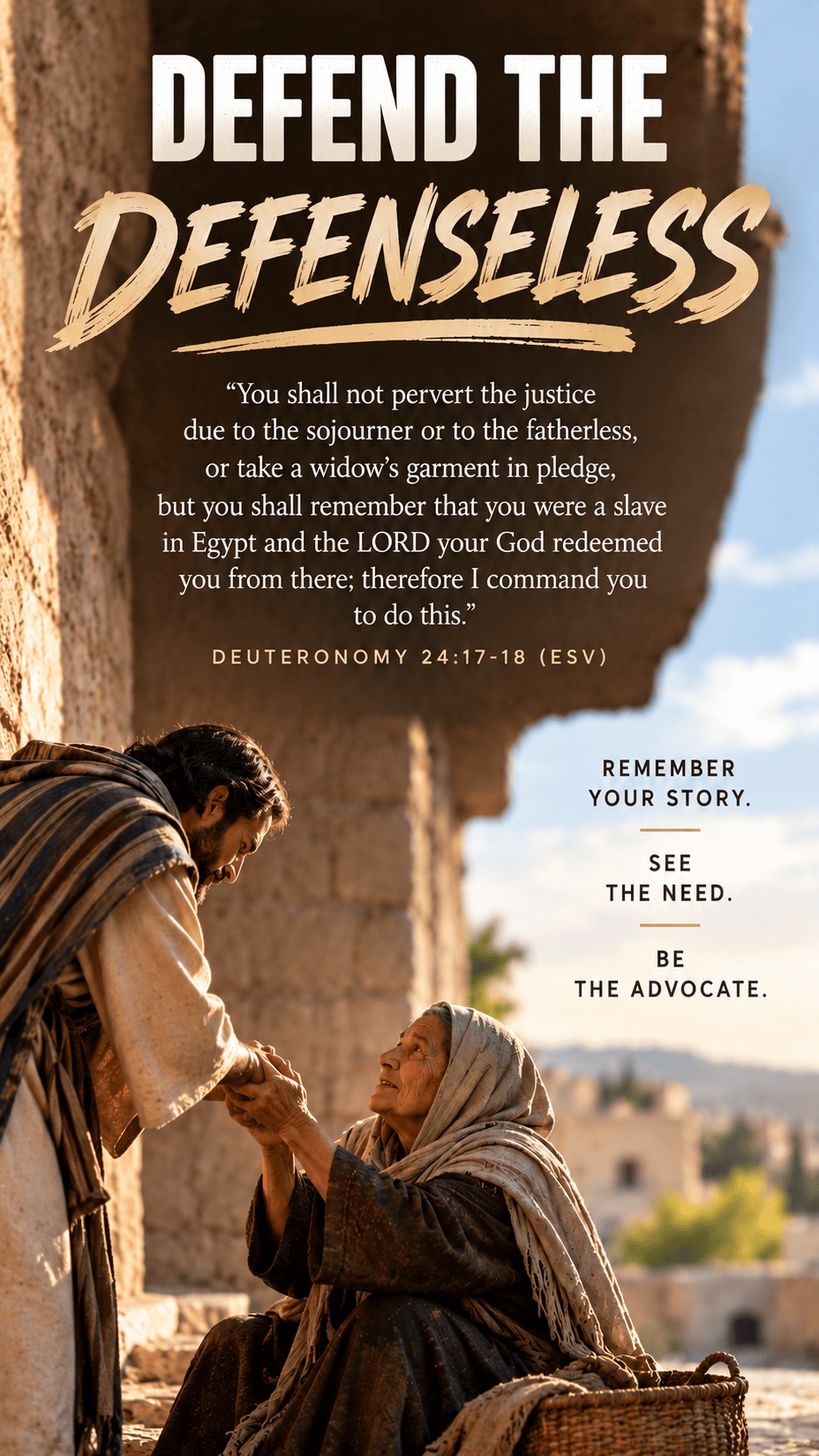
“You shall not pervert the justice due to the sojourner or to the fatherless, or take a widow’s garment in pledge, but you shall remember that you were a slave in Egypt and the LORD your God redeemed you from there; therefore I command you to do this.” — Deuteronomy 24:17–18 (ESV)
Devotional Thought
Here in Deuteronomy 24, Moses gives Israel several laws dealing with different situations they would encounter once they entered the Promised Land. As the chapter draws toward its conclusion, however, Moses focuses particularly on people who were vulnerable in Israelite society—the sojourner, the fatherless, and the widow. These were people who often lacked the family connections, financial resources, or social standing necessary to defend themselves when someone treated them unjustly.
God’s command was clear: His people were not to take advantage of someone’s weakness. They were to defend those who had no one to defend them.
This isn’t an isolated teaching in Scripture. Psalm 68:5 describes God as “Father of the fatherless and protector of widows.” Psalm 146 says that the Lord “watches over the sojourners” and “upholds the widow and the fatherless.” Proverbs 31:8 commands us to “open your mouth” for those who cannot speak for themselves and to defend the rights of the poor and needy. Isaiah condemned those who used their power to deprive the needy of justice.
The same concern continues into the New Testament. James 1:27 says that religion that is “pure and undefiled before God the Father” includes visiting “orphans and widows in their affliction.” Jesus consistently noticed people others ignored. He stopped for the blind beggar everyone else wanted to silence. He welcomed people society rejected. Throughout Scripture, God demonstrates a particular concern for people who are easily overlooked, mistreated, or pushed aside.
But here in Deuteronomy 24, Moses doesn’t merely tell Israel what to do. He tells them why they should do it. “Remember that you were a slave in Egypt.”
Israel knew what it felt like to be powerless. They had lived for generations under the authority of Pharaoh. They had few rights and no political influence. When their Egyptian taskmasters treated them cruelly, there was no court to which they could appeal and no powerful advocate willing to take their side.
Moses himself had witnessed that cruelty. Years earlier, he saw an Egyptian beating one of his fellow Hebrews and intervened. Now, decades later, Moses tells Israel never to forget what those years had been like.
But more importantly, they were to remember what God had done about it. “The LORD your God redeemed you from there.”
When Israel had no power to deliver themselves, God became their Defender. He heard their cries. He saw their suffering. He confronted Pharaoh, broke the power that held them, and brought them out of slavery. Therefore, when Israel encountered someone who was powerless, they were supposed to remember Egypt.
As Christians, we have an even greater reason to understand that principle. We know what it is to need a Defender. Sin had placed us under a debt we could never pay and a judgment we could never escape on our own. Yet God did not leave us helpless. He sent His own Son to take our punishment and offer us forgiveness, mercy, and grace.
Where would we be if God had not taken up our cause? That question should affect the way we see people around us.
When we encounter someone who has little influence, few resources, no powerful connections, or seemingly no one willing to speak on their behalf, followers of Christ shouldn’t be among those who look the other way. We should be people who care about justice, speak for those whose voices are ignored, and show mercy to those who need it.
That doesn’t mean ignoring truth or excusing wrongdoing. Biblical justice is still justice. But someone’s weakness should never make it easier for us to mistreat them, overlook them, or deny them what is right.
We have received far too much mercy to become people who refuse to show mercy. Remember where you were. Remember who rescued you. And defend those who are defenseless.
Reflection Questions
- Why do you think God repeatedly expresses concern for the sojourner, fatherless, widow, and others who are vulnerable?
- Who are some people around me who may feel powerless, overlooked, or without anyone willing to defend them?
- How should remembering what God has done for me change the way I respond to someone who needs help?
- Is there someone whose cause God may be calling me to defend or whose voice I need to help others hear?
Closing Prayer
Father, thank You for seeing me when I was helpless and for providing salvation through Your Son when I could never save myself. Help me never forget the mercy and grace You have shown me. Give me eyes to notice those who are overlooked, compassion for those who are hurting, and courage to stand for those who have no one to defend them. May I reflect Your character by pursuing justice, showing mercy, and treating every person with dignity and love. In Jesus’ name, Amen.


Leave a Reply