Scripture Focus
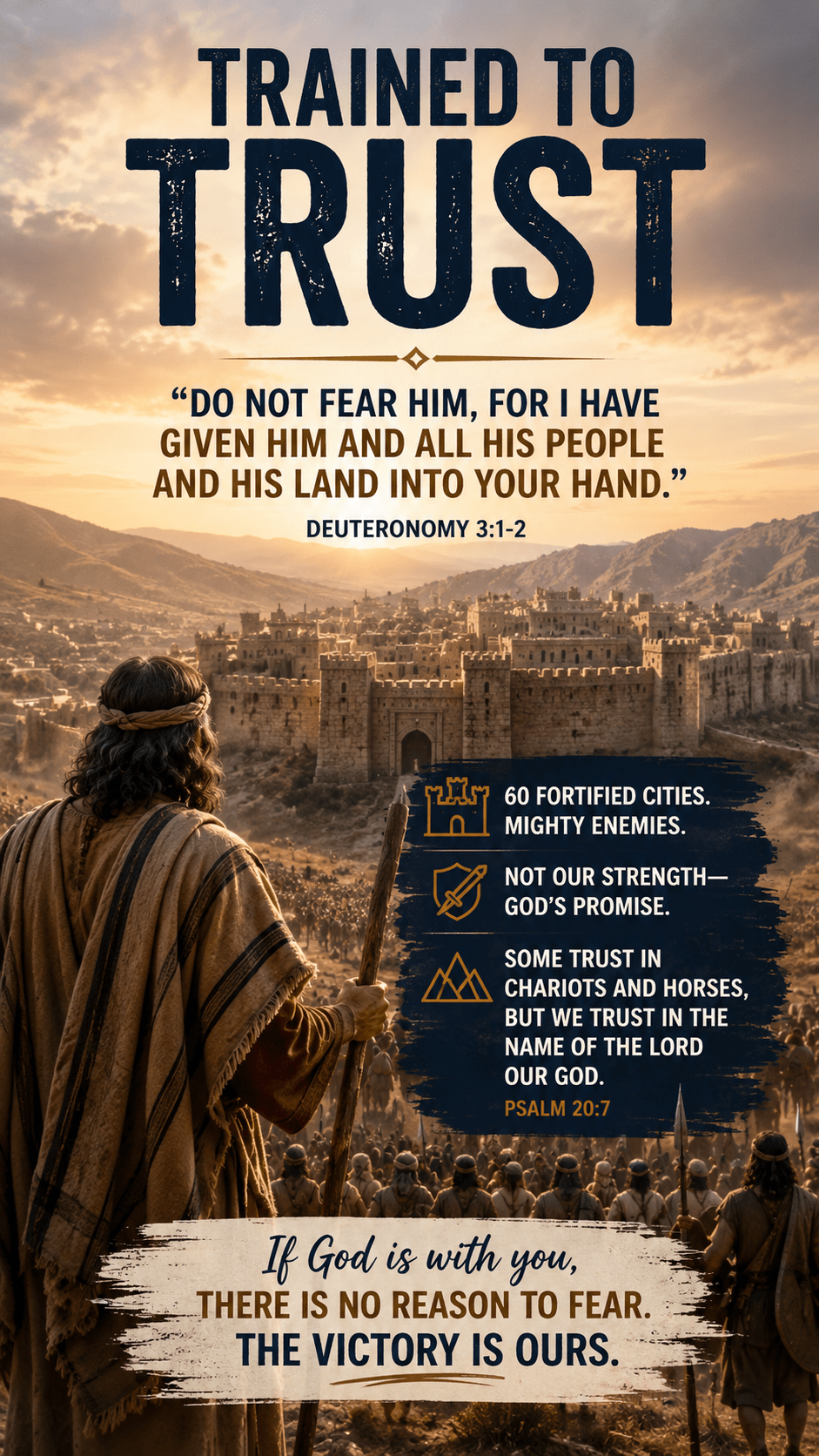
“Then we turned and went up the way to Bashan. And Og the king of Bashan came out against us, he and all his people, to battle at Edrei. But the LORD said to me, ‘Do not fear him, for I have given him and all his people and his land into your hand.’”
— Deuteronomy 3:1–2 (ESV)
Devotional Thought
As we continue through the opening chapters of Deuteronomy, a pattern begins to emerge. Israel isn’t simply marching through the wilderness conquering everyone in its path. Sometimes God tells them, Leave these people alone. I have given that land to them. At other times, Moses sends messengers asking permission to pass peacefully through a territory. Israel promises to stay on the road, purchase its food and water, and cause no trouble. If God says leave a nation alone, Israel must leave it alone. If God says move forward, Israel must move forward. The lesson is becoming clear: Israel must learn to trust God’s direction rather than its own judgment.
At the end of Deuteronomy 2, Sihon king of Heshbon refuses Israel’s peaceful request. Scripture tells us that God hardened Sihon’s spirit because He intended to give his kingdom into Israel’s hands. Israel defeated Sihon and took possession of his territory. Then, as chapter 3 begins, Og king of Bashan doesn’t even wait for negotiations. He gathers his army and comes out to meet Israel in battle.
God’s first words to Moses are important: “Do not fear him.”
There was plenty about Bashan that could have caused Israel to fear. Moses tells us that they captured sixty fortified cities, “with high walls, gates, and bars,” in addition to numerous unwalled villages (Deuteronomy 3:4–5). Does that description sound familiar? It surely must have sounded familiar to Israel. Forty years earlier, the spies had returned from Canaan talking about strong people, enormous inhabitants, and fortified cities. Their report caused Israel’s heart to melt with fear, and that generation refused to enter the land God had promised them.
Now God places another generation in front of something remarkably similar.
There were fortified cities. There were powerful armies. There were even connections to the giant peoples who had once inhabited these regions. Yet this time Israel moved forward, and Bashan fell. Sixty fortified cities with high walls, gates, and bars could not stop what God had determined to do.
So what changed?
It wasn’t that Israel had suddenly become the world’s greatest military power. The decisive difference wasn’t Israel’s strength; it was God’s presence and promise. When Israel had previously attempted to fight after God told them not to go, they were defeated. When God told them to leave Edom and Moab alone, obedience meant walking away. But when God said, “Do not fear him, for I have given him…into your hand,” obedience meant going forward.
God wasn’t merely training Israel to fight. He was training them to trust.
Perhaps that’s one reason these experiences were so important before Israel crossed the Jordan. The next generation was about to face the very kinds of things that had terrified their parents—armies, fortified cities, and intimidating enemies. God was graciously giving them opportunities to discover that their future would never depend primarily upon how strong they were. Their security was found in trusting the God who went before them.
We need the same lesson.
David later wrote, “Some trust in chariots and some in horses, but we trust in the name of the LORD our God” (Psalm 20:7). Chariots and horses represented military strength—the things human beings could see, count, and depend upon. Faith doesn’t mean pretending those things don’t exist. It means recognizing that none of them ultimately determine the outcome. Our confidence rests in God rather than ourselves.
The Gospel shows us this truth in its greatest form. Our greatest problem could never be conquered through our own strength. We couldn’t make ourselves righteous before God. We couldn’t overcome sin, defeat death, or earn our way into God’s family. So Jesus accomplished for us what we could never accomplish for ourselves. His righteousness is credited to us. His death pays for our sin. His resurrection becomes the guarantee of our life. We come to Him empty-handed, trusting what Christ has done rather than what we can do.
And that same posture of dependence should characterize the rest of the Christian life.
There will be battles in front of us that look intimidating. There will be walls that appear too high and obstacles that seem too strong. But the question isn’t simply, “Am I strong enough to handle this?” The better question is, “What has God called me to do?”
Sometimes faith means moving forward because God has clearly told us to go. Sometimes obedience means leaving something alone because God has said it isn’t ours to take. We shouldn’t manufacture battles and then expect God to bless them simply because we entered them confidently. But when God has clearly called us forward, fear doesn’t get the final word.
Israel needed to learn that lesson before entering Canaan, and perhaps we need to learn it before whatever God has placed ahead of us.
God wasn’t training Israel to become fearless because they were strong. He was training them to trust because He was faithful.
If God is leading us forward, we don’t have to be intimidated by the height of the walls. We simply have to trust the One who goes before us.
Reflection Questions
- Am I more likely to evaluate a challenge by the size of the obstacle or by the faithfulness of God?
- Is there an area of my life where God may be teaching me to trust Him rather than my own abilities?
- Have I ever entered a battle God didn’t call me to fight and then expected Him to bless my plans?
- How does the Gospel remind me that my relationship with God depends upon what Christ has accomplished rather than what I can accomplish?
Closing Prayer
Father, teach me to trust You more than I trust my own strength, wisdom, or resources. Give me discernment to know when You are calling me forward and humility to know when You are telling me to leave something alone. When the walls look high and the opposition seems overwhelming, remind me that nothing is greater than You. Thank You most of all for Jesus, who accomplished for me what I could never accomplish for myself. Train my heart to trust You, knowing that You are faithful in every battle You call me to face. In Jesus’ name, amen.


Leave a Reply