Scripture Focus
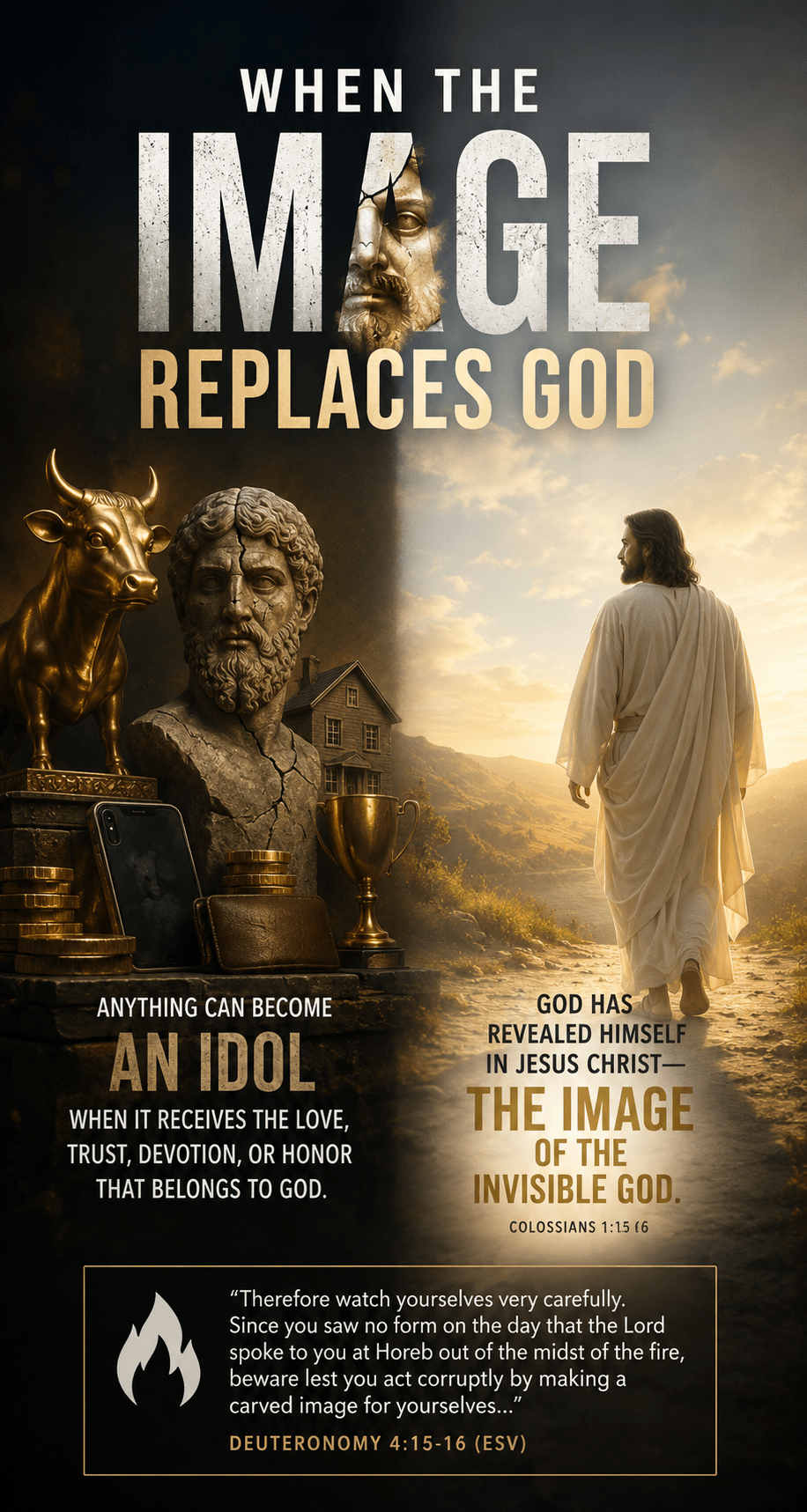
“Therefore watch yourselves very carefully. Since you saw no form on the day that the Lord spoke to you at Horeb out of the midst of the fire, beware lest you act corruptly by making a carved image for yourselves, in the form of any figure…” — Deuteronomy 4:15–16 (ESV)
Devotional Thought
As Moses continues reminding Israel of their history with God, he points them back to Mount Horeb. They had heard the voice of God speaking from the fire. They had witnessed His power and glory. They had received a law so wise that Moses said the surrounding nations would marvel at the wisdom God had given them. But Moses reminds them of something else that happened at Horeb—or, more precisely, something that didn’t happen: they never saw God’s form.
That detail had never really stood out to me before. Israel heard God, experienced His presence, and saw manifestations of His glory, but they never saw His face. Even Moses, who spoke with God in an extraordinary way, was told, “You cannot see my face, for man shall not see me and live” (Exodus 33:20). God placed Moses in the cleft of the rock, covered him, and allowed him only a limited glimpse of His glory as He passed by. Even that encounter left Moses’ face shining so brightly that the Israelites were afraid to look at him.
Certainly, one reason God did not reveal His face is that sinful human beings could not survive the unveiled glory of a holy God. But here in Deuteronomy 4, Moses seems to point us toward another reason Israel needed to remember that they had “seen no form”: the human heart has a natural tendency toward idolatry. Moses essentially says, “You didn’t see a form, so don’t make one.”
We want something tangible. We want something we can see, touch, hold, or control. Israel demonstrated that tendency almost immediately at Horeb. While Moses was on the mountain, they made a golden calf and said, “These are your gods, O Israel, who brought you up out of the land of Egypt!” (Exodus 32:4). They took the glory that belonged to the invisible God and attached it to something their own hands had made.
Perhaps that helps us understand the danger God was protecting Israel from. Had they seen some physical representation of God, how long would it have been before someone attempted to reproduce it? And how long before people began giving honor to the image instead of the God the image supposedly represented? The representation could eventually become a replacement.
This temptation certainly did not disappear with ancient Israel. Throughout human history, people have created statues, images, objects, and representations to make the spiritual world tangible. Even Christians must be careful that symbols intended to remind us of God never begin receiving the devotion that belongs to God alone. But idolatry goes much deeper than carved statues. Anything that receives the love, trust, devotion, identity, or honor that belongs to God can become an idol.
Our careers can become idols. Money can become an idol. Family, hobbies, possessions, relationships, politics, success, entertainment, and even ministry can become idols. Human beings were created to worship. If we refuse to worship the One who created us, we don’t stop worshiping—we simply find something else to worship.
And perhaps that is why Moses begins this warning with the words, “watch yourselves very carefully.” Idolatry isn’t merely something other religions practice or something ancient people did with carved statues. It is a danger lurking within every human heart. We continually face the temptation to take something God created and give it a place that belongs only to the Creator.
Yet the Gospel adds something remarkable to this passage. Israel saw no form at Horeb, but centuries later God did reveal Himself to humanity in a way we could behold. Jesus Christ is “the image of the invisible God” (Colossians 1:15). John writes, “No one has ever seen God; the only God, who is at the Father’s side, he has made him known” (John 1:18). We do not need to manufacture an image to show us what God is like. God has revealed Himself perfectly in His Son.
And still we live by faith as we wait for the day when faith becomes sight. Scripture promises that a day is coming when God’s people “will see his face” (Revelation 22:4). Until then, we resist the temptation to replace the invisible God with something we can see, possess, or control. We worship the God who has revealed Himself through His Word and ultimately through His Son, Jesus Christ.
No image our hands can make could ever contain His glory.
Reflection Questions
- Why do you think Moses connected Israel’s seeing “no form” at Horeb with his warning against making idols?
- What good things in your life could potentially receive the devotion, trust, or attention that belongs to God?
- Are there religious symbols, traditions, experiences, or practices that have become more important to you than the God they are meant to point toward?
- How does knowing that Jesus is “the image of the invisible God” change the way we think about knowing and worshiping God?
Closing Prayer
Father, You alone are worthy of my worship. Forgive me for the times I have given created things the love, trust, attention, or devotion that belongs to You. Search my heart and reveal anything that has begun to take Your place. Thank You that You have made Yourself known to us through Your Son, Jesus Christ. Teach me to walk by faith, worship You in spirit and truth, and look forward to the day when I will finally see Your face. In Jesus’ name, amen.


Leave a Reply