Scripture Focus
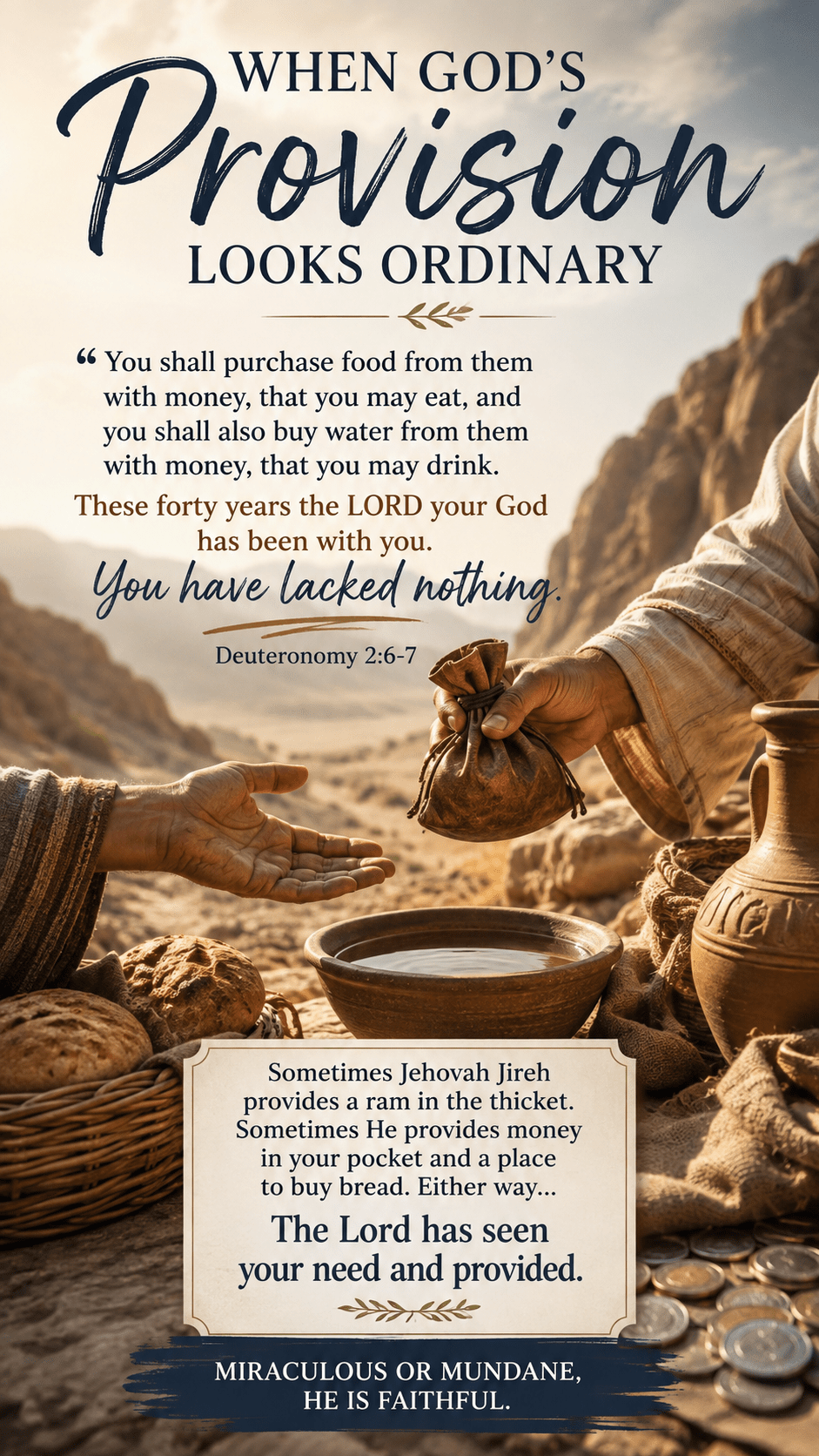
“You shall purchase food from them with money, that you may eat, and you shall also buy water from them with money, that you may drink. For the LORD your God has blessed you in all the work of your hands. He knows your going through this great wilderness. These forty years the LORD your God has been with you. You have lacked nothing.”
— Deuteronomy 2:6–7 (ESV)
Devotional Thought
After Israel refused to enter the Promised Land and then foolishly attempted to go forward without God’s blessing, they faced the consequences of their unbelief. They would wander in the wilderness until that rebellious generation had passed away. As Moses recounts those years, however, something interesting appears in God’s instructions concerning their journey through the territory belonging to the descendants of Esau.
Earlier in Israel’s journey, God’s provision had often been spectacular. His presence was visible in the cloud by day and the pillar of fire by night. At Sinai there was fire, smoke, thunder, and the sound of a trumpet. When the people needed food, manna appeared on the ground. When they wanted meat, God sent quail. When they needed water in the wilderness, God brought water from a rock. Again and again, God provided in ways that could only be described as miraculous.
But notice how ordinary God’s provision sounds in Deuteronomy 2. When Israel passed near the descendants of Esau, God told them not to take their land or their possessions. Instead, they were to buy their food and water. Moses explained, “The LORD your God has blessed you in all the work of your hands.” God had provided them with resources, and now they could simply purchase what they needed.
If you were an Israelite accustomed to manna appearing every morning, perhaps buying your supper wouldn’t seem very impressive. There was no bread falling from heaven and no water pouring from a rock. They had money, someone else had food and water, and they made a transaction. What could possibly be spiritual about that?
Quite a lot, apparently, because Moses follows those instructions with this remarkable statement: “These forty years the LORD your God has been with you. You have lacked nothing.”
The means of God’s provision may have changed, but the Provider had not.
We sometimes have trouble recognizing God’s hand in the ordinary. If I couldn’t pay my mortgage and an unexpected check arrived for exactly the amount I needed, I would probably tell everyone, “God provided!” And I would be right. But what if God gives me the ability to work, provides me with a job, gives me an employer who pays me for that work, and enables me to buy what I need each month? Isn’t that also God’s provision?
Most of us didn’t wake up this morning and find manna scattered across our yards. When we’re thirsty, water probably isn’t going to gush from a rock. We turn on a faucet. We go to the grocery store. We receive a paycheck and purchase food. Those things can become so ordinary that we stop seeing the gracious hand of God behind them.
Jesus taught us to pray, “Give us this day our daily bread” (Matthew 6:11). Most of the time, that daily bread doesn’t arrive miraculously. Yet Jesus still teaches us to recognize our Father as its ultimate source. The job, the strength to work, the paycheck, the food on the shelf, the farmer who grew it, and even the rain that watered the field are all part of God’s providential care.
Abraham discovered this truth in a dramatic way on Mount Moriah. When God provided a ram in place of Isaac, Abraham called the place “The LORD will provide”—Jehovah Jireh (Genesis 22:14). Sometimes Jehovah Jireh provides a ram caught in a thicket. Sometimes He provides manna on the ground or water from a rock. And sometimes He provides money in your pocket and a place where you can buy bread.
God’s provision doesn’t become less divine simply because it looks ordinary.
Perhaps we need to become better at noticing His goodness in the everyday things we have learned to take for granted. When we sit down to a meal, turn on the faucet, drive to work, deposit a paycheck, or open a refrigerator filled with food, we are surrounded by reminders of God’s provision. The miraculous should cause us to marvel, but the ordinary should cause us to give thanks.
Israel could look back across forty difficult years and hear Moses say, “The LORD your God has been with you. You have lacked nothing.” May we learn to look at our own lives and recognize the same faithful Provider. Whether His provision comes through the miraculous or the mundane, Jehovah Jireh deserves all the glory.
Reflection Questions
- Do I tend to recognize God’s provision only when something unusual or miraculous happens?
- What ordinary blessings in my life have I begun to take for granted?
- How has God provided for me through work, relationships, resources, or circumstances that may not have seemed miraculous at the time?
- What can I thank God for today that I normally consider simply part of everyday life?
Closing Prayer
Father, thank You for being my faithful Provider. Forgive me for the times I have overlooked Your goodness simply because Your provision came through ordinary means. Open my eyes to see Your hand in my daily bread, my work, my home, and all the countless ways You care for me. Whether You provide through the miraculous or the mundane, help me remember that every good gift ultimately comes from You. You have been faithful, and You deserve all the glory and honor for everything You provide. In Jesus’ name, amen.


Leave a Reply