Scripture Focus
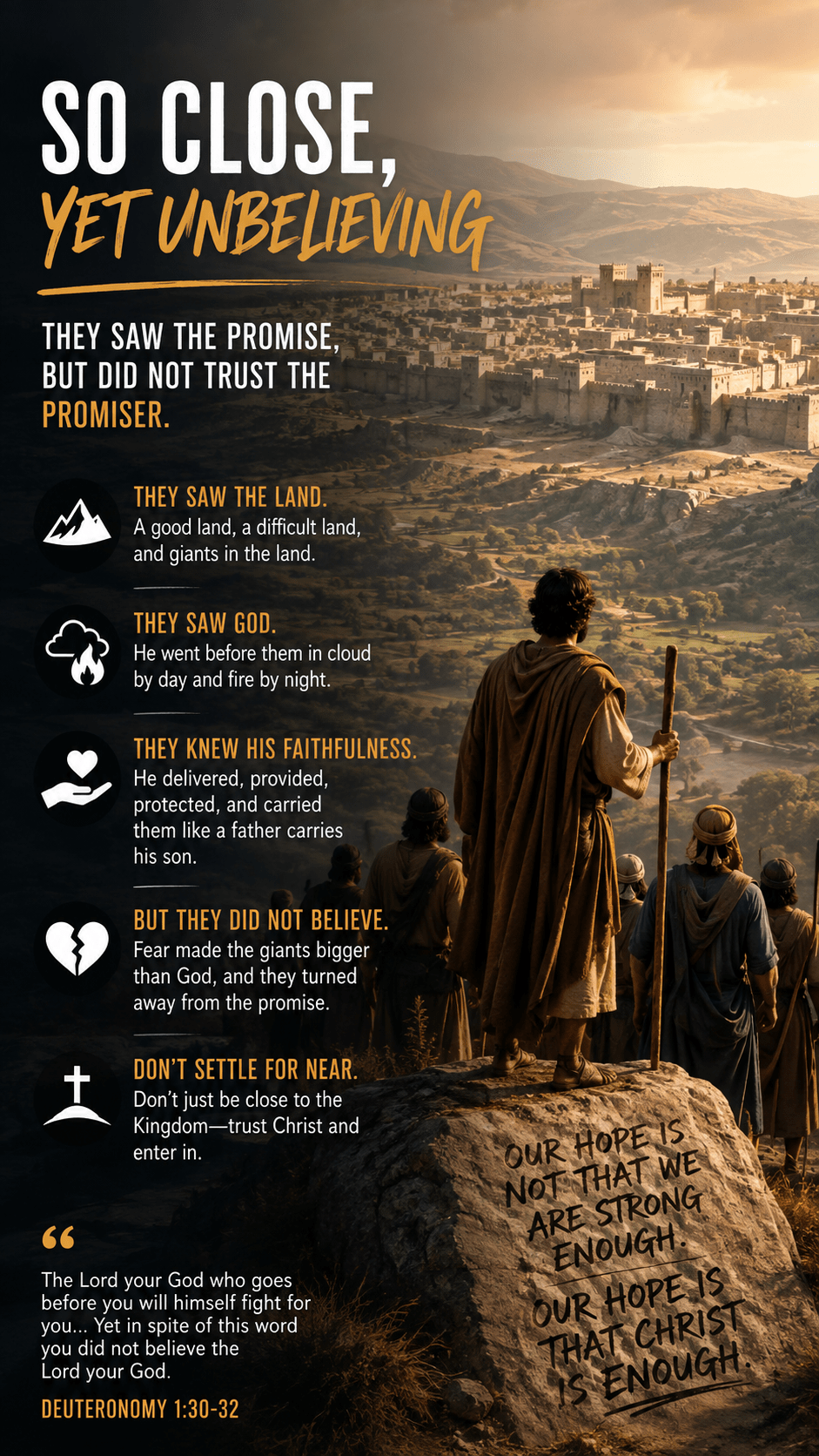
“Then I said to you, ‘Do not be in dread or afraid of them. The Lord your God who goes before you will himself fight for you, just as he did for you in Egypt before your eyes, and in the wilderness, where you have seen how the Lord your God carried you, as a man carries his son…’ Yet in spite of this word you did not believe the Lord your God.” — Deuteronomy 1:29–32 (ESV)
Devotional Thought
As Moses recounts Israel’s history to the generation preparing to enter the Promised Land, he reminds them of one of the saddest moments in their parents’ journey. Israel had finally arrived at Canaan, and twelve men—one from each tribe—were sent to spy out the land. All twelve saw essentially the same things: a beautiful and fruitful land, fortified cities, and powerful people, including the descendants of Anak. But they did not interpret what they saw the same way. Ten looked at the inhabitants, then looked at themselves, and concluded, We cannot do this. Joshua and Caleb looked at those same inhabitants, then looked at God, and concluded, He can. The real question was never whether Israel was strong enough to conquer Canaan. They weren’t. The question was whether the God who had promised them the land was strong enough to give it to them.
Sadly, the people listened to the ten rather than the two. They murmured in their tents and even said, “Because the Lord hated us he has brought us out of the land of Egypt…to destroy us.” Sometimes I read Israel’s complaints and wonder how God put up with these people, but then He reminds me of myself—my own complaining, my own fears, and the many times my faith has been smaller than it should have been. Consider where Israel could have been without God’s grace, mercy, and provision. They could still have been slaves in Egypt, but God sent the plagues and delivered them. They could have died at the Red Sea, but God divided the waters and brought them through on dry ground. They could have starved in the wilderness, but God gave them manna and quail. They could have died of thirst, but God gave them water from a rock. Even after their terrible sin with the golden calf, God showed them mercy.
Yet when they reached the border of the land God had promised them, they accused Him of bringing them there because He hated them. How quickly fear can distort our view of God. The God who heard their cries in Egypt, delivered them from Pharaoh, divided the sea, fed them every morning, gave them water, and visibly led them by cloud and fire was suddenly being accused of abandoning them. They looked at the giants ahead and allowed those circumstances to reinterpret everything God had already done behind them. We can do the same thing. A prayer isn’t answered as we expected, a door closes, the future becomes uncertain, or something appears too difficult, and suddenly we wonder whether God has forgotten us. Israel’s problem wasn’t a lack of evidence of God’s faithfulness. Their problem was unbelief. Moses says it plainly: “Yet in spite of this word you did not believe the Lord your God.”
What makes their unbelief even more remarkable is that God had made His presence so obvious among them. They had witnessed miracles that most generations would never see. Yet Moses reminds them of something even more personal: in the wilderness, “the Lord your God carried you, as a man carries his son.” Israel thought God had brought them into the wilderness to destroy them; God said He had been carrying them like a father carries his child. They saw abandonment where God saw fatherly care. They saw giants where God saw a land He had already promised to give them. Faith does not pretend the giants aren’t real. Joshua and Caleb saw exactly what everyone else saw. Faith simply refuses to make the giants bigger than God.
Perhaps the most tragic part of the story is how close Israel was. They were no longer in Egypt or wandering somewhere far from God’s promise. They were standing at its border. They had seen the land and tasted its fruit, yet an entire generation turned away because they would not believe God. Their unbelief led to forty years of wandering, and that generation would die in the wilderness, with Joshua and Caleb being the great exceptions. They were close to the promise, but being close wasn’t enough.
This gives us an important Gospel application. The New Testament repeatedly points back to Israel’s wilderness experience as a warning against unbelief. These Israelites were tremendously blessed. They belonged to God’s covenant people, heard His Word, experienced His power, ate the manna, and followed the cloud—and yet many remained faithless. There is a sobering parallel for those who spend their lives surrounded by the things of God without ever personally trusting Christ. A person can grow up in church, hear countless sermons, know Bible stories, sing worship songs, and be surrounded by Christians while remaining only near the Kingdom. Jesus encountered religious people who knew the Scriptures and were waiting for the Messiah, yet when the Messiah stood among them, many refused to believe. Being near the Kingdom is not the same as entering it.
Israel could never possess what God had promised through its own strength, and neither can we save ourselves from sin and death through ours. The Gospel announces that Jesus Christ has accomplished what we could never accomplish. He lived the righteous life we have failed to live, bore our sin upon the cross, died in our place, and rose again. Our hope is not that we are strong enough; our hope is that Christ is enough. The tragedy would be to come right up to the border—to hear the Gospel, understand it, perhaps even agree that it is true—and still refuse to trust Christ.
The ten spies looked at their weakness and concluded that God’s promise could not possibly come true. Joshua and Caleb looked at God’s faithfulness and knew that their weakness could never cancel His promise. When fear tells us to look at the giants, faith reminds us to look at the God who has carried us this far. And when it comes to the Gospel, don’t settle for simply being near the Kingdom. Trust Christ.
Reflection Questions
- When difficulties arise, do I focus more on the size of the problem or the faithfulness of God?
- Have I allowed fear or disappointment to make me question God’s goodness despite His past faithfulness?
- What “giants” am I facing that I need to view in light of who God is?
- Am I simply familiar with the Gospel, or have I personally placed my faith in Jesus Christ?
Closing Prayer
Father, forgive me for the times I complain about my circumstances while forgetting how faithfully You have carried me. When fear makes the obstacles ahead seem overwhelming, remind me of all You have already done. Help me not to interpret Your goodness through my circumstances, but to see my circumstances in light of Your faithfulness. Most of all, keep me from merely being near the Kingdom. Thank You for Jesus, who accomplished what I could never accomplish for myself. Help me to trust Him completely and to walk forward in faith. In Jesus’ name, amen.


Leave a Reply