Scripture Focus
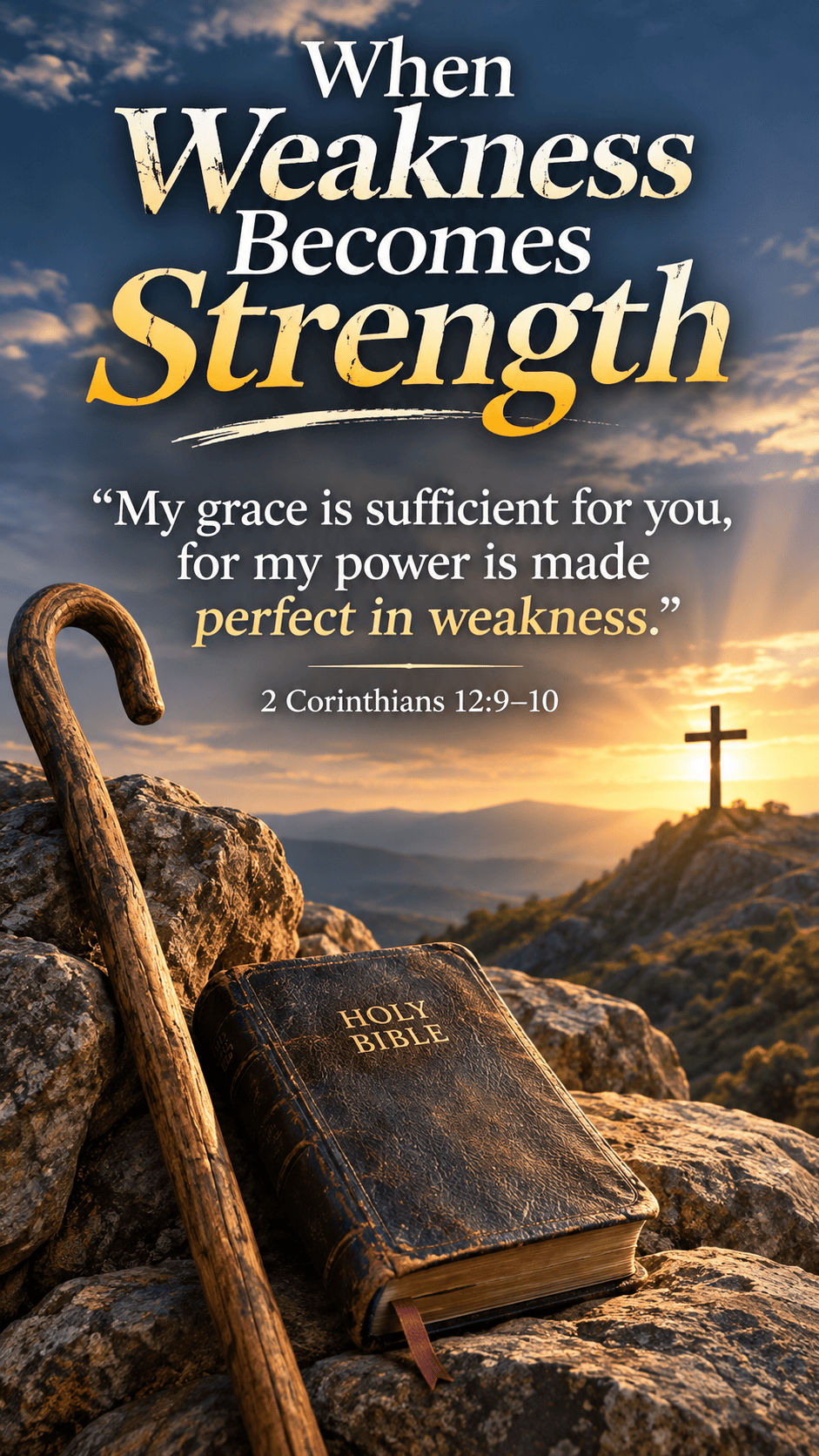
“But he said to me, ‘My grace is sufficient for you, for my power is made perfect in weakness.’ Therefore I will boast all the more gladly of my weaknesses, so that the power of Christ may rest upon me. For the sake of Christ, then, I am content with weaknesses, insults, hardships, persecutions, and calamities. For when I am weak, then I am strong.” — 2 Corinthians 12:9–10 (ESV)
Devotional Thought
I believe this passage is vitally important for every believer, but especially for those who desire to serve the Lord in ministry. Whether we’re preaching, teaching, sharing the Gospel, leading worship, or exercising the spiritual gifts God has given us, we often have some very mistaken ideas about what makes a person effective in God’s service. We tend to believe that strength, intelligence, eloquence, charisma, physical appearance, and natural talent are the qualities that make someone successful. We assume that the more impressive a person appears to others, the more effectively God can use that person. But in these verses, Paul challenges that entire way of thinking.
Remember what we’ve just learned about Paul’s thorn in the flesh. God had allowed this affliction in Paul’s life to prevent him from becoming conceited because of the extraordinary revelations he had received. Interestingly, Paul’s opponents in Corinth had already criticized him for being unimpressive in person and lacking the eloquence they apparently expected from a great spiritual leader. From their perspective, Paul wasn’t particularly impressive. Yet even this man, who apparently lacked many of the outward qualities people admired, needed a thorn in the flesh to keep him humble. That ought to tell us something about the danger of pride in ministry.
Think about what many churches look for when searching for a pastor or ministry leader today. They often want someone who is attractive, articulate, intelligent, talented, energetic, and charismatic. They want someone who can command a room, inspire a congregation, and attract people through the force of his personality. Now, there’s certainly nothing wrong with possessing those qualities. God gives people different abilities and talents, and He can use every one of them for His glory. But here’s the question we ought to be asking: Are those the qualities that make someone effective in the hands of God?
Perhaps we should ask a few other questions. How likely is someone with all those natural advantages to depend completely upon the Lord? Why are people drawn to that particular leader? And when something remarkable happens through that person’s ministry, who receives the glory? Certainly, a gifted and charismatic leader can be genuinely humble and consistently direct people’s attention toward Christ. But we also know something about human nature. We enjoy recognition. We appreciate compliments. We like knowing that people admire our abilities. And if we’re not careful, we can begin trusting in those abilities rather than in the God who gave them to us.
I’ve always been fascinated by the story of Jonathan Edwards, the eighteenth-century preacher and theologian who delivered the famous sermon Sinners in the Hands of an Angry God in Enfield, Connecticut, in 1741. Historical accounts describe an extraordinary response among those who heard the message, with people crying out in distress over their spiritual condition. Interestingly, Edwards is often described as having delivered his sermons in a relatively restrained manner, without the dramatic gestures and theatrical presentation we might associate with such an emotional response. Whatever we make of the historical descriptions of his preaching style, the account reminds us that the power of God’s Word does not depend upon the showmanship of the person delivering it.
Now, I’m going to tell on myself a little bit. I remember the 1960 Disney movie Pollyanna, starring Hayley Mills. In that film, Karl Malden portrays Reverend Paul Ford, a preacher whose sermons are filled with fire and brimstone. In one memorable scene, he delivers portions of Jonathan Edwards’ famous sermon with such intensity that the chandeliers appear to shake! It’s a wonderfully dramatic scene, and Malden certainly gives a powerful performance. But the movie’s portrayal is quite different from the restrained delivery traditionally associated with Edwards himself. The contrast makes an interesting point. We tend to associate powerful preaching with powerful presentation, but those two things are not necessarily the same. A preacher can deliver a message with tremendous emotion and accomplish very little spiritually, while another can speak quietly and simply and see God accomplish something extraordinary.
And that brings us back to Paul’s words. After pleading with the Lord three times to remove his thorn in the flesh, Paul received an answer he probably wasn’t expecting: “My grace is sufficient for you, for my power is made perfect in weakness.” God wasn’t going to remove Paul’s weakness. Instead, He was going to demonstrate His power through it. Paul had been concerned about something he believed was hindering his effectiveness, but God assured him that his limitations were no obstacle to divine power. In fact, those very limitations would provide an opportunity for God’s strength to be displayed more clearly.
Notice how dramatically Paul’s attitude changed. Instead of continuing to complain about his weakness, he declared that he would gladly boast about it! He even said he was content with weaknesses, insults, hardships, persecutions, and calamities for the sake of Christ. Why? Because he had discovered something that completely changed his understanding of strength: “For when I am weak, then I am strong.” Paul wasn’t saying that weakness itself somehow produces strength. He was saying that when he recognized his own limitations and depended upon Christ, the power of Christ was at work in him. His strength wasn’t found in what he could accomplish on his own, but in what God could accomplish through him.
I wonder how many believers have convinced themselves that God can’t use them because they don’t possess the qualities they see in others. Perhaps you don’t consider yourself particularly intelligent or articulate. Maybe you’re uncomfortable speaking in front of people. Perhaps you don’t have an impressive appearance, a commanding personality, or the natural talents that seem to make ministry easier for someone else. You may look at your own limitations and conclude that you’re simply not qualified to accomplish anything significant for the Lord.
But what if you’ve been looking at those limitations all wrong? What if the very things you consider weaknesses are opportunities for God to demonstrate His strength? What if God can accomplish more through someone who knows he is completely dependent upon the Lord than through someone who believes he has everything necessary to succeed on his own?
Of course, this doesn’t mean we should neglect developing the abilities God has given us or excuse laziness and a lack of preparation. We should always offer the Lord our very best. But we must never confuse our best efforts with the source of spiritual power. We can prepare, study, practice, and work diligently, but only God can accomplish the spiritual work that truly matters. And when He works through someone whose limitations are obvious, there is little question about who deserves the glory.
Perhaps that’s one of the greatest lessons Paul learned through his thorn in the flesh. God wasn’t looking for a man who could impress the world with his abilities. He was working through a man who had learned to depend upon the sufficiency of His grace. Paul’s weakness didn’t disqualify him from serving Christ. It taught him where his true strength was found.
So, do you consider yourself weak? Do you feel unimpressive, inadequate, or unqualified? Don’t assume those limitations mean God cannot use you. You may be exactly the kind of person through whom He desires to demonstrate His power. Remember, God’s power is not limited by our weaknesses. Sometimes our weaknesses are the very means through which His strength is most clearly revealed.
Reflection Questions
- Have you ever felt unqualified to serve the Lord because you lacked certain abilities, talents, or personal qualities? How does Paul’s experience challenge that thinking?
- Are there areas of your life where you rely more upon your own abilities than upon the power and grace of God?
- How might God use something you consider a weakness to demonstrate His strength and bring glory to Himself?
Closing Prayer
Heavenly Father, thank You for reminding me that Your power is not limited by my weaknesses. Forgive me for the times I’ve trusted in my own abilities or compared myself to others and concluded that I wasn’t good enough to serve You. Help me to remember that Your grace is sufficient for every challenge I face and every task You call me to accomplish. Keep me humble when You bless my efforts, and teach me to depend upon Your strength rather than my own. May everything You accomplish through my life bring glory and honor to You alone. In Jesus’ name, Amen.


Leave a Reply