Scripture Reading: Daniel 12:4–13
Scripture Focus
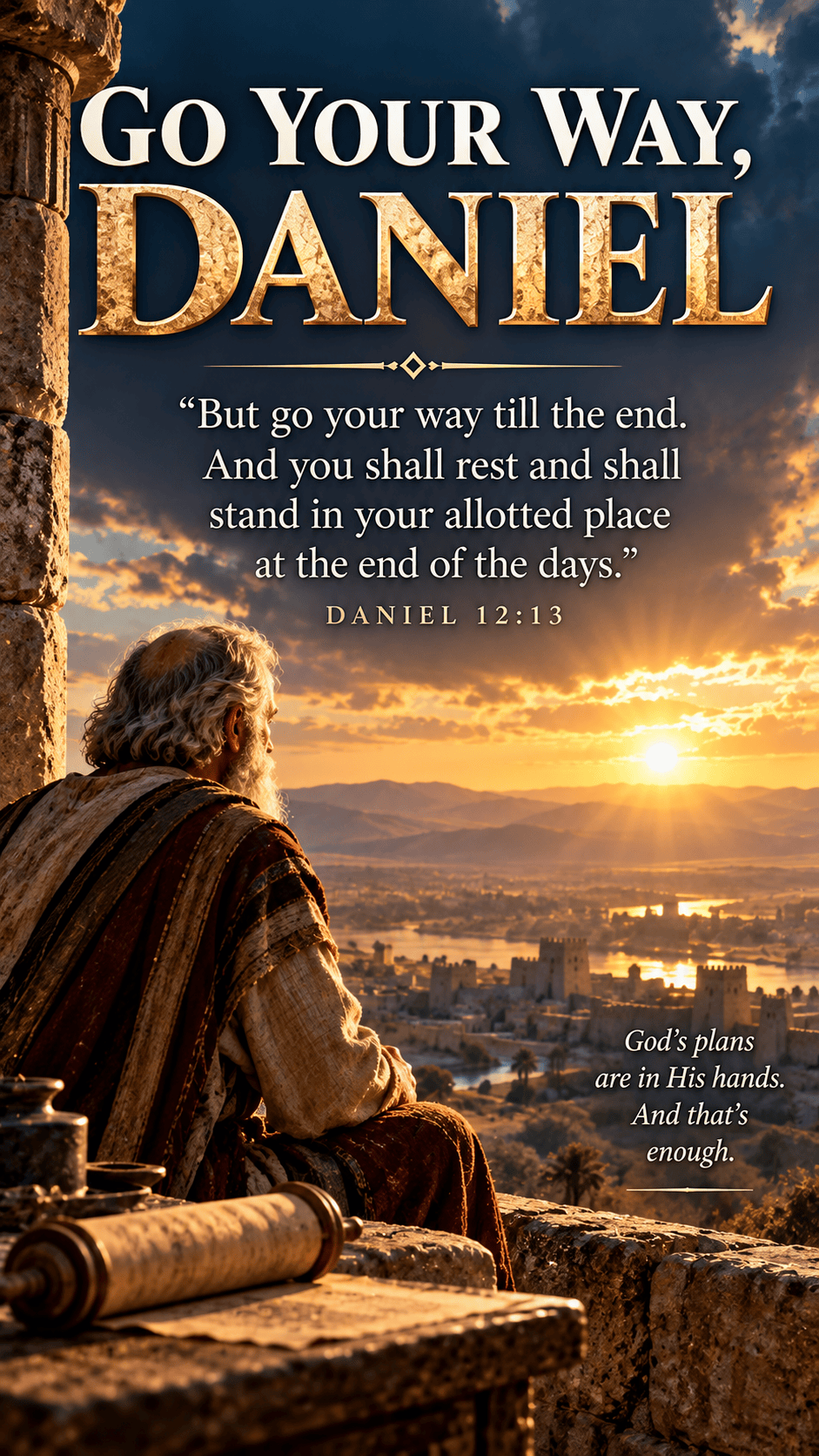
“I heard, but I did not understand. Then I said, ‘O my lord, what shall be the outcome of these things?’ He said, ‘Go your way, Daniel, for the words are shut up and sealed until the time of the end.’ … ‘But go your way till the end. And you shall rest and shall stand in your allotted place at the end of the days.’” — Daniel 12:8–9, 13 (ESV)
Devotional Thought
As we come to the final verses of Daniel, I feel as though we need to spend at least a little time considering the numbers that appear near the end of this remarkable book. After all, Daniel has just received an extraordinary revelation concerning events that would unfold long after his lifetime. And now, as the vision draws to a close, the heavenly messenger gives him two very specific numbers. In verse 11, Daniel is told that from the time the regular burnt offering is taken away and the abomination that makes desolate is established, there will be 1,290 days. Then, in verse 12, the messenger adds, “Blessed is he who waits and arrives at the 1,335 days.” What are we supposed to do with those numbers?
Well, throughout the centuries, biblical scholars have offered a variety of interpretations. Some understand these periods as literal days associated with events that occurred during the persecution of the Jewish people under Antiochus IV Epiphanes. Others understand them as referring to events still future, associated with the end of the age. Still others interpret the days symbolically or apply a day-for-a-year approach to the prophecy. And, as you might imagine, these different approaches have produced a wide range of proposed dates and explanations. I’m not going to pretend that I can settle a debate that has occupied serious students of Scripture for centuries. I certainly don’t know the precise starting point for these calculations, nor can I confidently explain how every detail will ultimately be fulfilled.
But here’s something that encourages me tremendously. Daniel didn’t understand everything either! In verse 8, Daniel makes a remarkably honest admission: “I heard, but I did not understand.” Think about who is saying that. This is Daniel, the man to whom God had given extraordinary wisdom and understanding. He had interpreted Nebuchadnezzar’s dreams when the wise men of Babylon could not. He had explained the handwriting on the wall to Belshazzar. He had received visions of kingdoms that would rise and fall and had been shown remarkable glimpses of God’s eternal purposes. And yet, here near the end of his life, Daniel admits that there are things God has revealed that he still does not understand.
So he asks a perfectly reasonable question: “What shall be the outcome of these things?” And how does the messenger respond? “Go your way, Daniel, for the words are shut up and sealed until the time of the end.” In other words, Daniel was not going to receive all the answers he wanted. Some things would remain hidden until God’s appointed time. But Daniel was not being asked to understand everything. He was being asked to trust the God who did. I think there’s an important lesson here for all of us.
God has revealed enough about the future to assure us that His purposes will be accomplished. He has told us that evil will not ultimately prevail, that Christ will return, that the dead will be raised, and that those who belong to Him will inherit everlasting life. But He has not given us every detail. And He certainly has not invited us to spend our lives attempting to calculate the precise date of Christ’s return. Jesus Himself warned His disciples that the day and hour were not theirs to know. Unfortunately, some believers become so consumed with trying to decipher prophetic timelines that they lose sight of the responsibilities God has already placed before them. Instead of producing confidence and hope, their speculation produces anxiety, fear, and sometimes confusion among those who listen to them. But biblical prophecy was never intended to make God’s people fearful of tomorrow. It was given to strengthen our confidence in the God who holds tomorrow in His hands.
And that’s where I think the final words spoken to Daniel become so meaningful. “Go your way.” What a wonderfully simple instruction. Daniel, you don’t have to figure everything out. You don’t have to know exactly when these things will happen. You don’t have to understand how every event will unfold. God knows, and that’s enough. So go your way. Live the life God has given you. Continue trusting Him. Remain faithful to the responsibilities He has placed before you. And leave the things you cannot control in His hands.
Sometimes we spend far too much time trying to pick up things that God never intended for us to carry. We worry about tomorrow, attempt to control circumstances beyond our reach, and exhaust ourselves trying to answer questions God has not yet answered. But we cannot hold those things in our hands. They’re too big for us. And when we insist on carrying them anyway, we often find ourselves burdened by anxiety that accomplishes absolutely nothing. There is no better place for the future to be than in the hands of God.
And then comes the final promise. “But go your way till the end. And you shall rest and shall stand in your allotted place at the end of the days.” What a beautiful conclusion to Daniel’s story. After a lifetime of faithful service, Daniel is told that he will rest. His earthly life will eventually come to an end. But that will not be the end of his story. God promises that Daniel will stand again and receive the inheritance appointed for him. The same God who had sustained Daniel through captivity, political upheaval, persecution, and the lions’ den would remain faithful to him even beyond the grave. And through Jesus Christ, we have that same assurance of God’s faithfulness. Those who belong to Christ have been promised resurrection and an eternal inheritance that will never perish, spoil, or fade.
As we close this remarkable book, I find myself thinking about everything Daniel experienced. He was carried away from his homeland as a young man. He served under powerful kings and witnessed the rise and fall of empires. He stood firm when obedience to God placed his life in danger. He prayed faithfully, even when prayer became a crime. And he trusted God through circumstances that were entirely beyond his control. Now, at the end, God tells him to go his way and rest in the certainty of His promises. Perhaps that’s the greatest lesson we can take from Daniel’s life. We don’t have to understand everything. We don’t have to control everything. And we certainly don’t have to carry the weight of the future on our shoulders. We simply need to know the God who does understand, who is in control, and who has promised never to forsake His people.
Think about how this remarkable book began. Daniel was a young man living in Jerusalem when Nebuchadnezzar came and besieged the city. His homeland was conquered, his future seemed uncertain, and he was carried away into captivity in a foreign land. From a human perspective, everything familiar and secure had been taken from him. But as we reach the final verses of his story, we discover that his future had never been in the hands of Nebuchadnezzar, Belshazzar, Darius, or any other earthly ruler. It had always been in the hands of God. The book begins with a young man whose future seems to have been taken from him, and it ends with an old man being assured that his future has always been secure in God’s hands.
So go your way. Live faithfully. Trust God’s promises. Do the work He has given you to do. And leave tomorrow in His hands. The God who held Daniel’s future in His hands is the same God who holds ours. And we can trust Him all the way to the end.
Reflection Questions
- Are there circumstances in your life that you have been trying to control even though they are beyond your ability to change? What would it look like to surrender those things to God?
- How does Daniel’s willingness to trust God without understanding every detail challenge the way you approach uncertainty about the future?
- If God were to tell you today, “Go your way,” what responsibilities would He be calling you to fulfill faithfully while trusting Him with the outcome?
Closing Prayer Heavenly Father, thank You for the remarkable testimony of Daniel and for the faithfulness You demonstrated throughout his life. Thank You that Your purposes are certain, even when I cannot understand how they will unfold. Forgive me for the times I have allowed worry about tomorrow to distract me from the work You have given me today. Help me surrender the things I cannot control and trust that they are safe in Your hands. Give me the courage to remain faithful when circumstances are difficult, the wisdom to obey Your Word when I do not have all the answers, and the peace that comes from knowing my future belongs to You. And when my earthly journey comes to an end, may I rest in the promise of resurrection and everlasting life through Jesus Christ. Until that day, help me go my way, serving You faithfully and trusting You completely. In Jesus’ name, Amen.


Leave a Reply