Scripture Reading: Daniel 8:1–27
Scripture Focus
“And I, Daniel, was overcome and lay sick for some days. Then I rose and went about the king’s business, but I was appalled by the vision and did not understand it.” —Daniel 8:27 (ESV)
Devotional Thought
Have you ever watched someone succeed by doing what you knew was wrong? Perhaps dishonesty brought them recognition, cruelty strengthened their influence, or compromise opened doors that faithfulness seemed to keep closed. Experiences like these can leave us wondering why God allows evil to prosper while His people struggle. Daniel’s vision brings us face to face with that troubling reality. It describes a time when powerful rulers would conquer nations, but its greatest concern is what would happen to God’s people when one of those rulers turned his ambition against their worship and their faith.
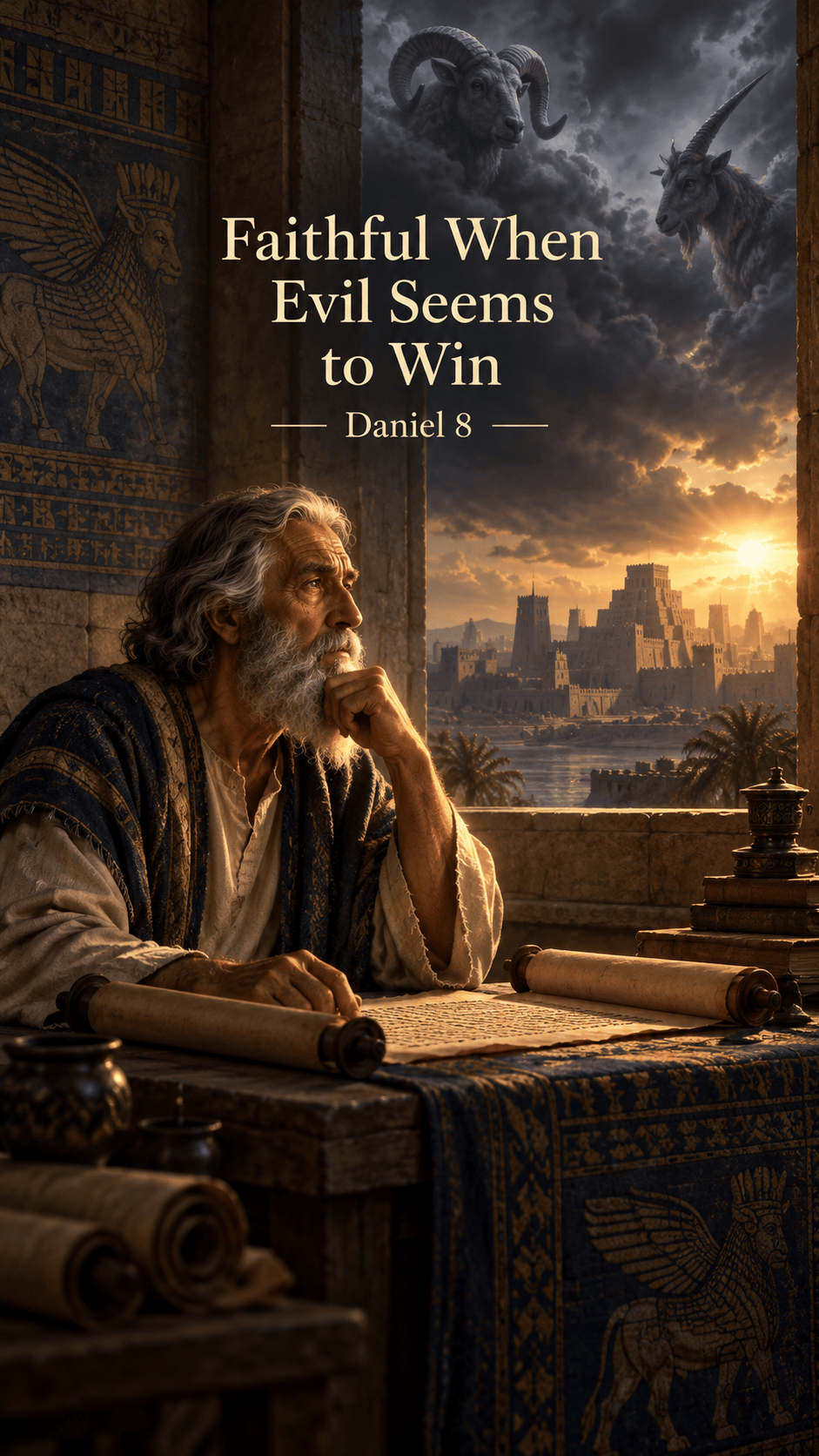
The images may seem strange, but Gabriel helps Daniel understand their meaning. The ram with two horns represents Media and Persia. The goat represents Greece, and its great horn points to its first great king, historically understood as Alexander the Great. When that horn breaks, four others rise in its place, representing kingdoms that emerge from the divided empire. Then the vision turns toward a ruler who attacks God’s people, interferes with their worship, and profanes the sanctuary. This little horn is best understood in its immediate historical setting as Antiochus IV Epiphanes, whose persecution brought terrible suffering to the Jewish people. Although some details remain difficult, the burden of the vision is clear: God was preparing His people for a time when wickedness would appear powerful and faithfulness would become costly.
One statement is especially disturbing. The ruler would throw truth to the ground and prosper in what he did. We might expect such blatant rebellion to bring immediate judgment, yet for a time his evil purposes would seem to succeed. That should challenge the way we measure success. A person’s influence does not prove that God approves of their actions. Popularity does not make a teaching true, and prosperity does not make dishonesty acceptable. When we measure righteousness by visible results, we may begin admiring what God condemns or questioning what He commands. We need the discernment to recognize that something can appear successful while remaining deeply offensive to God.
For believers, this raises a searching question: Will we remain faithful when obedience brings no immediate advantage? It is easy to affirm our commitment to truth when telling the truth costs us little. The challenge comes when a lie might protect our reputation, compromise might gain acceptance, or silence might preserve a relationship we are afraid to lose. Daniel’s vision reminds us that loyalty to God may require us to stand against what others celebrate. We must decide whether we will honor Christ because He is worthy of our obedience, even when the results are painful and the benefits are not yet visible.
The suffering in this chapter also reminds us that belonging to God does not spare His people from distress. The sanctuary is desecrated, worship is interrupted, and the faithful are attacked. These events are painful precisely because they touch what God’s people hold most dear. Yet their suffering does not mean that God has abandoned them. He reveals the coming trouble before it arrives, and He promises that the sanctuary will be restored. His people would need endurance during that season, but they could endure knowing that the persecutor’s apparent triumph would not last forever. We should be careful, therefore, about assuming that hardship proves God’s displeasure or that an easy life proves His favor.
In the midst of the vision, a holy one asks how long this devastation will continue. Even within this heavenly conversation, there is concern over the suffering of God’s people. We may bring that same concern before the Lord. The question “How long?” can express the faith of someone who knows that God alone can bring the needed deliverance. We do not have to hide our grief or pretend that evil does not trouble us. We can pray honestly, tell Him what burdens our hearts, and continue trusting Him while we wait. The answer includes the difficult reference to 2,300 evenings and mornings, and interpreters differ over how that period should be understood and calculated. The promise of restoration, however, is clear. The sanctuary will be restored, and the arrogant ruler who rises against the Prince of princes will be broken. God has not surrendered His authority.
As Christians, our confidence rests ultimately in Jesus Christ. At the cross, those who opposed Him appeared to have prevailed. His followers grieved, and the One in whom they had placed their hope lay in a tomb. His resurrection revealed the victory that His enemies’ violence could not prevent. We follow a risen Savior, and that gives us reason to remain faithful even when present circumstances offer little encouragement. We may not see how God will resolve the trouble before us, but we know that our hope is grounded in the Lord who has overcome death and will bring His purposes to completion.
Daniel’s own response gives this chapter a deeply human ending. He was overwhelmed by what he had seen, became sick, and needed time to recover. Even after receiving Gabriel’s explanation, he did not fully understand the vision. Scripture allows us to see the weight he carried without criticizing him for being troubled. A faithful servant of God can be deeply distressed by suffering and still have unanswered questions. Eventually, Daniel rose and returned to the king’s business. He resumed the responsibilities before him while still struggling to comprehend what God had shown him. His service continued before all his questions were resolved.
Perhaps that is where you find yourself today. You cannot explain what God is allowing. You are weary from watching evil succeed, and you have prayed for answers that have not yet come. Even so, the next step of obedience may still be clear. Care for your family, keep your word, serve your church, refuse dishonesty, and encourage someone who is hurting. Bring your questions to God and continue doing the good He has placed before you. Daniel’s example reminds us that we do not have to understand every part of God’s plan to remain faithful to the God who holds it.
Reflection Questions
- Have I confused someone’s success, popularity, or influence with evidence of God’s approval?
- Where am I tempted to compromise truth because faithfulness seems costly?
- What grief or unanswered question do I need to bring honestly before the Lord?
- What responsibility can I faithfully carry out today, even while I wait for greater understanding?
Closing Prayer
Father, it troubles us to see evil prosper and Your people suffer. Keep us from measuring truth by popularity or righteousness by success. Give us courage to obey You when obedience is costly, and help us bring our grief and questions honestly before You. Thank You that Jesus Christ is risen and that wickedness will not have the final word. When we cannot understand what You are allowing, strengthen us to trust You and faithfully fulfill the responsibilities You have given us. In Jesus’ name, amen.


Leave a Reply