Scripture Focus
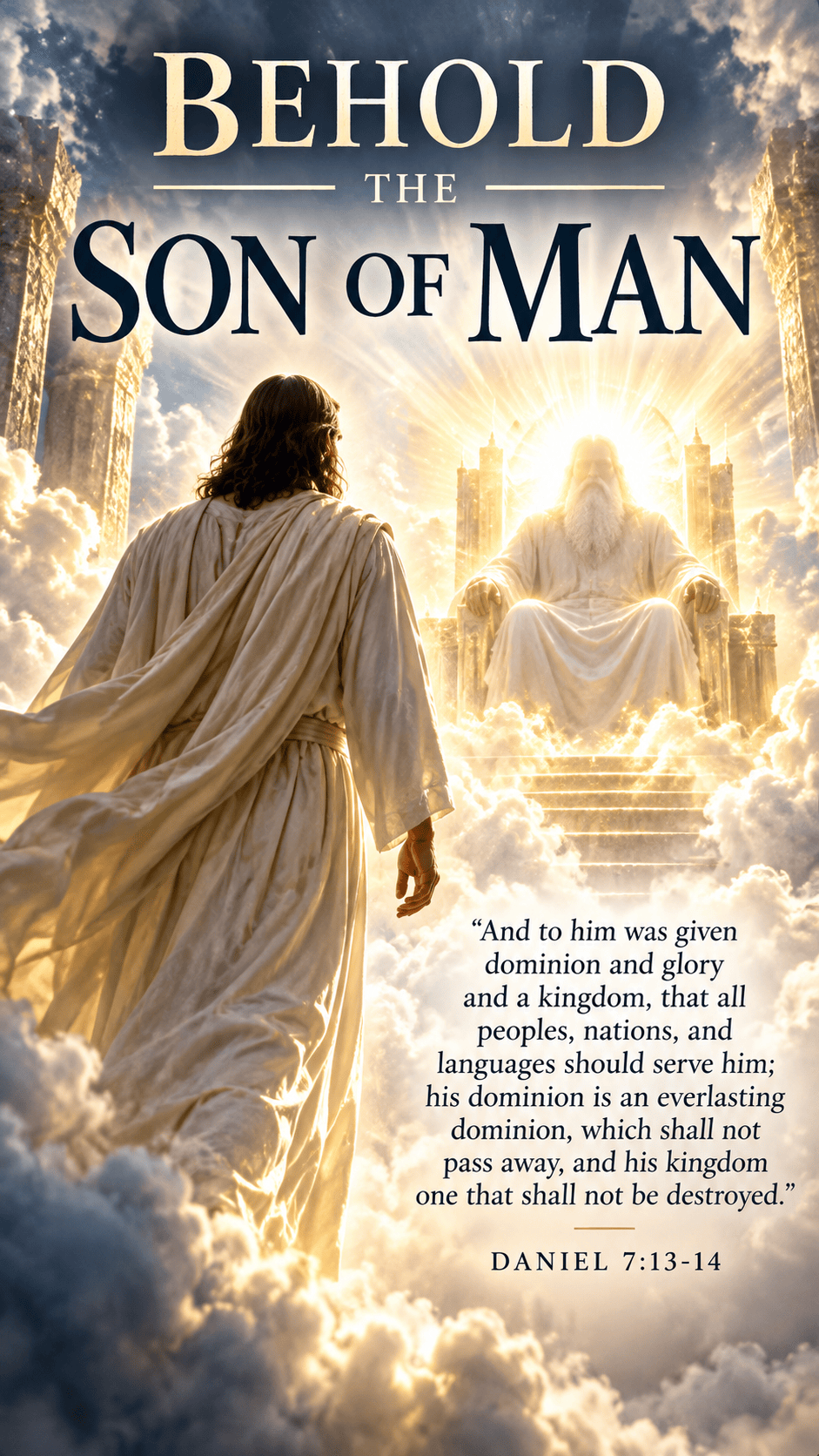
“I saw in the night visions, and behold, with the clouds of heaven there came one like a son of man, and he came to the Ancient of Days and was presented before him. And to him was given dominion and glory and a kingdom, that all peoples, nations, and languages should serve him; his dominion is an everlasting dominion, which shall not pass away, and his kingdom one that shall not be destroyed.” — Daniel 7:13–14 (ESV)
Devotional Thought
I don’t believe we can leave Daniel 7 without spending a little more time considering this remarkable figure Daniel sees entering the throne room of the Ancient of Days. We’ve spent considerable time examining the beasts, the kingdoms they represent, and the judgment that awaits them. But here, in the middle of all these terrifying visions of earthly kingdoms and their eventual destruction, Daniel sees Someone whose kingdom will never end. And we know who He is.
In the previous devotional, we identified the Ancient of Days as God the Father, Yahweh Himself. Now Daniel sees One coming with the clouds of heaven who is described as being “like a son of man.” This is God the Son, Jesus Christ, the promised Messiah. He approaches the Ancient of Days and receives dominion, glory, and an everlasting kingdom. Daniel tells us that all peoples, nations, and languages will serve Him. That description should sound familiar to anyone who has read the book of Revelation.
In Revelation 7:9, John describes another remarkable scene in heaven: “After this I looked, and behold, a great multitude that no one could number, from every nation, from all tribes and peoples and languages, standing before the throne and before the Lamb, clothed in white robes, with palm branches in their hands” (ESV).
Do you see the connection? Daniel sees the Son of Man receiving an everlasting kingdom in which people from every nation and language will serve Him. John sees an innumerable multitude from those very nations and languages standing before the throne and before the Lamb. The Lamb John sees is the same divine Redeemer Daniel sees approaching the Ancient of Days. These visions reveal different aspects of the same glorious reality: Jesus Christ is the eternal King, and His redeemed people will worship Him forever.
But there’s another connection that I find particularly fascinating, and it helps us understand one of the most dramatic moments in the earthly ministry of Jesus. Throughout the Gospels, Jesus repeatedly refers to Himself as the “Son of Man.” We sometimes read that title as though Jesus were simply emphasizing His humanity. And certainly, He was fully human. But His use of that title also points directly back to Daniel 7. Jesus was identifying Himself with the One Daniel saw coming with the clouds of heaven, the One who would receive an everlasting kingdom.
Consider what happened when Jesus stood before the Jewish high priest Caiaphas and the Sanhedrin. In Mark 14:61–63, the high priest asks Jesus, “Are you the Christ, the Son of the Blessed?” Jesus answers, “I am, and you will see the Son of Man seated at the right hand of Power, and coming with the clouds of heaven.” The high priest immediately tears his garments and declares that no further witnesses are necessary. Why such an extreme reaction?
To someone unfamiliar with the Old Testament, Jesus’ answer might seem almost confusing. Caiaphas asks whether He is the Son of God, and Jesus responds by identifying Himself as the Son of Man. Why would that be considered blasphemy? Because Caiaphas understood exactly what Jesus was claiming.
When Jesus answered, “I am,” He was giving an unmistakable affirmative answer to the high priest’s question. Those words also carry a profound resonance with God’s self-revelation in the Old Testament. But Jesus didn’t stop there. He combined the language of Psalm 110, where the Lord’s anointed sits at His right hand, with the vision of Daniel 7, where the Son of Man comes with the clouds of heaven and receives everlasting dominion.
In other words, Jesus was identifying Himself as the divine Messiah, the One who would share in heavenly authority and before whom every earthly ruler would ultimately answer.
Think about the significance of that moment. Jesus stood before the most powerful religious authorities in Jerusalem, bound and accused, facing condemnation and death. Yet He declared that the day would come when they would see Him in the position of ultimate authority. The One standing before their judgment would one day be revealed as the Judge of all the earth. No wonder Caiaphas tore his garments. He understood the claim. What he refused to accept was that the Man standing before him was telling the truth.
But this raises another important question. Why did the eternal Son of God need to become a man at all? The answer takes us to the very heart of the gospel. Humanity’s debt of sin was a debt humanity owed. God’s justice demanded that sin be judged, and no ordinary human being could satisfy that judgment on behalf of others because every one of us stands guilty before God. We needed a Redeemer who could truly represent us, One who could stand in our place, bear our punishment, and fulfill the righteousness we could never achieve.
That Redeemer had to be fully human. He had to share our nature, experience our humanity, and obey the law we had broken. As a man, He could suffer and die in our place. But He also had to be fully God. Only the eternal, sinless Son could offer a sacrifice sufficient to redeem sinners. His deity ensured that He was not merely another fallen descendant of Adam attempting to pay a debt of His own. He was the holy Son of God, without sin, perfectly obedient to the Father, and uniquely qualified to accomplish our salvation.
And that is precisely who Jesus Christ is. He is not half God and half man. He is fully God and fully man, two natures united in one Person. He did not surrender His deity when He became human. He took on humanity while remaining everything He had eternally been as God the Son. In His humanity, He perfectly obeyed the Father, fulfilled the law, and suffered for our sins. In His divine person, His sacrifice possesses the infinite worth necessary to accomplish our redemption. No one else could have done it.
The Son of Man Daniel saw receiving an everlasting kingdom is the same Jesus who was born in Bethlehem, walked the dusty roads of Galilee, stood before Caiaphas, and willingly went to the cross. He is the Lamb who was slain, the Redeemer whose sacrifice was no afterthought but was central to God’s eternal plan of salvation.
And when Jesus cried out from the cross, “It is finished,” He wasn’t announcing defeat. He was declaring that the work the Father had given Him to accomplish had been completed. The debt had been paid. The sacrifice had been offered. Redemption had been secured. Now we await the complete and final manifestation of His everlasting kingdom.
Daniel saw the kingdom promised. John saw the redeemed multitude worshiping before the throne. And we live between Christ’s finished work of redemption and the final fulfillment of all that God has promised. The kingdoms of this world will rise and fall. Rulers will come and go. Nations will struggle for power, and human beings will continue to imagine that they control their own destinies. But none of those things can overturn what God has decreed.
The kingdom given to the Son of Man is everlasting. His dominion will never pass away. His kingdom will never be destroyed. God’s purposes cannot be frustrated. His power cannot be overcome. His promises cannot fail. What He has decreed will certainly come to pass because He is the eternal, omnipotent, unchanging God.
So where else shall we go? That was essentially Peter’s question when others were turning away from Jesus. In John 6:68, Peter answered Him, “Lord, to whom shall we go? You have the words of eternal life.” And he was right. There is no other Redeemer. There is no other Savior. There is no other King whose kingdom will endure forever.
The Son of Man who came to redeem us is the eternal Son of God who reigns over all creation. And He is the only One who can give eternal life to those who believe.
Reflection Questions
- How does understanding the connection between Daniel 7 and Jesus’ testimony before Caiaphas deepen your understanding of who Jesus claimed to be?
- Why is it essential to our salvation that Jesus Christ is both fully God and fully man? What would be lost if either truth were denied?
- Daniel saw the Son of Man receiving an everlasting kingdom. How should the certainty of Christ’s eternal reign affect the way you respond to the uncertainty and instability of the world around you?
- When Peter asked, “Lord, to whom shall we go?” he recognized that eternal life could be found in Christ alone. Are there areas of your life where you are still looking elsewhere for the security, hope, or satisfaction that only Jesus can provide?
Closing Prayer
Heavenly Father, thank You for revealing Your eternal plan of redemption through Your Word. Thank You for sending Your Son, who willingly took on our humanity without surrendering His deity, lived the perfect life we could never live, and paid the debt of sin we could never pay. Lord Jesus, You are the Son of Man, the Lamb who was slain, and the eternal King whose kingdom will never end. Forgive us when we become so distracted by the temporary kingdoms and troubles of this world that we forget who truly reigns. Strengthen our faith in Your finished work, deepen our confidence in Your promises, and help us live each day in joyful submission to Your authority. We have nowhere else to go, Lord, for You alone have the words of eternal life. May our lives bring glory to Your name until the day we stand with that great multitude from every nation and language before Your throne. In the precious name of Jesus Christ, our Savior and King, we pray. Amen.


Leave a Reply