Scripture Focus
“Then the king, when he heard these words, was much distressed and set his mind to deliver Daniel. And he labored till the sun went down to rescue him. Then these men came by agreement to the king and said to the king, ‘Know, O king, that it is a law of the Medes and Persians that no injunction or ordinance that the king establishes can be changed.’ Then the king commanded, and Daniel was brought and cast into the den of lions. The king declared to Daniel, ‘May your God, whom you serve continually, deliver you!’” — Daniel 6:14–16 (ESV)
Devotional Thought
As I’ve continued reading Daniel 6, something has caught my attention that I don’t believe I’ve ever considered quite this way before. We generally focus on Daniel’s courage in continuing to pray despite the king’s decree, or on God’s miraculous deliverance when Daniel was thrown into the lions’ den. But there’s another remarkable aspect of this account that deserves our attention: Daniel’s apparent refusal to defend himself.
Think about everything that happened to Daniel. He was one of the most trusted officials in the kingdom. King Darius was so impressed with Daniel’s integrity and excellence that he intended to place him over the entire kingdom. But Daniel’s fellow officials were jealous. They couldn’t find anything wrong with his conduct, so they devised a scheme to use his faithfulness to God against him.
They persuaded Darius to sign a decree prohibiting anyone from making a petition to any god or man other than the king for thirty days. Anyone who violated the decree would be thrown into the lions’ den. It was a carefully constructed trap, and Daniel was its intended victim.
I wonder whether Daniel knew what these men were planning before the decree was signed. Considering his position in the government, it’s certainly possible. If he did, he could have gone to Darius and warned him. He could have exposed the jealousy and dishonesty of the other officials. He might even have persuaded the king to abandon the proposal before it became law.
But Scripture records no such intervention.
Even after Daniel was caught praying and brought before the king, we find no recorded attempt to defend himself. He doesn’t beg for an exception. He doesn’t accuse the men who conspired against him. He doesn’t point out how foolish the king had been to sign such a decree.
And he certainly would have had plenty to say if he had chosen to say it!
I find myself wondering whether Daniel’s silence reflected, at least in part, his concern for Darius. Daniel had served the king faithfully, and there is every reason to believe he respected him. Perhaps Daniel understood that any attempt to force the king to reverse his decision would only make an already difficult situation worse. We cannot know all that Daniel was thinking, but we do know that his actions demonstrated extraordinary trust in God.
Meanwhile, Darius was desperately trying to find a way to rescue Daniel. Verse 14 tells us that he labored until sundown to deliver him. But the king had allowed himself to be manipulated into signing a law that even he could not overturn. And Daniel went into the lions’ den.
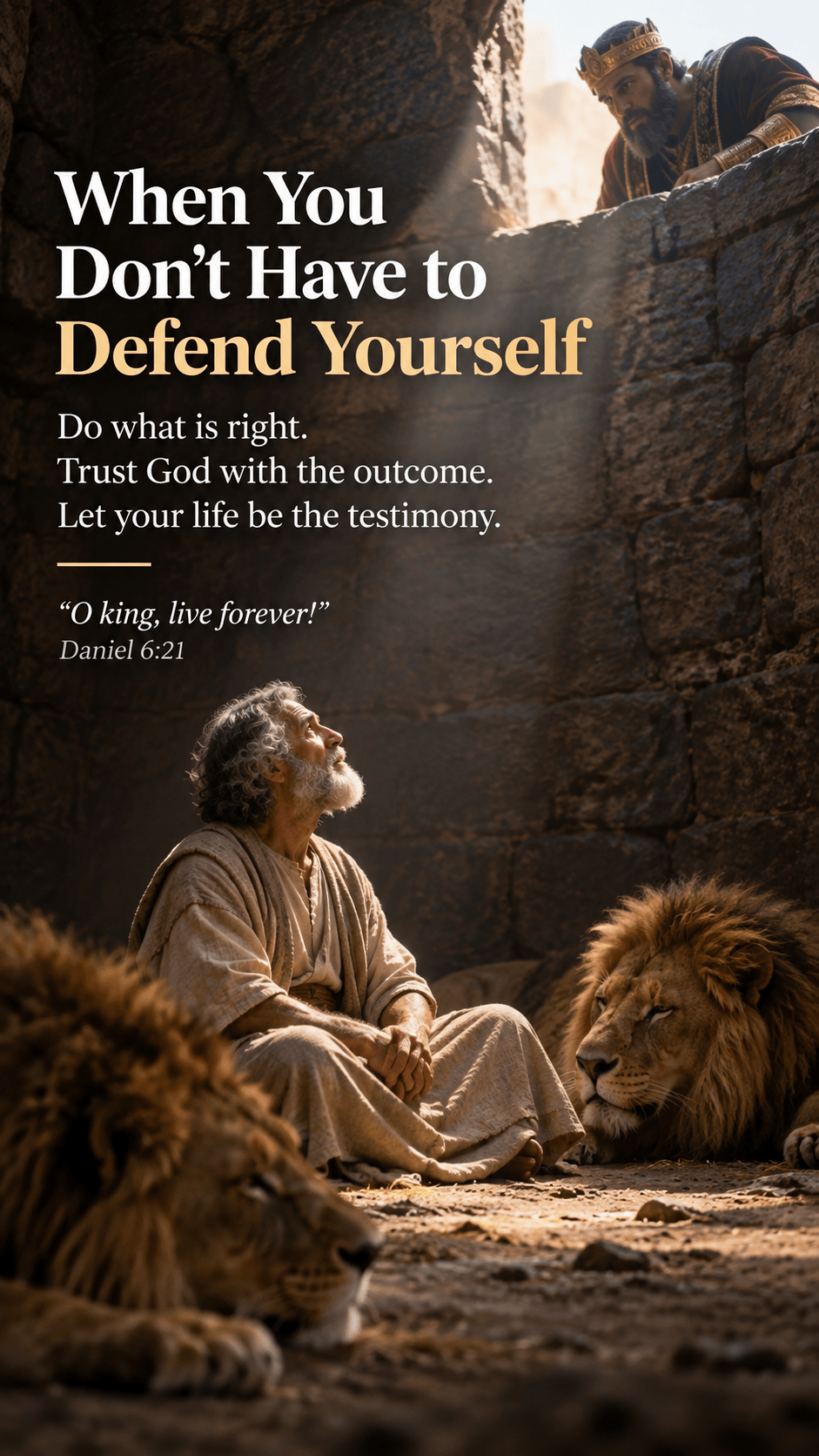
What impresses me even more is what happened the following morning. Darius hurried to the den and cried out in anguish, asking whether Daniel’s God had been able to deliver him. Daniel answered, “O king, live forever!” (Daniel 6:21).
Think about that response! Here was the man whose foolish decision had resulted in Daniel spending the night surrounded by hungry lions. Yet Daniel didn’t greet him with anger or bitterness. He didn’t say, “I hope you’ve learned your lesson!” He didn’t remind Darius that the whole situation could have been avoided if the king had exercised a little wisdom. Instead, he greeted him with respect and goodwill.
Matthew Henry makes a wonderful observation about this passage. He notes that Daniel did not reproach the king for yielding to the malice of his enemies. Rather, his greeting demonstrated that he had forgiven him. Henry also points out that Daniel had left his vindication to God, who had demonstrated his innocence through the miracle of his deliverance.
There’s a lesson here that I believe we desperately need to learn. We don’t always have to defend ourselves. When someone falsely accuses us, misrepresents our motives, or treats us unfairly, our natural instinct is to fight back. We want to explain ourselves. We want everyone to know what really happened. We want to expose the people who have wronged us and make certain they receive the blame they deserve.
And sometimes it is appropriate to speak up, particularly when the truth needs to be established or others need to be protected. But there are also times when our determination to defend ourselves reveals that we’re more concerned about protecting our reputation than trusting God.
I think we sometimes forget just how small our arguments really are in comparison with the wisdom and sovereignty of God. We speak with such confidence about our own knowledge, wisdom, and understanding. We argue over who is right and who is wrong, who deserves the credit, and who deserves the blame. Yet from the perspective of eternity, many of our disputes must look something like children on a playground arguing over whose turn it is to go down the slide.
God sees what we cannot see. He knows what we cannot know. And He doesn’t need our help to establish the truth. That doesn’t mean we shouldn’t speak the truth or stand up for what is right. It means we don’t have to win every argument or answer every accusation. We can faithfully do what God has called us to do and trust Him with the outcome.
I’m reminded of Daniel’s three Hebrew friends, who stood before Nebuchadnezzar and declared that God was able to deliver them from the fiery furnace. But they added those remarkable words: “But if not…” (Daniel 3:18). Their faith wasn’t dependent upon God rescuing them. Neither was Daniel’s. And ultimately, Daniel’s example points us to someone far greater than Daniel.
Peter writes concerning Jesus: “When he was reviled, he did not revile in return; when he suffered, he did not threaten, but continued entrusting himself to him who judges justly.” — 1 Peter 2:23 (ESV) Jesus was falsely accused, mocked, beaten, and condemned. He could have defended Himself against every accusation. He could have exposed the hypocrisy of His accusers and the cowardice of those who condemned Him. He could have called upon the armies of heaven to deliver Him.
But He didn’t. Instead, He entrusted Himself to the Father and willingly went to the cross, where He bore our sins so that we might be forgiven and reconciled to God. And remember this: Jesus’ decisive public vindication came after His death, through His resurrection. The One whom men rejected and condemned was raised from the dead, demonstrating that He truly is the Son of God. His enemies had rendered their verdict, but God had the final word.
Daniel was delivered from the lions’ den. Jesus passed through death and emerged victorious over it. And because of His victory, those who belong to Him can trust that even death itself will not have the final word.
So what should we do when we’re falsely accused, misunderstood, or mistreated? We should tell the truth when it is necessary. We should stand faithfully for what is right. But we should also resist the temptation to retaliate, to tear others down, or to believe that our future depends upon winning every argument.
Sometimes the greatest testimony we can give isn’t found in what we say to defend ourselves, but in what we refuse to say about those who have wronged us. Daniel didn’t need to emerge from the lions’ den with an argument. He emerged with a testimony.
Reflection Questions
- When someone falsely accuses me or misunderstands my motives, is my first response to defend myself, retaliate, or entrust the situation to God?
- Have I ever allowed my desire to prove that I was right to become more important than demonstrating the character of Christ?
- How does Jesus’ example of entrusting Himself to the Father challenge the way I respond to unfair treatment?
- Is there a situation in my life right now where I need to stop trying to win the argument and trust God with the outcome?
Closing Prayer
Heavenly Father, thank You for the example of Daniel, who remained faithful to You even when he was falsely accused and condemned. Forgive me for the times when I’ve been more concerned about defending my reputation than demonstrating Your character. Help me to know when I should speak and when I should remain silent. Give me the grace to respond to those who wrong me with patience, humility, and forgiveness rather than anger and bitterness. Above all, thank You for Jesus, who endured false accusations and suffering without retaliation, and who willingly gave His life for my salvation. Teach me to entrust myself to You, knowing that You see every injustice, know every heart, and will ultimately make all things right. In Jesus’ name, Amen.


Leave a Reply