Scripture Focus
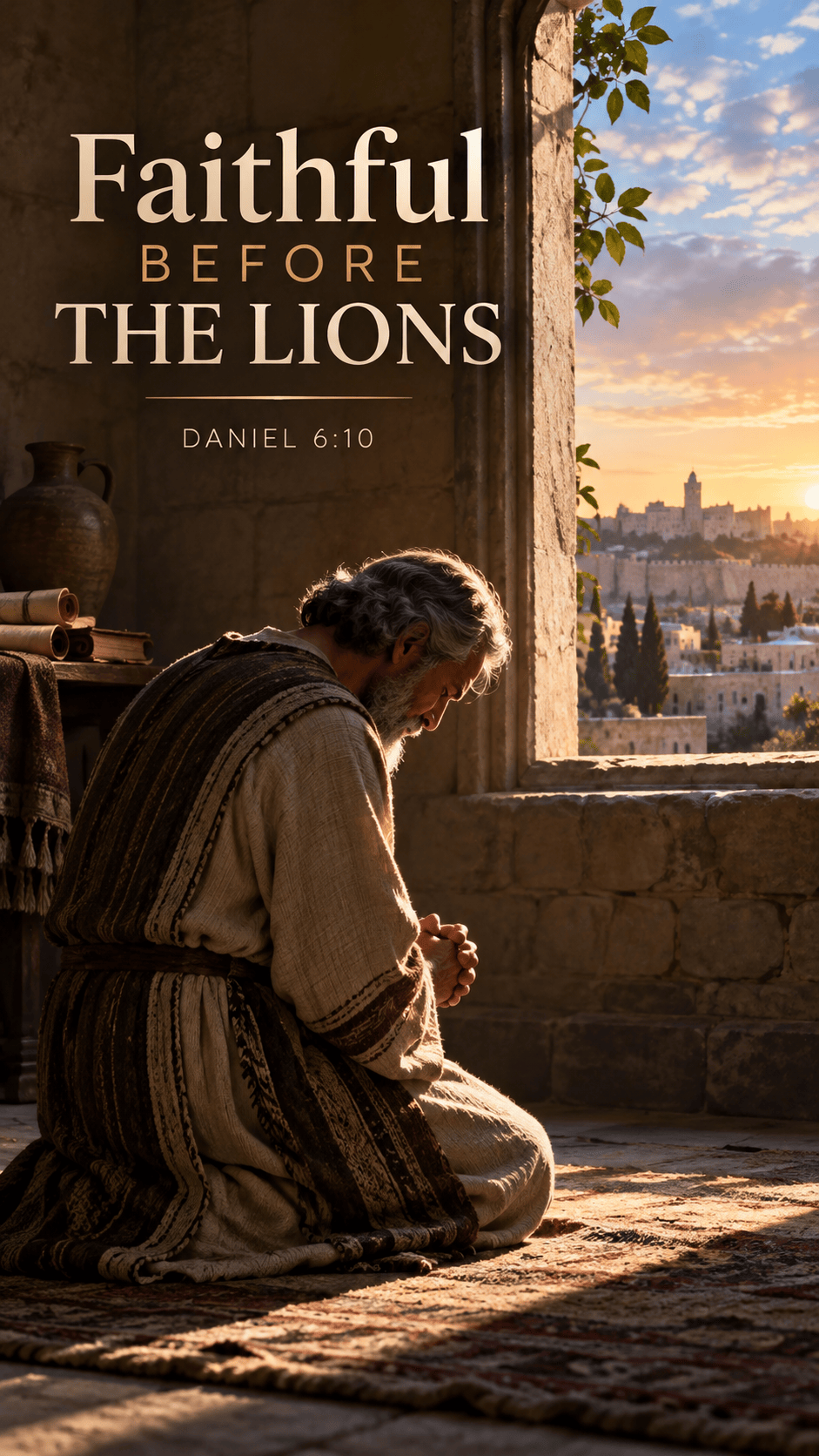
“When Daniel knew that the document had been signed, he went to his house where he had windows in his upper chamber open toward Jerusalem. He got down on his knees three times a day and prayed and gave thanks before his God, as he had done previously.” — Daniel 6:10 (ESV)
Devotional Thought
In our last devotional, we met King Darius and learned about his tremendous confidence in Daniel. Daniel had distinguished himself above the other officials because of his excellent spirit, his integrity, and his faithfulness. In fact, Darius was planning to place Daniel over the entire kingdom. The king recognized something in Daniel that made him different from the other officials. He was a man who could be trusted.
Unfortunately, not everyone was pleased with the king’s decision. The other officials were jealous of Daniel’s position and apparently had no intention of allowing him to enjoy the king’s favor without a fight. Daniel 6:2 tells us that Darius had appointed three high officials, including Daniel, to oversee the kingdom’s satraps so that the king would suffer no loss. That last phrase is interesting. Darius wanted trustworthy men managing the affairs of his kingdom, and Daniel was exactly the kind of man he needed. Perhaps the other officials resented Daniel because his integrity would prevent them from taking advantage of their positions. Whatever their motives, they wanted Daniel out of the way.
So they began looking for something they could use against him. They examined his work, searching for corruption, dishonesty, or some failure in his responsibilities. But they couldn’t find anything. Daniel was faithful in his duties, and there was no negligence or wrongdoing they could use to accuse him before the king. Since they couldn’t find fault with Daniel’s character, they decided to attack his devotion to God instead. They knew Daniel prayed regularly. They knew his commitment to God was not something he would abandon simply because it became inconvenient. And they decided to use that faithfulness against him.
Their plan was remarkably clever and terribly wicked. They approached Darius and appealed to something that nearly every one of us struggles with from time to time: pride. They proposed a law declaring that for thirty days no one could make a petition to any god or man except the king. Anyone who violated the decree would be thrown into a den of lions. Imagine the appeal to Darius’s ego! For thirty days, the entire kingdom would be required to direct its petitions to him alone. And the officials reminded him that once he signed the decree, it would be established according to the law of the Medes and Persians, which could not be revoked.
The trap was set, and what strikes me about this account is the contrast between the men who devised the scheme and the man they were trying to destroy. They were willing to manipulate the king, abuse the law, and endanger an innocent man’s life to advance their own interests. Daniel, on the other hand, was unwilling to compromise his devotion to God even to preserve his own life. But I want us to pay particular attention to what Daniel did when he learned that the decree had been signed. He didn’t panic. He didn’t organize a protest. He didn’t try to negotiate an exception for himself. He simply went home, entered his upper chamber, knelt before God, and prayed. And notice something else: He gave thanks! Daniel knew that continuing to pray could cost him his life. He knew his enemies were watching for an opportunity to accuse him. Yet he still knelt before God and gave thanks.
Now, when we first read that Daniel prayed in an upper chamber with windows open toward Jerusalem, we might wonder whether he was deliberately making a spectacle of himself. Was he opening those windows so everyone could see him? Was he trying to provoke the officials into arresting him? I don’t believe that’s what was happening at all. The final words of verse 10 tell us why: “as he had done previously.” Daniel wasn’t putting on a performance. He wasn’t suddenly becoming more religious because someone had challenged his faith. He wasn’t trying to draw attention to himself. He was simply doing what he had always done.
Those five words may be the most important words in this entire account. Daniel’s faithfulness in this crisis didn’t begin when the king signed the decree. It had been cultivated through years of walking with God. Prayer wasn’t something Daniel turned to only when he found himself in trouble. It was already part of the regular rhythm of his life. Most of us will never face a law threatening to throw us into a den of lions for praying. But we regularly encounter situations in which remaining faithful to God may cost us something. Perhaps it’s an opportunity for advancement that requires us to compromise our integrity. Perhaps it’s the desire to be accepted by people who don’t share our convictions. Perhaps it’s the temptation to remain silent about our faith because speaking openly might make someone uncomfortable. Sometimes the people who oppose us may even seem like angry lions themselves!
But here’s the question: Are we developing the kind of relationship with God today that will sustain us when those difficult moments arrive? If Daniel had waited until the decree was signed to begin developing a habit of prayer, I wonder how differently he might have responded. But he didn’t have to decide whether prayer was worth the risk. He had already established that God was worthy of his devotion.
There’s another lesson here that I don’t want us to overlook. Daniel didn’t hide his faith, but neither did he use it as a means of drawing attention to himself or condemning others. His prayer life wasn’t a public performance designed to demonstrate how righteous he was. Yet he also wasn’t ashamed of his relationship with God. That’s a balance we need to maintain as believers today. Jesus warned against those who pray publicly simply to be seen and admired by others (Matthew 6:5). But He also told His followers to let their light shine before others so that people might see their good works and give glory to their Father in heaven (Matthew 5:16). Those teachings aren’t contradictory. The difference is our motivation. We don’t need to make a spectacle of our faith to prove how spiritual we are. We shouldn’t use our convictions as weapons to belittle people who disagree with us. But neither should we conceal our devotion to Christ simply because someone might object. We don’t have to make a show of our faith, but we should never be ashamed of it.
Daniel had served under different kings and witnessed the rise and fall of powerful kingdoms. Political leaders changed. Governments changed. Laws changed. But Daniel continued to seek the Lord. And when a new law threatened his life, he didn’t have to invent a new response. He simply went home and prayed, as he had done previously.
I wonder what our response would be if following Christ suddenly became more costly than it is today. Would we continue walking faithfully with Him, or would we find ourselves struggling to establish convictions and habits that we had neglected when life was easier? The time to develop a faithful prayer life isn’t when the lions are already waiting. It’s today. Because when the difficult days come, I want to be able to do what Daniel did. I want to keep walking with God, as I had done previously.
Reflection Questions
- What habits of prayer, Bible study, and fellowship with God am I developing today that will help sustain my faith when difficult circumstances arise?
- Have I ever been tempted to compromise my faith or integrity because I was afraid of losing an opportunity, someone’s approval, or some other benefit?
- Am I willing to live openly as a follower of Christ without making a spectacle of my faith or using it to condemn others?
Closing Prayer
Heavenly Father, thank You for the example of Daniel and his unwavering faithfulness to You. Forgive me for the times I have allowed the pressures of life, the opinions of others, or my own desire for comfort to interfere with my relationship with You. Help me develop a consistent habit of seeking Your face through prayer and the study of Your Word. Teach me to walk faithfully with You in the ordinary moments of life so that I will be prepared when difficult days come. Give me the courage to live openly for Christ without pride or self-righteousness, and help me never to be ashamed of belonging to You. May my faithfulness today prepare me to stand firm tomorrow, whatever circumstances I may face. In Jesus’ name, Amen.


Leave a comment