Scripture Focus
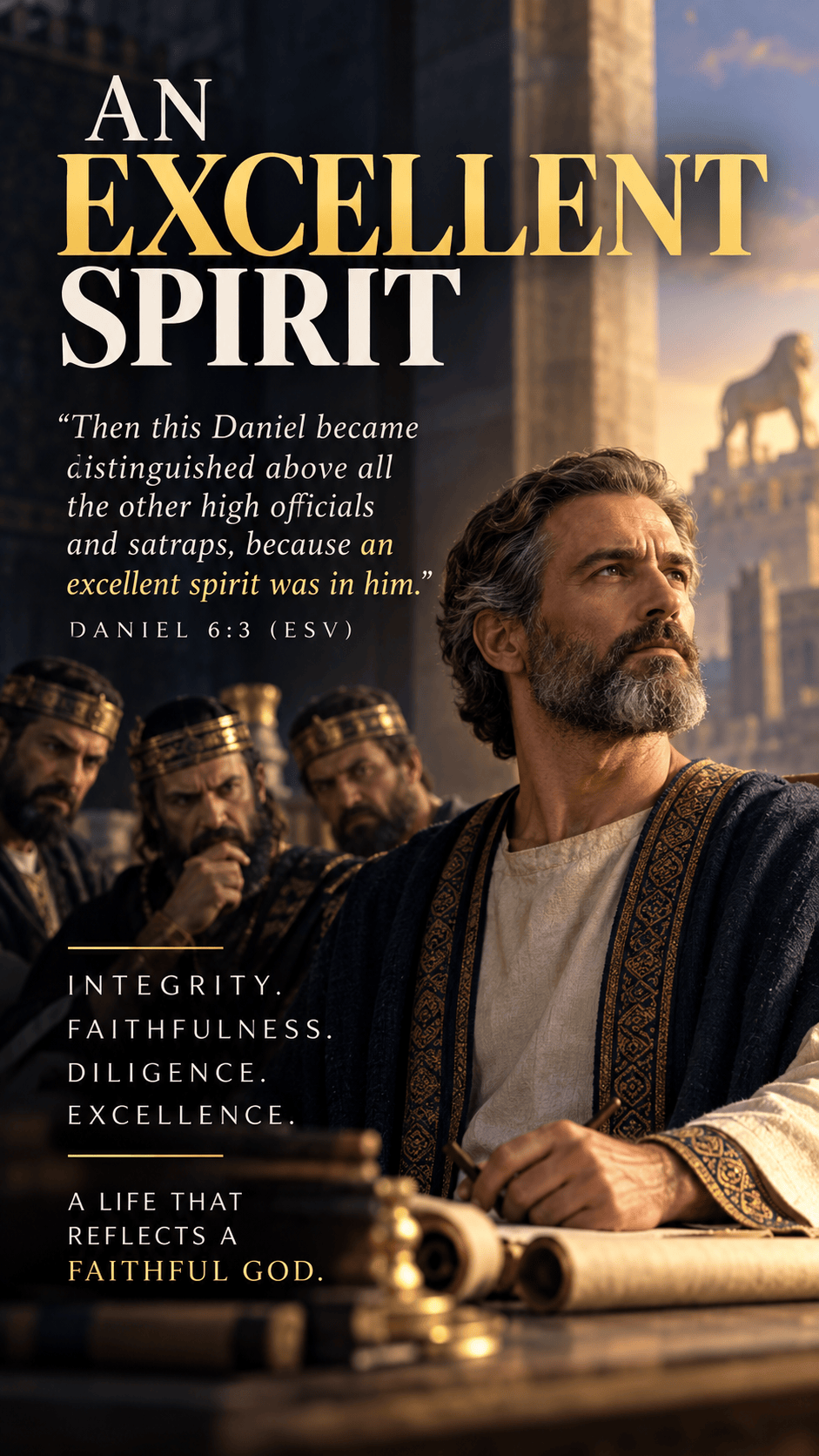
“Then this Daniel became distinguished above all the other high officials and satraps, because an excellent spirit was in him. And the king planned to set him over the whole kingdom. Then the high officials and the satraps sought to find a ground for complaint against Daniel with regard to the kingdom, but they could find no ground for complaint or any fault, because he was faithful, and no error or fault was found in him. Then these men said, ‘We shall not find any ground for complaint against this Daniel unless we find it in connection with the law of his God.’” — Daniel 6:3–5 (ESV)
Devotional Thought
One phrase especially caught my attention as I read Daniel 6: “an excellent spirit was in him.”
We have already learned a great deal about Daniel. He was wise. He was faithful. He refused to compromise his convictions. He had served under kings and survived the rise and fall of empires. But this description seems particularly significant. There was something about Daniel himself—his character, his disposition, the way he approached his responsibilities—that distinguished him from the people around him.
The phrase reminded me of David’s prayer after his sin with Bathsheba: “Create in me a clean heart, O God, and renew a right spirit within me” (Psalm 51:10). I don’t believe either passage is using the word spirit as a direct reference to the Holy Spirit. Daniel had an “excellent spirit,” and David prayed for a “right spirit.” They were talking about something within themselves—the disposition of the heart and the kind of person they were becoming.
But that certainly does not mean God had nothing to do with it. A right spirit and an excellent spirit grow out of a right relationship with God. Daniel’s relationship with God had shaped his character so thoroughly that it showed up in the way he did his job.
John Gill describes Daniel as exact, diligent, laborious, faithful, conscientious, prudent, and honest. Matthew Henry points out that Daniel “dealt fairly between the sovereign and the subject.” Daniel wasn’t simply loyal to the king when loyalty benefited him. He was committed to doing what was right. That distinction matters.
The king had placed Daniel and two other officials over the satraps so that “the king might suffer no loss” (Daniel 6:2). Apparently, Darius had reason to be concerned about corruption, dishonesty, or people using government positions for their own benefit. Daniel was exactly the kind of man you would want watching the books. He wouldn’t cheat the satraps for the king. And he wouldn’t allow the satraps to cheat the king. That probably explains at least some of their hostility toward him.
If these men had been honest themselves, Daniel’s integrity wouldn’t have threatened them. They would have appreciated having an honest man overseeing the affairs of the kingdom. But if they intended to use their positions for personal advantage, Daniel presented a serious problem. He wasn’t going to look the other way. His “excellent spirit” meant that he could be trusted even when doing the right thing made him unpopular.
So they started looking for something they could use against him. Imagine having your enemies investigate your life with the specific purpose of destroying you. They examined Daniel’s work. They looked for dishonesty. They looked for negligence. They looked for mistakes. They looked for some occasion when Daniel had abused his authority or used his position for personal gain. They found nothing.
Scripture says, “he was faithful, and no error or fault was found in him.” Matthew Henry sees Daniel as an example for anyone entrusted with responsibility. We should seek to be both careful and conscientious—not merely avoiding deliberate wrongdoing, but doing our work with such diligence that others can depend upon us.
Daniel’s excellence wasn’t perfection. He was still a human being. But there was a consistency between the God he worshiped and the life he lived. And finally his enemies came to an extraordinary conclusion: If we’re going to find something against Daniel, it will have to involve his God. What a testimony!
They couldn’t accuse him of stealing. They couldn’t accuse him of lying. They couldn’t accuse him of laziness. They couldn’t accuse him of corruption. They couldn’t accuse him of abusing his authority. But they knew one thing about Daniel that they could count on: He would obey his God.
They knew Daniel’s faith wasn’t something he turned on and off depending upon circumstances. If they could create a conflict between obedience to the king and obedience to God, they already knew which one Daniel would choose. That’s what an excellent spirit looks like.
It isn’t simply being talented or successful. It isn’t climbing higher than everyone around us. Daniel’s excellence certainly brought recognition—Darius planned to place him over the entire kingdom—but Daniel’s character wasn’t produced by ambition. His promotion was the result of a life that could be trusted.
John Calvin points out that Daniel’s wisdom and abilities were ultimately gifts from God. Daniel had been given extraordinary ability, but he faithfully used what God had given him. God shaped the man, and Daniel faithfully lived as that man wherever God placed him.
Most of us will never administer an empire. But we all have places where our character becomes visible—in our homes, churches, workplaces, schools, finances, conversations, and relationships. The question isn’t whether someone could find evidence that we’re imperfect. They certainly could. The better question is this: What would someone discover if they seriously examined the way we live?
Would they find that we are dependable when nobody is watching? Would they discover that we refuse to benefit from dishonesty? Would they see people who work diligently instead of doing just enough to get by? Would they find that we treat people fairly even when we have the power to do otherwise? And if someone wanted to use our faith against us, would there be enough evidence to work with?
Daniel’s enemies knew exactly where he would be. They knew exactly what he would do. They knew exactly whom he would obey. An excellent spirit was in him. May the same kind of thing be said about us—not because we are naturally exceptional, but because walking faithfully with an excellent God has shaped the kind of people we have become.
Reflection Questions
- If someone carefully examined the way you handle your responsibilities, what would your work reveal about your character?
- Are there areas where you are tempted to “look the other way” because doing what is right might create conflict or make you unpopular?
- Has your relationship with God shaped you into someone others can trust to be honest, diligent, fair, and faithful?
- If someone wanted to use your commitment to God against you, would your life provide enough evidence for them to do it?
Closing Prayer Father, create in me a heart that seeks You and a spirit that reflects the work You are doing in my life. Make me faithful in the responsibilities You have given me. Help me to be honest when dishonesty would benefit me, diligent when no one is watching, fair when I have the advantage, and courageous when doing what is right makes me unpopular. May my relationship with You shape every part of who I am, so that others can see integrity, faithfulness, and excellence in the way I live. And if my faith is ever tested, may there be no question about whom I will obey. In Jesus’ name, amen.


Leave a comment