Scripture Focus
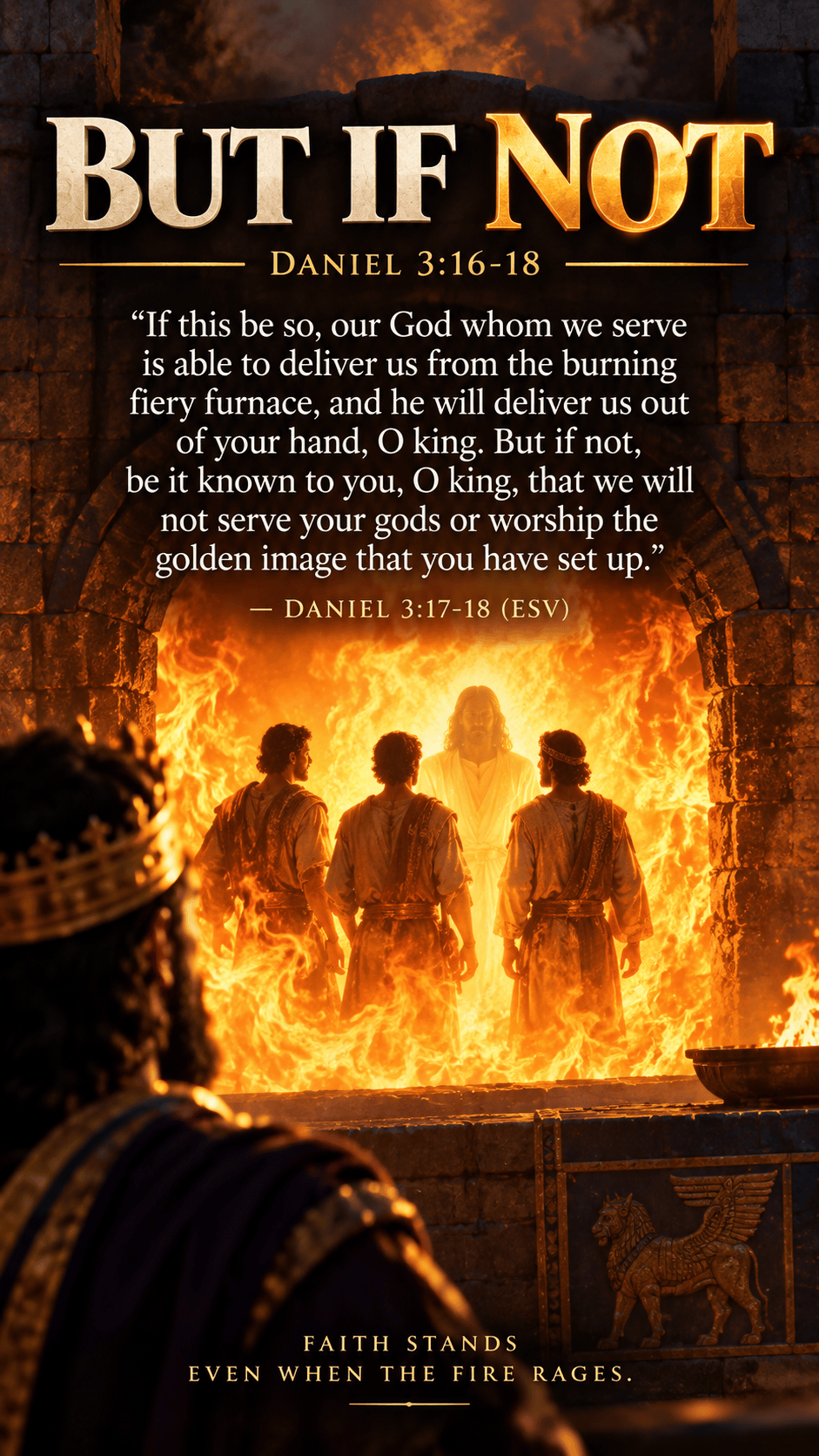
“Shadrach, Meshach, and Abednego answered and said to the king, ‘O Nebuchadnezzar, we have no need to answer you in this matter. If this be so, our God whom we serve is able to deliver us from the burning fiery furnace, and he will deliver us out of your hand, O king. But if not, be it known to you, O king, that we will not serve your gods or worship the golden image that you have set up.’” — Daniel 3:16–18 (ESV)
Devotional Thought
This may be one of the most sincere displays of faith in all the Old Testament. Think about the man Shadrach, Meshach, and Abednego are standing before. Nebuchadnezzar is enormously powerful, incredibly proud, and now absolutely furious. He has already been confronted with the truth about God. He has witnessed Daniel reveal and interpret a dream that no human wisdom could uncover. He has even confessed, “Truly, your God is God of gods and Lord of kings” (Daniel 2:47). Yet here he is in chapter three, demanding worship for the golden image he has erected and threatening anyone who refuses with death.
And three young Hebrew men refuse to bow. Their response is remarkable: “We have no need to answer you in this matter.” In other words, O King, there really isn’t anything to discuss. They aren’t negotiating. They aren’t asking for additional time. They aren’t searching for a compromise that will allow them to bow outwardly while remaining faithful inwardly. Their minds are already made up.
Then comes their declaration: “Our God whom we serve is able to deliver us.” Notice carefully what they believe. They don’t merely believe that God exists. They believe that God is able. Nebuchadnezzar may have the furnace. He may have the soldiers. He may have the authority of Babylon behind him. But he does not have ultimate authority over these three men. God does.
Then come three of the most powerful words in the chapter: “But if not…” That’s faith. Their crisis of belief wasn’t whether God could deliver them from the fire. It was whether He would still be worthy of their trust if He didn’t. God can rescue us. We believe He can deliver us from your hand. But our obedience is not dependent upon His doing so. If God rescues us, we will worship Him. If God allows us to die in this furnace, we will worship Him. Either way, O King, we will not bow.
There is an interesting detail here that is easy to overlook. We know these three men almost exclusively by their Babylonian names: Shadrach, Meshach, and Abednego. But those aren’t the names they were given at birth. They were Hananiah, Mishael, and Azariah. Their Hebrew names pointed toward the God of Israel. Hananiah means something like “Yahweh has been gracious.” Mishael asks, “Who is what God is?” and Azariah means “Yahweh has helped.” Babylon replaced those names with names associated with its own culture and religion; Abednego, for example, appears to mean “servant of Nego/Nebo.”
There is some irony here. Babylon could change their names. Babylon could change their address. Babylon could change their education. Babylon could even tell everyone else what to call them. But Babylon could not change their God.
Nebuchadnezzar becomes so furious at their refusal that he orders the furnace heated seven times hotter than usual. The furnace becomes so intense that the soldiers who throw the three men into it are killed by the flames. From a human perspective, the story should end there. But then Nebuchadnezzar stands up in astonishment. “Did we not cast three men bound into the fire?” His counselors confirm that they did. Nebuchadnezzar responds, “But I see four men unbound, walking in the midst of the fire, and they are not hurt.” Then he says that the appearance of the fourth is “like a son of the gods” (Daniel 3:25).
Christians throughout history have understandably wondered whether this mysterious fourth figure was an appearance of the pre-incarnate Christ. Others understand him as an angel sent by God; indeed, Nebuchadnezzar himself later says that God “sent his angel” (Daniel 3:28). The text doesn’t explicitly identify the fourth man beyond that. But we don’t have to settle that question to understand the point: they were not alone in the fire.
God could have kept them from ever entering the furnace, but He didn’t. Instead, God demonstrated His power by meeting them there and bringing them through it. When Nebuchadnezzar calls them out, something remarkable has happened. The ropes that bound them are gone, but the men themselves are unharmed. Their clothes aren’t burned. Their hair isn’t singed. They don’t even smell like smoke. The king had tried to destroy them with the fire, but God used the fire only to burn away what bound them.
And perhaps that’s where this story comes closest to home. There will be moments when we know that God is able, but we don’t know what God will do. God is able to heal. God is able to provide. God is able to restore the relationship. God is able to open the door. God is able to change the circumstances. God is able to deliver us from the fire. But genuine faith cannot ultimately rest upon God giving us the outcome we desire.
Sometimes faith says, “My God is able.” But there are other moments when faith must add three more words: “But if not…” But if He doesn’t heal, if the door doesn’t open, if the circumstances don’t change, if following Him costs me something I desperately wanted to keep—I will still trust Him. That kind of faith doesn’t come merely from human courage or determination. It is produced by God in the hearts of people who have learned that God Himself is worth trusting, regardless of the outcome.
Hananiah, Mishael, and Azariah didn’t know when they spoke those words that there would be a fourth man waiting for them in the furnace. They simply knew the God to whom they belonged.
And that was enough.
Reflection Questions
- What is the difference between believing God can deliver us and demanding that He must?
- Is there something in your life right now about which you are praying, “God, I know You are able”?
- Could you sincerely add, “But if not, I will still trust You”?
- What did Babylon manage to change about these three men, and what could it never change?
- How does God’s presence with them in the furnace change the way you think about difficult circumstances?
Closing Prayer Father, I know that You are able. There is no circumstance beyond Your power and no furnace too hot for Your presence. But give me a faith that trusts You even when You do not answer the way I hope. Teach me to say, “But if not, I will still follow You.” When You choose not to keep me from the fire, remind me that You have not abandoned me in it. Give me the faith to stand when others bow and to trust You with whatever comes next. In Jesus’ name, Amen.


Leave a comment