Scripture Focus
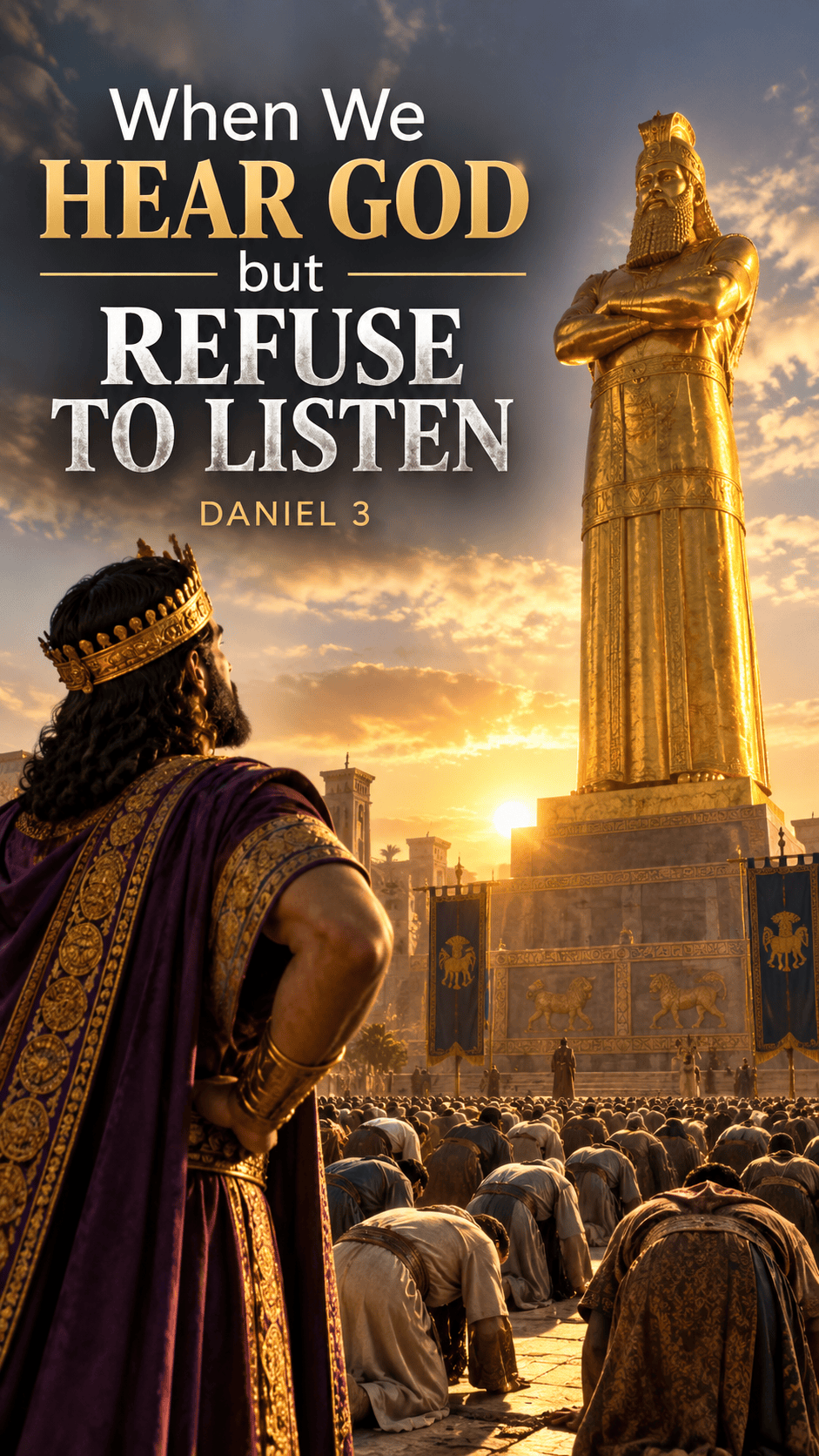
“King Nebuchadnezzar made an image of gold, whose height was sixty cubits and its breadth six cubits. He set it up on the plain of Dura, in the province of Babylon.” — Daniel 3:1 (ESV)
“And the herald proclaimed aloud, ‘You are commanded, O peoples, nations, and languages, that when you hear the sound of the horn, pipe, lyre, trigon, harp, bagpipe, and every kind of music, you are to fall down and worship the golden image that King Nebuchadnezzar has set up.’” — Daniel 3:4–5 (ESV)
Devotional Thought
As Daniel chapter two ends, it seems Nebuchadnezzar has had quite an epiphany.
Daniel has revealed both the king’s dream and its interpretation—something none of Babylon’s supposedly wise men could do. And Daniel has been careful to give all the glory to God. He tells Nebuchadnezzar plainly, “There is a God in heaven who reveals mysteries” (Daniel 2:28).
Nebuchadnezzar seems convinced. By the end of the chapter, he declares, “Truly, your God is God of gods and Lord of kings” (Daniel 2:47). That sounds like a man who has learned something. Then chapter three begins. “King Nebuchadnezzar made an image of gold.”
”Does that remind you of anything? The dream God had just given Nebuchadnezzar involved an enormous image. Its head was made of gold, and Daniel specifically told him, “You are the head of gold” (Daniel 2:38). But the rest of the statue represented kingdoms that would come after him. Eventually the entire image—from its feet all the way to its golden head—would be shattered by a stone “cut out by no human hand.”
God’s message was unmistakable: Nebuchadnezzar might be powerful, but his kingdom would not last forever. God’s kingdom would.
And now, almost immediately afterward, Nebuchadnezzar builds an enormous image of his own.Not merely a head of gold. An image of gold. It almost seems as though Nebuchadnezzar is answering God’s revelation with one of his own. God showed him an image declaring that earthly kingdoms rise and fall. Nebuchadnezzar erected an image demanding that the peoples, nations, and languages bow before it.
Perhaps we cannot know exactly what was going through Nebuchadnezzar’s mind when he built the image. But the contrast between these two chapters is difficult to miss.
God gave Nebuchadnezzar an image in chapter two. Nebuchadnezzar built his own image in chapter three. And that raises an uncomfortable question. Did Nebuchadnezzar actually learn anything?
He had heard the truth. He had seen evidence of God’s power. He had even said the right things about God. But acknowledging truth for a moment is not the same thing as submitting our lives to it.
And Nebuchadnezzar isn’t the only person capable of doing that. We can sit in church and hear God’s Word preached. We can read Scripture in the morning. We can recognize that something God says is true. We may even say “Amen” to it.
Then we can walk away and build our own statue. God says, “Forgive,” but we hold onto bitterness. God says, “Trust Me,” but we insist upon controlling everything ourselves. God says, “Seek first the kingdom of God,” but we build our lives around possessions, success, comfort, or recognition.
God says that this world and its kingdoms are temporary, yet we can spend our lives building things as though they will last forever. Nebuchadnezzar’s problem wasn’t that God hadn’t spoken clearly. His problem was that after hearing what God said, he still wanted to build something else.
Perhaps one of the most dangerous forms of foolishness is not ignorance of God’s Word. It is hearing God’s Word, acknowledging that it is true, and then living as though God never spoke.
Nebuchadnezzar’s golden image would not change what God had revealed in chapter two. And neither will ours.
God’s truth does not change simply because we would prefer to build something different.
Reflection Questions
1. What had God already revealed to Nebuchadnezzar about the future of his kingdom?
2. What is the difference between acknowledging that God is right and actually submitting to what He has said?
3. Is there an area of your life where you know what Scripture says but are still resisting it?
4. What “images” are we tempted to build—success, possessions, reputation, control, comfort—that compete with our submission to God?
5. What would obedience to something God has already shown you look like today?
Closing Prayer
Father, thank You for speaking truth to us through Your Word. Forgive me for the times when I have heard what You said, agreed with it, and then continued living according to my own desires. Show me where I am building my own images instead of submitting to You. Give me humility not merely to hear Your Word, but to obey it. Help me remember that the things I build will pass away, but Your kingdom will stand forever. In Jesus’ name, Amen.


Leave a comment