Scripture Focus
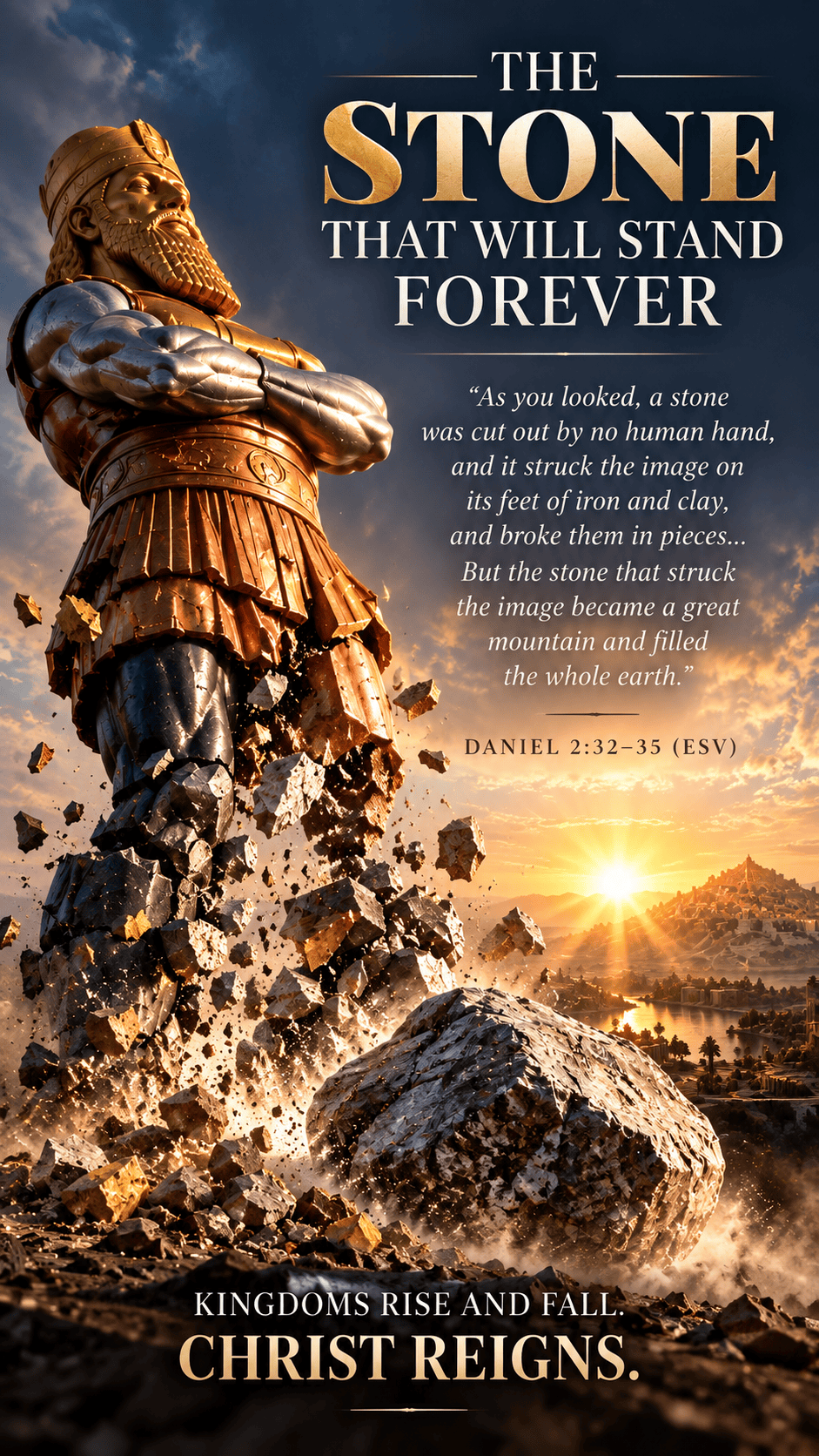
“The head of this image was of fine gold, its chest and arms of silver, its middle and thighs of bronze, its legs of iron, its feet partly of iron and partly of clay. As you looked, a stone was cut out by no human hand, and it struck the image on its feet of iron and clay, and broke them in pieces. Then the iron, the clay, the bronze, the silver, and the gold, all together were broken in pieces, and became like the chaff of the summer threshing floors; and the wind carried them away, so that not a trace of them could be found. But the stone that struck the image became a great mountain and filled the whole earth.” — Daniel 2:32–35 (ESV)
Devotional Thought
As we look further into Daniel 2, we finally hear Daniel’s description and interpretation of King Nebuchadnezzar’s dream. And as Daniel explains what the king had seen, perhaps we begin to understand why Nebuchadnezzar was so troubled by it. He may have suspected that the dream wasn’t entirely good news for him—and it wasn’t.
Daniel tells the king that God was revealing what would take place in the future, particularly concerning kingdoms that would rise and fall. The head of gold represented Nebuchadnezzar and Babylon.
We should remember just how impressive that golden head must have seemed at the time. Babylon was one of the most powerful kingdoms in the world, and Nebuchadnezzar was one of its most powerful rulers. He had conquered nations almost at will. When Babylon came marching, nations trembled. Nebuchadnezzar had plenty of earthly reasons to feel strong, secure, and perhaps even invincible.
But God’s message through the dream was simple: No earthly kingdom is permanent.
What strikes me about the dream is the contrast between the enormous statue and the stone. The statue is impressive—a head of gold, chest and arms of silver, middle and thighs of bronze, legs of iron, and feet of iron and clay. By comparison, the least impressive thing in the dream seems to be a stone.
But then the stone moves.
Daniel says that this stone was “cut out by no human hand.” It struck the image, shattered it, and reduced all that gold, silver, bronze, iron, and clay to something like chaff blowing away in the wind. In the end, not a trace of that magnificent statue remained.
But the stone remained.
In fact, the stone became a great mountain and filled the whole earth.
Daniel later explains that the kingdoms represented in the dream will eventually pass away, but “the God of heaven will set up a kingdom that shall never be destroyed” (Daniel 2:44).
In other words: Nebuchadnezzar, you are not permanent. Babylon is not permanent. No earthly kingdom ruled by human beings is permanent. There is only one Kingdom that will stand forever—the Kingdom of God.
And that stone imagery should sound familiar to us as Christians.
Psalm 118:22 says, “The stone that the builders rejected has become the cornerstone.” Jesus applies that passage to Himself in Matthew 21, and then adds these striking words: “And the one who falls on this stone will be broken to pieces; and when it falls on anyone, it will crush him” (Matthew 21:44).
Centuries after Nebuchadnezzar, Rome looked invincible. Caesar looked powerful. Pilate had authority. The religious leaders who opposed Jesus appeared to have power of their own. And Jesus? He was rejected, beaten, crucified, and placed in a borrowed tomb.
For a moment, the kingdoms of this world appeared to have won. But they hadn’t.
The Stone still stands.
That is something worth remembering when we look at our own world. Nations can appear permanent. Leaders can appear untouchable. Governments, institutions, movements, and cultures can become so powerful that we begin to imagine that things will always be the way they are now.
Nebuchadnezzar probably thought so too.
But only a couple of chapters later, this seemingly invincible king would be brought extraordinarily low, insane and eating grass like a cow. I doubt he saw that coming. And eventually Nebuchadnezzar died. Babylon fell. Other kingdoms arose and eventually fell as well. That is the nature of earthly kingdoms.
And really, it is the nature of our earthly lives. The things that seem enormous to us right now will not always be here. Our accomplishments, possessions, positions, troubles, and even our earthly lives are temporary.
So Daniel 2 calls us to live with an eternal perspective. Don’t build your hope around what looks powerful today. Don’t give your life to things that will eventually be carried away like chaff in the wind.
Build your life on the Stone.
Live for Christ. Live for His Kingdom. Walk humbly. Love others. Hold loosely to the temporary things of this world, and hold tightly to the One whose Kingdom will never end.
The statue looked enormous. The Stone looked small. But when the dream was over, the statue was gone—and the Stone was still standing.
Reflection Questions
- What things in this world sometimes seem so powerful or permanent that I forget they are temporary?
- Am I building my life primarily around earthly things that will eventually pass away or around the eternal Kingdom of God?
- How does knowing that Christ’s Kingdom will ultimately stand forever change the way I view current circumstances?
- What would it look like for me today to “build my life on the Stone”?
Closing Prayer
Father, help me remember that the things that seem powerful and permanent in this world will one day pass away. Keep me from placing my hope in earthly kingdoms, possessions, accomplishments, or people. Teach me to build my life upon Jesus Christ and to live faithfully for Your eternal Kingdom. Give me an eternal perspective so that I may walk humbly, love others well, and remain faithful no matter what rises or falls around me. In Jesus’ name, amen.


Leave a comment