Scripture Focus
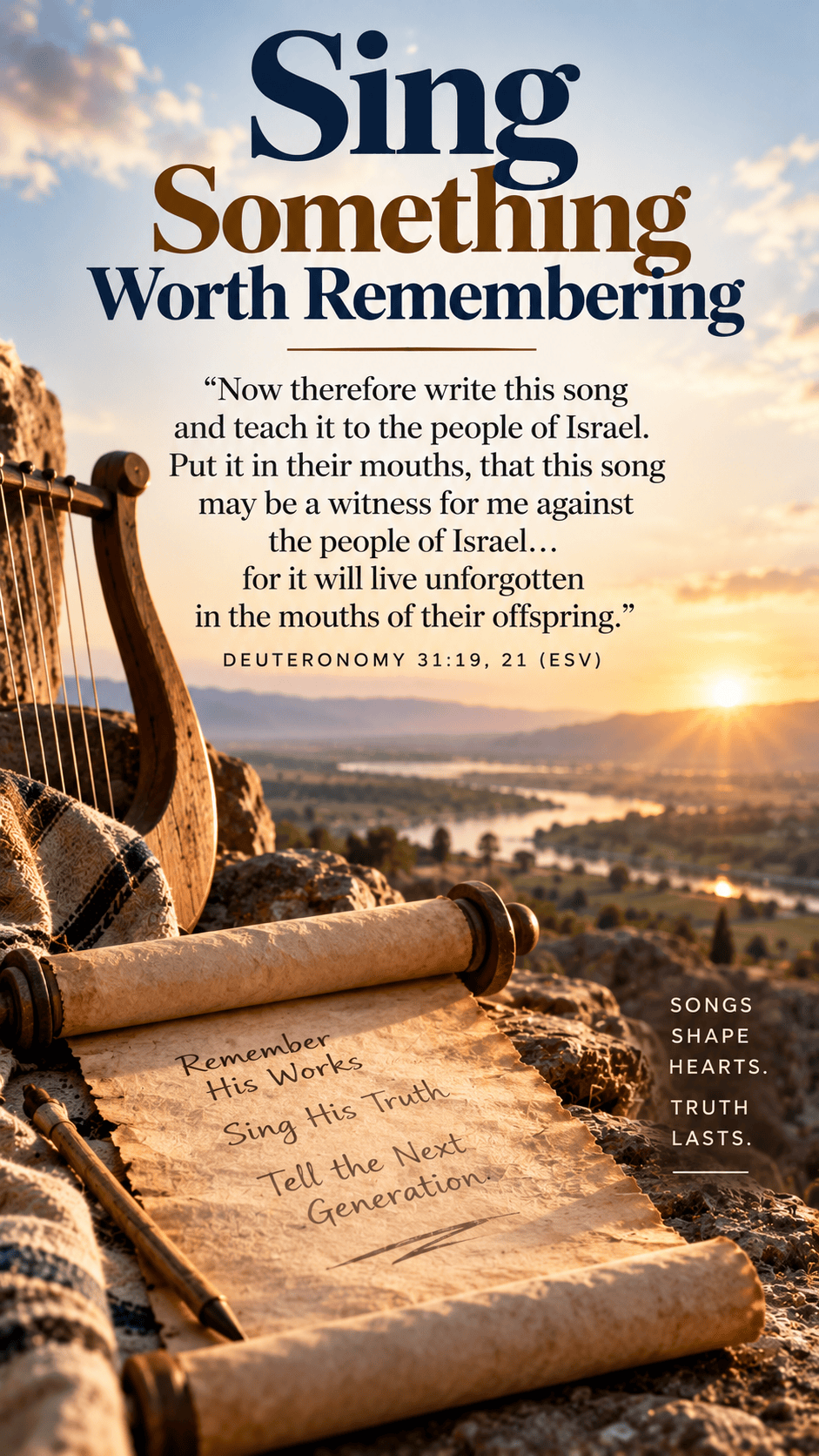
“Now therefore write this song and teach it to the people of Israel. Put it in their mouths, that this song may be a witness for me against the people of Israel. For when I have brought them into the land flowing with milk and honey, which I swore to give to their fathers, and they have eaten and are full and grown fat, they will turn to other gods and serve them, and despise me and break my covenant. And when many evils and troubles have come upon them, this song shall confront them as a witness (for it will live unforgotten in the mouths of their offspring). For I know what they are inclined to do even today, before I have brought them into the land that I swore to give.” So Moses wrote this song the same day and taught it to the people of Israel. — Deuteronomy 31:19–22 (ESV)
Devotional Thought
This devotional may sound a little self-serving at first because I’ve spent much of my life leading worship in the local church. In my defense, though, I’m writing devotionals through Deuteronomy, and this happens to be the next section of Scripture! So while this subject is certainly near and dear to my heart, I didn’t go looking for it.
Here in Deuteronomy 31, God tells Moses to do something interesting. He tells him to write a song and teach it to the people of Israel.
The song itself is recorded for us in Deuteronomy 32. I have to admit, I would love to know what the tune sounded like. We have the lyrics, but the melody has been lost to history. Here in chapter 31, however, God gives us the backstory behind the song and explains why Moses was supposed to teach it to Israel.
Think about this for a moment. Moses had been preaching to these people throughout the book of Deuteronomy. He could have simply preached another sermon. God could have told Moses, “Remind them one more time about everything I’ve done for them.”
Instead, God said, “Write this song and teach it to the people.” Why a song? God actually gives us part of the answer in verse 21: “It will live unforgotten in the mouths of their offspring.” We remember songs.
Think back to your childhood. I’ve been attending church since I was a baby in the nursery, and there are songs I learned as a child that I can still sing today: Jesus Loves Me, Jesus Loves the Little Children, This Little Light of Mine, Father Abraham, Deep and Wide, I’m in the Lord’s Army, and many others.
Some of those songs I haven’t sung regularly in decades, yet the words are still stored somewhere in my memory. Music does that. Most of us couldn’t recite a sermon we heard twenty years ago. For that matter, many of us couldn’t recite the sermon we heard three Sundays ago. But someone can begin playing a song we haven’t heard since childhood, and suddenly the words come flooding back. God understood that perfectly when He told Moses to write a song.
And that brings me to my soapbox.
Let me begin with a disclaimer: there are many excellent Christian songs being written today. I love many modern worship songs, and Scripture itself repeatedly encourages God’s people to sing a new song to the Lord. This isn’t an argument that old songs are automatically good and new songs are automatically bad.
But I do believe we need to think carefully about what we are putting into the mouths and memories of God’s people. Some songs have plenty of musical appeal but very little spiritual substance. They’re catchy. They’re emotional. They have a driving beat. They’re easy to sing. They repeat the same phrase enough times that everyone knows the chorus before the song is finished.
People sometimes jokingly call these “7-11 songs”—the same seven words sung eleven times.
One example would be I Could Sing of Your Love Forever. I’m not suggesting that it’s an evil song or that there’s anything wrong with singing about God’s love. There certainly isn’t. But the chorus consists primarily of the title phrase repeated again and again. The irony is that after singing “I could sing of Your love forever” enough times, you may begin to feel as though you’ve actually done it!
Again, repetition isn’t necessarily wrong. Scripture itself uses repetition, and some wonderful worship songs do too. The question isn’t simply, “Does this song repeat itself?” The better question is, “What truth is this song helping God’s people remember?”
Read the Song of Moses in Deuteronomy 32 and notice its content. Moses sings about God’s character. He remembers God’s works. He reminds Israel of God’s faithfulness and provision. He speaks about God’s justice, His care for His people, their tendency to wander, the consequences of rebellion, and the faithfulness of God. There’s some theological meat in that song.
Recently, two young men in their early to mid-twenties approached me separately after a worship service and made essentially the same comment. Both told me that they enjoyed singing the old hymns more than many modern praise songs.
I was a little surprised, so I asked them why. Their answers were almost identical: there’s more depth and meaning in many of those hymns. I understand exactly what they meant.
Some of the great hymns of the church don’t simply give us something pleasant to sing. They teach us theology. They remind us who God is, what Christ has done, what the gospel means, and where our hope is found. Their words become embedded in our memories, sometimes remaining there for an entire lifetime.
That’s exactly why the songs we sing matter. When God’s people gather for worship, we aren’t merely trying to create an emotional atmosphere. We’re putting words into people’s mouths. And if those songs are sung often enough, we’re putting those words into their memories.
That is an enormous responsibility. Paul tells the church in Colossians 3:16, “Let the word of Christ dwell in you richly, teaching and admonishing one another in all wisdom, singing psalms and hymns and spiritual songs.”
Notice how closely singing is connected with the Word of Christ dwelling richly within us. When we sing together, we’re not merely singing to God. In a very real sense, we’re also teaching and reminding one another of truth.
That’s why I don’t believe our primary question should be whether a worship song is old or new, traditional or contemporary, accompanied by an organ or an electric guitar.
The question should be: Is it true? Is it biblical? Does it say something meaningful about God? Does it remind us of what He has done? Is it putting words into our hearts that will help us trust Him when life becomes difficult?
God knew Israel would eventually wander from Him. He knew trouble would come. And He wanted this song to remain in their mouths so that its truth would confront them and remind them of what they had forgotten.
There will come moments in our lives when we need those same kinds of reminders. There will be hospital rooms and funeral homes. There will be seasons of disappointment and uncertainty. There will be temptations and failures. There will be moments when God seems distant and we need to remember what we know to be true.
And sometimes, in those moments, a song we’ve sung a hundred times will come back to us. A lyric about God’s faithfulness. A reminder of the cross. A declaration of Christ’s victory. A promise from Scripture. A truth about the character of God. And suddenly we’re singing theology to our own troubled hearts.
So yes, let’s sing new songs. Let’s sing old hymns. Let’s sing with joy. Let’s sing with emotion. Let’s use beautiful melodies and instruments and everything God has given us to praise Him. But whatever we sing, let’s sing something worth remembering.
Reflection Questions
- What Christian songs have remained in your memory for years, and what truths about God have they helped you remember?
- When you sing during worship, do you pay attention to the words you are singing and the truths they are teaching?
- Are the songs you listen to and sing helping God’s Word dwell richly within you?
- What truths about God’s character, the gospel, or His faithfulness do you especially need to remember in your current circumstances?
Closing Prayer
Father, thank You for the gift of music and for the way a song can place truth deep within our hearts and memories. Give us wisdom about the songs we sing and the words we allow to shape our thinking. Help us to worship You not merely with emotion, but with hearts and minds filled with truth about who You are and what You have done. Let the word of Christ dwell richly within us, and use the songs we sing to remind us of Your faithfulness when life is difficult. May our worship honor You, teach one another, strengthen our faith, and give us truths worth remembering for the rest of our lives. In Jesus’ name, Amen.
 Revcort's Ramblings
Leave a comment