Scripture Focus
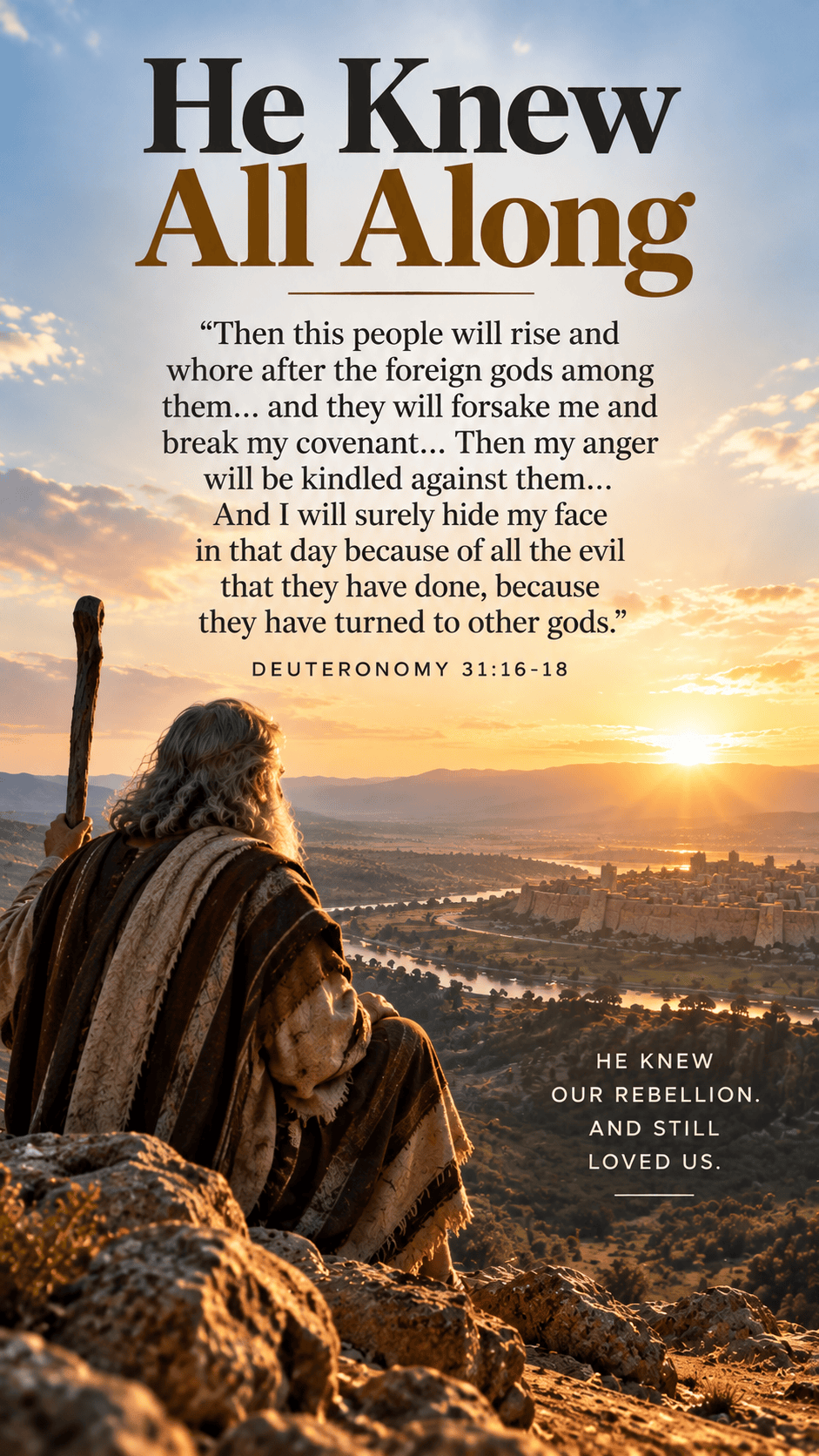
“And the LORD said to Moses, ‘Behold, you are about to lie down with your fathers. Then this people will rise and whore after the foreign gods among them in the land that they are entering, and they will forsake me and break my covenant that I have made with them. Then my anger will be kindled against them in that day, and I will forsake them and hide my face from them, and they will be devoured. And many evils and troubles will come upon them, so that they will say in that day, “Have not these evils come upon us because our God is not among us?” And I will surely hide my face in that day because of all the evil that they have done, because they have turned to other gods.’” — Deuteronomy 31:16–18 (ESV)
Devotional Thought
This conversation between God and Moses in Deuteronomy 31 is fascinating to me. Moses is approaching the end of his life. God has already told him that he will not lead Israel across the Jordan into the Promised Land, and Joshua is preparing to take his place. But then God tells Moses something else: He tells him what Israel is going to do after they enter the land.
And the picture isn’t pretty.
God says they will chase after the foreign gods of Canaan. They will forsake Him. They will break the covenant He made with them. God’s anger will be kindled against them, and He will remove His hand of protection. Then, when the consequences of their rebellion begin falling upon them, the people will ask, “Have not these evils come upon us because our God is not among us?”
In other words, they will rebel against God and then wonder why God has abandoned them.
As I read that, I find myself wondering what I would do if I were God.
I know these people are going to rebel. In fact, they’ve been rebelling ever since I brought them out of Egypt. They’ve complained about their circumstances, questioned their leaders, doubted My provision, and even refused to enter the Promised Land the first time because they didn’t believe I could give it to them.
I’ve freed them from slavery. I’ve parted the Red Sea. I’ve fed them in the wilderness. I’ve given them My law. I’ve remained faithful despite their repeated unfaithfulness. And now I’m about to give them the land I promised their fathers.
Yet I already know that once they get there, they’re going to turn around and worship somebody else’s gods.
I have to tell you, I’d be angry. I might consider scrapping the whole arrangement. I might tell them, “Fine. If you want the gods of Canaan so badly, see if those gods can give you Canaan.” I might choose another nation and start over with somebody who would appreciate everything I had done for them.
It’s a good thing for Israel that I’m not God. For that matter, it’s a good thing for me that I’m not God. Because when I look honestly at Israel’s story, I eventually have to stop pointing my finger at them and start looking at myself.
Am I really that different? Don’t I complain when circumstances don’t unfold according to my plans? Don’t I sometimes allow other things to become more important than God? Don’t I become distracted by the things of this world? Haven’t there been times when I’ve neglected prayer, worship, or God’s Word? Haven’t I sometimes received God’s blessings and then become so occupied with the blessings that I’ve neglected the One who gave them?
And here’s the remarkable thing: God knew all of that about me before any of it happened. None of our sin has ever caught God by surprise.
Jesus illustrated something similar in His parable of the tenants. A landowner entrusted his vineyard to tenants and later sent servants to receive what was due. The tenants beat and killed the servants. Finally the owner sent his son, and they killed him too, thinking that by killing the heir they could take the inheritance for themselves.
That story reflects the tragic history of humanity’s rebellion against God. God sent His prophets, and they were rejected. Then He sent His Son, and sinful men rejected and crucified Him.
And God knew it would happen. Israel’s history repeatedly demonstrated the same pattern. God blessed them. They became comfortable. They forgot Him. They rebelled. They experienced the consequences of their sin. They cried out for deliverance. And God showed them mercy again. Then the cycle started all over.
There were certainly consequences for their rebellion. God’s grace never meant that their sin didn’t matter. Israel eventually experienced devastating judgment, including captivity under Assyria and Babylon. Deuteronomy 31 itself makes it clear that a holy God takes rebellion seriously.
Yet their unfaithfulness did not destroy God’s redemptive plan. Generation after generation passed. Judges came and went. Kings rose and fell. Israel rebelled, suffered, repented, and rebelled again.
And still, in the fullness of time, God sent His Son. Jesus came knowing exactly what kind of people He had come to save. He taught them. He healed them. He showed compassion to them. He revealed the Father to them. He lived the perfectly righteous life none of us could live.
And humanity rejected Him. They mocked Him, beat Him, placed a crown of thorns upon His head, nailed Him to a cross, and killed Him. Yet even that was not outside God’s plan of redemption. Jesus died for sinners. He rose again. And through Him, rebellious people like us can be forgiven, reconciled to God, and given eternal life.
Romans 5:8 says, “but God shows his love for us in that while we were still sinners, Christ died for us.”
Not after we had cleaned ourselves up. Not after we had proven we could be faithful. Not after God discovered that we were finally worth saving. While we were still sinners.
Speaking only for myself, I would have given up on me a long time ago. But God knew all along. He knew every failure. Every selfish decision. Every misplaced priority. Every complaint. Every wandering thought. Every time I would neglect Him. Every sin I would ever commit. And still He sent His Son.
That doesn’t make me want to take advantage of His grace. It makes me marvel at it. It makes me want to love the God who loved me knowing perfectly well who I was.
God is more patient than we deserve, more gracious than we can comprehend, and more merciful than we could ever earn. He knew all along who we were. And He loved us anyway.
How could we refuse such a Father?
Reflection Questions
- When you read about Israel’s repeated rebellion, do you recognize any of the same patterns in your own relationship with God?
- Are there blessings, priorities, or distractions in your life that have gradually begun taking God’s rightful place?
- How does it change your understanding of God’s grace to realize that He knew every sin and failure of your life before Christ ever went to the cross?
- Does God’s patience with you lead you toward greater obedience and love for Him, or have you sometimes used His grace as an excuse to remain unchanged?
Closing Prayer
Father, when I look honestly at my own heart, I know that I am not so different from Israel. I have complained, wandered, become distracted, and placed other things ahead of You. Yet none of this has ever surprised You. You knew all along exactly who I was, and still You loved me. Thank You for Your patience, mercy, and grace. Thank You most of all for sending Jesus, who lived the life I could never live, died for my sins, and rose again so that I could be forgiven and redeemed. Help me never to take Your grace for granted. Instead, let the greatness of Your love draw my heart toward greater love, worship, gratitude, and obedience to You. In Jesus’ name, Amen.
 Revcort's Ramblings
Leave a comment