Scripture Focus
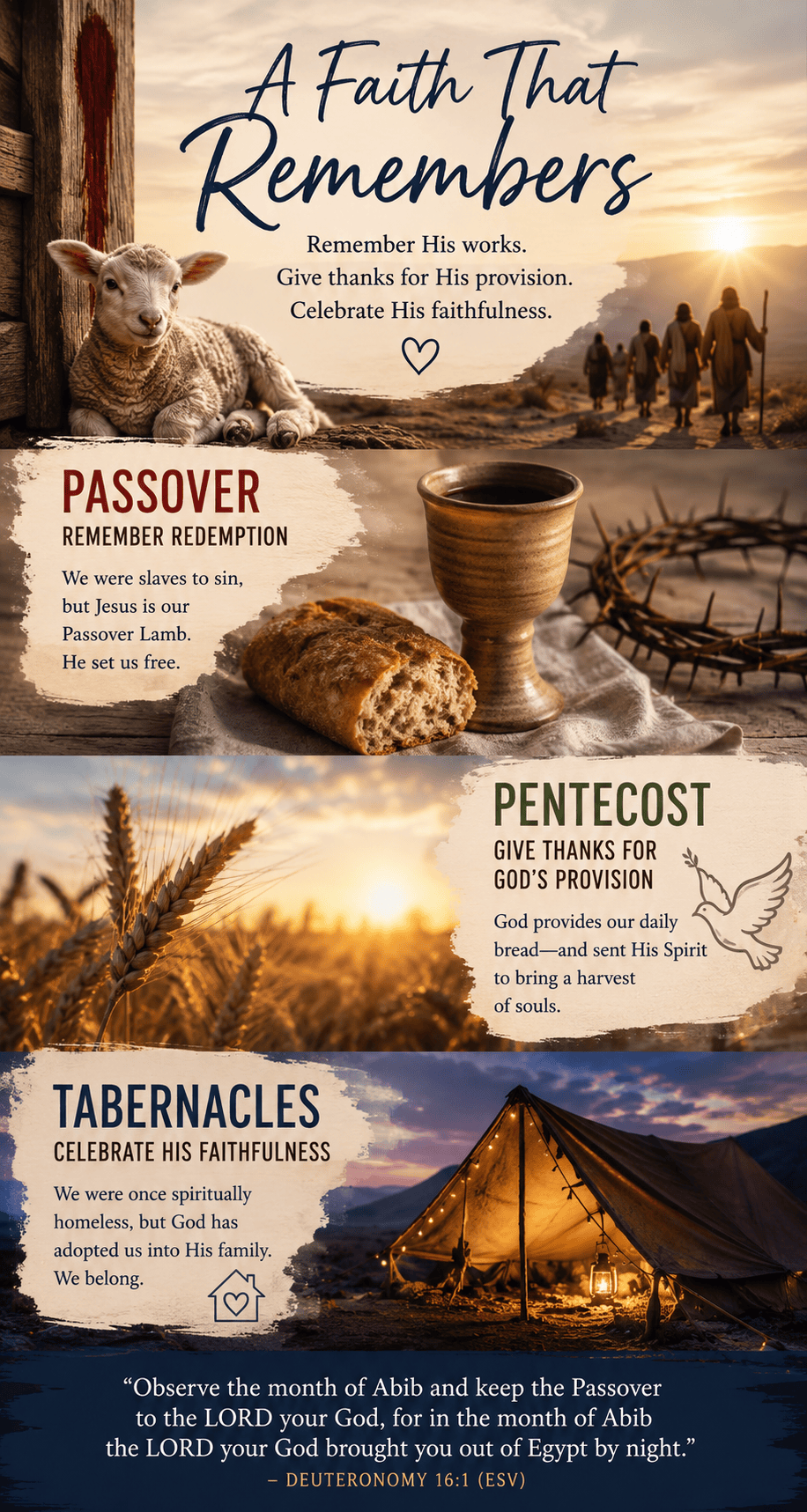
“Observe the month of Abib and keep the Passover to the LORD your God, for in the month of Abib the LORD your God brought you out of Egypt by night.” — Deuteronomy 16:1 (ESV)
Devotional Thought
Deuteronomy 16 contains Moses’ instructions concerning three important feasts Israel was to observe: Passover, the Feast of Weeks, and the Feast of Booths. Each celebration had special significance in the lives and faith of God’s people. These weren’t simply holidays on Israel’s calendar. God was intentionally building reminders of His faithfulness into the rhythm of their lives.
Passover reminded Israel of their deliverance from Egypt. For generations they had lived as slaves, unable to free themselves from Pharaoh’s power. But God intervened. On the night of the final plague, the Israelites placed the blood of the Passover lamb on their doorposts, and judgment passed over their homes. Soon afterward, Pharaoh released them. Every year when Israel celebrated Passover, they were reminded, We were slaves, but God delivered us.
Seven weeks later came the Feast of Weeks, which we often call Pentecost. This celebration came around the time of harvest and reminded Israel that the crops growing in their fields and the food appearing on their tables were ultimately gifts from God. They worked the fields, planted the seed, and gathered the harvest, but God was their Provider. The feast taught them to stop in the middle of their prosperity and recognize the One from whom every blessing had come.
Later in the year came the Feast of Booths, or Tabernacles. During this celebration, the Israelites lived in temporary shelters as a reminder of the years their ancestors had wandered through the wilderness. There had been a time when Israel had no permanent home, no farms, no vineyards, and no certainty about where tomorrow’s food would come from. Yet God had provided for them, protected them, and eventually brought them into the land He had promised.
As an American Christian, these Jewish feasts have never been a significant part of my religious life. Yet the principles behind them are tremendously important for our faith. God never intended our relationship with Him to become a small compartment of life—something reserved for Sunday morning and disconnected from everything else we do. God was teaching His people to build remembrance into their lives. They were to remember where they had come from, recognize what God was presently doing, and celebrate His faithfulness along the way.
For Christians, Passover is perhaps the easiest connection to see. We too were once slaves—not to Pharaoh, but to sin. And we could no more free ourselves from sin than Israel could free themselves from Egypt. But Jesus came to rescue us. Scripture even describes Christ as “our Passover lamb” (1 Corinthians 5:7). When we observe Communion or the Lord’s Supper, we remember His body given for us and His blood shed for us. We remember that our freedom was purchased by Jesus Christ.
Pentecost also took on an even greater meaning after the resurrection of Jesus. Acts 2 tells us that during Pentecost the Holy Spirit came upon the believers and the gospel was proclaimed in Jerusalem. That day, instead of merely celebrating a harvest of grain, the followers of Jesus witnessed a harvest of souls as about three thousand people received the message and were baptized. Pentecost reminds us that God still provides everything His people need—not only our daily bread, but His Spirit, His power, and the opportunity to participate in His work of bringing people to Christ.
And the Feast of Tabernacles reminds me of something equally beautiful. Israel remembered a time when they had wandered without a permanent home. Spiritually speaking, we were once homeless too. We were separated from God and strangers to His promises. But through Christ, God has brought us home. He has adopted us into His family. We are no longer strangers and outsiders; we belong to the household of God.
Maybe that is one reason God gave Israel these celebrations. God knows how quickly we forget.
We can enjoy the freedom without remembering the One who freed us. We can enjoy the harvest without remembering the One who provided it. We can enjoy the security of home without remembering the wilderness from which God brought us.
So perhaps we need reminders too.
Remember when you were lost and Christ found you. Remember the prayers God answered. Remember the seasons when you didn’t know how you would make it, but somehow God provided. Remember the wilderness seasons when He carried you. Remember the people He placed in your life at just the right moment. Remember where you were, where you are now, and Who brought you here.
Our faith was never meant to occupy only one day of our week. It should shape the rhythm of our entire lives.
Remember your redemption. Give thanks for God’s provision. Celebrate that He has brought you home.
And above all, don’t forget the God who has been faithful through it all.
Reflection Questions
- What are some specific things God has done in your life that you never want to forget?
- How does remembering that you were once a slave to sin change the way you think about Christ’s sacrifice for you?
- What provisions in your life have you begun to take for granted instead of recognizing them as gifts from God?
- What practices could you build into the rhythm of your life to help you regularly remember and celebrate God’s faithfulness?
Closing Prayer
Father, thank You for reminding me that I should never forget what You have done. Thank You for rescuing me from slavery to sin through Jesus Christ, my Passover Lamb. Thank You for providing for me each day and for giving Your Spirit to Your people. Thank You that although I was once separated from You, through Christ You have brought me into Your family and given me a home. Forgive me for the times I enjoy Your blessings while forgetting the One who gave them. Help me build a life that remembers Your works, gives thanks for Your provision, and celebrates Your faithfulness. In Jesus’ name, amen.


Leave a Reply