Scripture Focus
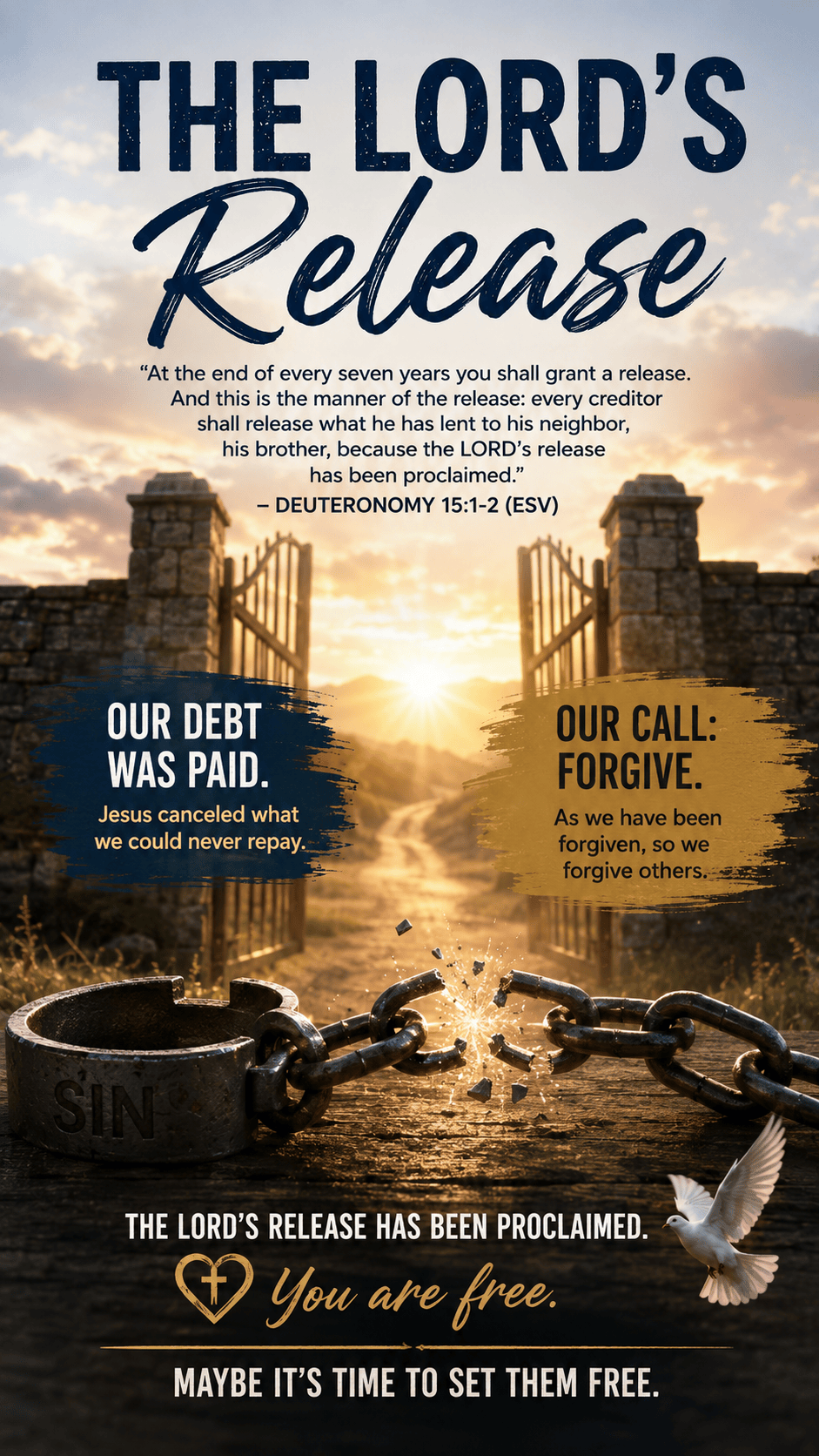
“At the end of every seven years you shall grant a release. And this is the manner of the release: every creditor shall release what he has lent to his neighbor. He shall not exact it of his neighbor, his brother, because the LORD’s release has been proclaimed.” — Deuteronomy 15:1–2 (ESV)
Devotional Thought
In Deuteronomy 15, Moses explains a remarkable command God gave to Israel. Every seventh year, Israel was to observe what Moses calls “the LORD’s release.” Debts owed by fellow Israelites were to be released, and Hebrew servants were to be set free. This seven-year release was related to the same principles we later see in the Year of Jubilee described in Leviticus 25.
It’s difficult to imagine something like this operating in our modern economy. I can’t imagine banks and credit card companies getting excited about announcing that everyone’s balance has suddenly been forgiven! But imagine what this must have meant to an Israelite who had fallen deeply into debt. The approaching year of release wasn’t something to fear. It was something to anticipate.
Your debt was going to be released.
Of course, the wealthy lender might have viewed the approaching seventh year very differently. In fact, Moses specifically warns the Israelites not to become stingy when the year of release was approaching. They might have been tempted to think, If I lend this person money now, there’s a good chance I’ll never get it back. God told them to give anyway.
“You shall give to him freely, and your heart shall not be grudging when you give to him” (Deuteronomy 15:10). God promised to bless His people for their generosity. They were being taught to trust that their security ultimately came from God rather than from whatever someone else owed them.
Although these specific laws belonged to God’s covenant with ancient Israel and are not instructions for how our modern banking system should operate, the principle behind them points us toward something much greater. Because spiritually speaking, we are the ones who owed the enormous debt.
Our sin created a debt before God that none of us could ever repay. No amount of good behavior, religious activity, generosity, or personal improvement could erase what we owed. If our salvation depended upon our ability to settle the account ourselves, we would be hopeless.
But Jesus Christ came to do what we could never do. At the cross, He paid the debt of our sin and offered us something infinitely greater than Israel’s seventh-year release. In Christ, God declares freedom to those who could never purchase it for themselves.
Our debt has been paid. Our release has been proclaimed.
And once we understand how much we have been forgiven, another uncomfortable question begins to emerge: What about the debts we are still holding against other people?
Jesus taught us to pray, “Forgive us our debts, as we also have forgiven our debtors” (Matthew 6:12). Later, in Matthew 18, Jesus told the story of a servant who owed his king an enormous debt—so large that he could never realistically repay it. The king showed compassion and forgave everything.
But then that same servant found another man who owed him a comparatively small amount. Instead of extending the mercy he had just received, he demanded payment and had the man thrown into prison. Jesus’ point is difficult to miss. How can people who have been forgiven an immeasurable debt by God refuse to extend forgiveness to those who have wronged them?
That doesn’t mean the wrong didn’t matter. Forgiveness doesn’t require us to pretend that something wasn’t painful, excuse abusive behavior, eliminate appropriate boundaries, or automatically restore trust. But forgiveness does mean surrendering our personal claim to vengeance and releasing the debt into God’s hands.
Sometimes we keep people imprisoned in our hearts long after the offense occurred. We replay what they did. We rehearse what they owe us. We imagine the apology they should give or the punishment they deserve.
Meanwhile, we stand before God as people whose own debt has been completely forgiven. Perhaps there is someone whose debt you’ve been carrying for far too long. You remember what they said. You remember what they did. You know exactly what they owe you. But then you look toward the cross and remember what you owed. And you hear the wonderful announcement of grace: The LORD’s release has been proclaimed.
Jesus has set you free from a debt you could never repay. Maybe it’s time to set someone else free.
Reflection Questions
- How does Israel’s “release” help you understand what Christ has done with the debt of your sin?
- Do you sometimes forget how much God has forgiven you?
- Is there someone whose offense you continue to hold against them?
- What would it look like for you to release that debt to God while still maintaining any necessary and appropriate boundaries?
- How might remembering the forgiveness you have received in Christ make it easier to forgive someone else?
Closing Prayer
Father, thank You for forgiving the enormous debt of my sin that I could never have repaid. Thank You for sending Jesus to the cross to pay the price for me and to proclaim freedom to those who trust in Him. Help me never to forget how much mercy You have shown me. Search my heart and show me if there is someone whose debt I am still holding onto. Give me the grace to forgive as I have been forgiven, surrender my desire for vengeance to You, and extend to others the mercy You have so freely extended to me. Thank You that because of Jesus, my debt has been paid and I have been set free. In Jesus’ name, Amen.


Leave a Reply