Scripture Focus
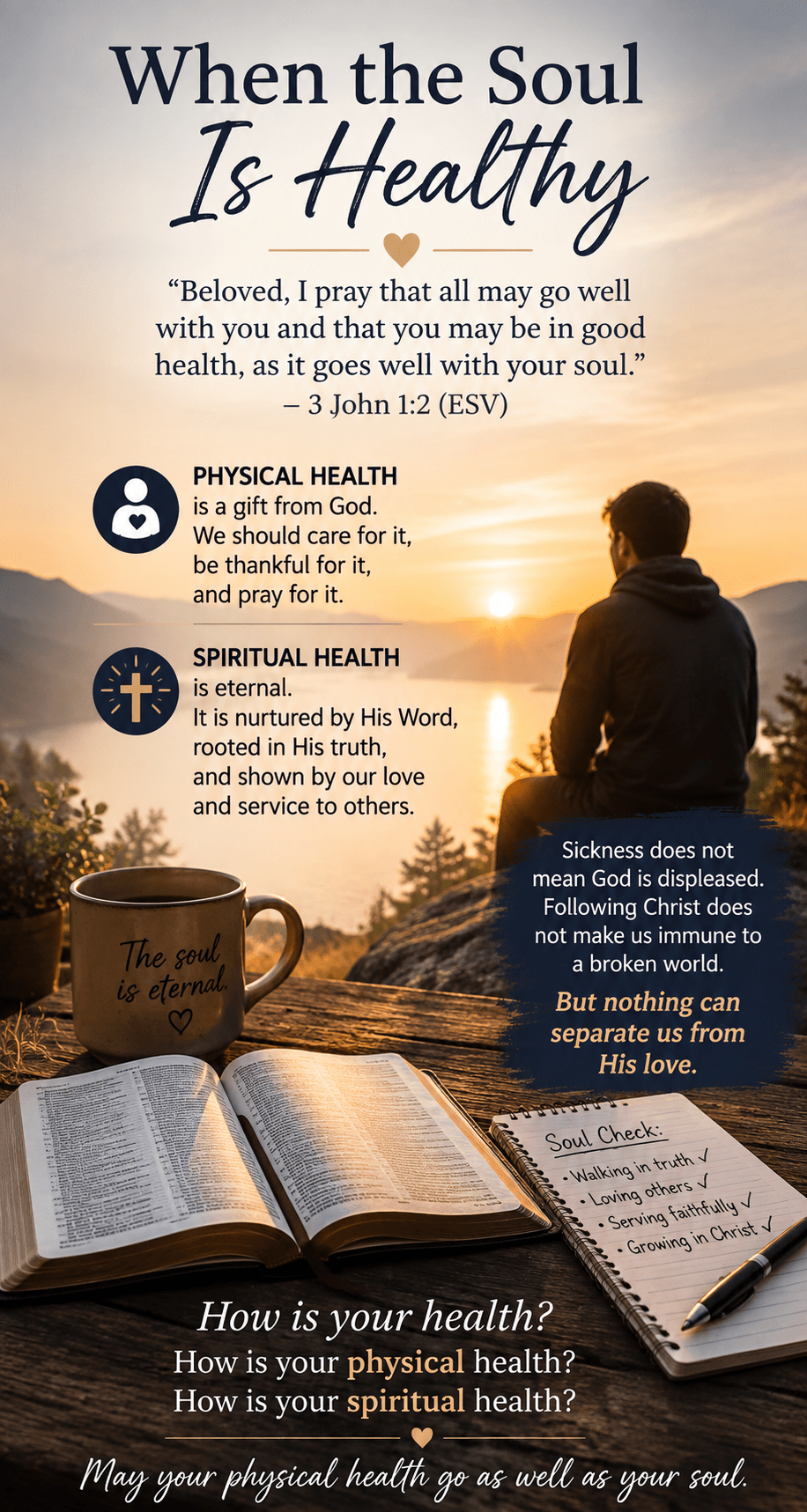
“Beloved, I pray that all may go well with you and that you may be in good health, as it goes well with your soul.” — 3 John 1:2 (ESV)
Devotional Thought
John begins his third letter with a warm greeting to a believer named Gaius. We are not told exactly where Gaius lived or which local church he attended, but as the letter unfolds, it becomes clear that John had tremendous confidence in him. Gaius had demonstrated faithfulness by serving fellow believers, including traveling Christians who were strangers to him. John also seems to entrust him with helping navigate a difficult conflict involving a man named Diotrephes, who was causing trouble within the church.
But before John addresses any of those matters, he says something simple that caught my attention: “I pray that all may go well with you and that you may be in good health, as it goes well with your soul.”
John makes an important distinction between physical health and spiritual health. They are not the same thing, and one does not necessarily indicate the condition of the other. That is important because some have taught that if a Christian has enough faith, walks closely enough with God, or claims the right promises, God will guarantee that person continued health, wealth, and prosperity. According to that way of thinking, sickness can almost become evidence of deficient faith or some spiritual failure.
But Scripture simply does not teach that. God certainly can heal. We should pray for those who are sick, and John himself prayed for Gaius’s physical well-being. Every good gift ultimately comes from God, including the blessing of good health. But nowhere does the Gospel promise that faithful Christians will be protected from sickness, injury, suffering, or physical decline.
In fact, some of the most faithful believers we know suffer tremendously. I’ve experienced various illnesses myself, and my physical health has not always been in sync with my spiritual health. I’ve watched faithful people in our church experience the same thing. A person can love Christ deeply, walk faithfully with Him, serve others sacrificially, and still experience serious physical difficulties.
And when someone becomes sick, we should be very careful about assuming that their suffering means they have sinned and God is punishing them.
Jesus directly confronted that kind of thinking. In Luke 13, people told Jesus about Galileans who had suffered a terrible death. Jesus responded: “Do you think that these Galileans were worse sinners than all the other Galileans, because they suffered in this way? No, I tell you; but unless you repent, you will all likewise perish.” — Luke 13:2–3 (ESV)
Then Jesus mentioned another tragedy. A tower in Siloam had fallen and killed eighteen people. Again He asked whether those who died were worse offenders than everyone else in Jerusalem. His answer was the same: No.
We live in a fallen world. Sickness, disease, accidents, disasters, persecution, and the sinful actions of other people affect both believers and unbelievers. Following Christ does not make us immune to the brokenness of this world. The great promise of the Gospel is not that Christians will never get sick. It is that even sickness and death cannot separate us from Christ.
Now consider again what John actually says about Gaius.
He prays that Gaius’s physical health would prosper in the same way his soul was already prospering. It is possible that John knew Gaius was struggling with some physical ailment, although the text does not tell us that directly. What it does tell us is something remarkable about Gaius: his soul was doing well.
John knew this man’s spiritual condition. He had heard about his faithfulness. In the following verses, John says that others had testified that Gaius was “walking in the truth.” His love for fellow believers was visible through his actions. His spiritual health wasn’t merely something Gaius claimed; there was evidence of it in the way he lived.
In fact, John seems to have such confidence in Gaius’s walk with Christ that he entrusts this letter to him and expects him to continue faithfully serving the church even as difficult circumstances arise.
That brings John’s greeting very close to home. How is your health? Certainly, we should care about our physical health. Our bodies are gifts from God, and good stewardship includes taking reasonable care of them. We should be thankful for good health, seek appropriate care when we are sick, and pray for God’s healing when illness comes.
But there is another question that matters even more: How is your soul?
Suppose someone who knew you well prayed John’s prayer over you: “I pray that your physical health would be as good as your spiritual health.” Would that be a prayer you would want God to answer? Imagine if tomorrow morning your physical condition perfectly reflected the present condition of your soul. Would you wake up strong and healthy—or weak, neglected, and desperately in need of nourishment?
That is a searching question. We spend enormous amounts of time caring for our physical bodies. We think about what we eat, how much we exercise, whether we’re getting enough sleep, what our numbers look like at the doctor’s office, and whether something hurts that didn’t hurt yesterday. Those things matter.
But our bodies are temporary. Our souls are eternal. Perhaps one of the greatest compliments that could ever be given to a Christian is the one John quietly gives Gaius: your soul is prospering.
May that increasingly be true of us. May we walk closely with Christ, remain rooted in His Word, confess our sins, love His people, serve faithfully, and grow in obedience. And whether our bodies are strong or weak, healthy or sick, young or old, may there be no question about the condition of our souls. May our souls be thriving in Christ.
Reflection Questions
- How would you honestly describe your spiritual health right now—thriving, growing, stagnant, or struggling?
- Have you ever been tempted to interpret sickness or suffering as evidence that God is displeased with you or someone else? How do Jesus’ words in Luke 13 challenge that assumption?
- If your physical health suddenly matched your spiritual health, what condition would you be in?
- What practices or changes might help strengthen the health of your soul and deepen your walk with Christ?
Closing Prayer
Father, thank You for every good gift You give us, including the blessing of physical health. Help me to care wisely for the body You have given me, but keep me from believing that physical health is the measure of Your love or my faithfulness. When sickness and suffering come, remind me that I still belong to You and that nothing can separate me from Christ. Most of all, help me to care for the health of my soul. Draw me closer to Jesus, nourish me through Your Word, strengthen me through Your Spirit, and make my life evidence of a soul that is prospering in You. May I walk faithfully in the truth, love Your people well, and serve You all my days. In Jesus’ name, Amen.


Leave a Reply