Scripture Focus
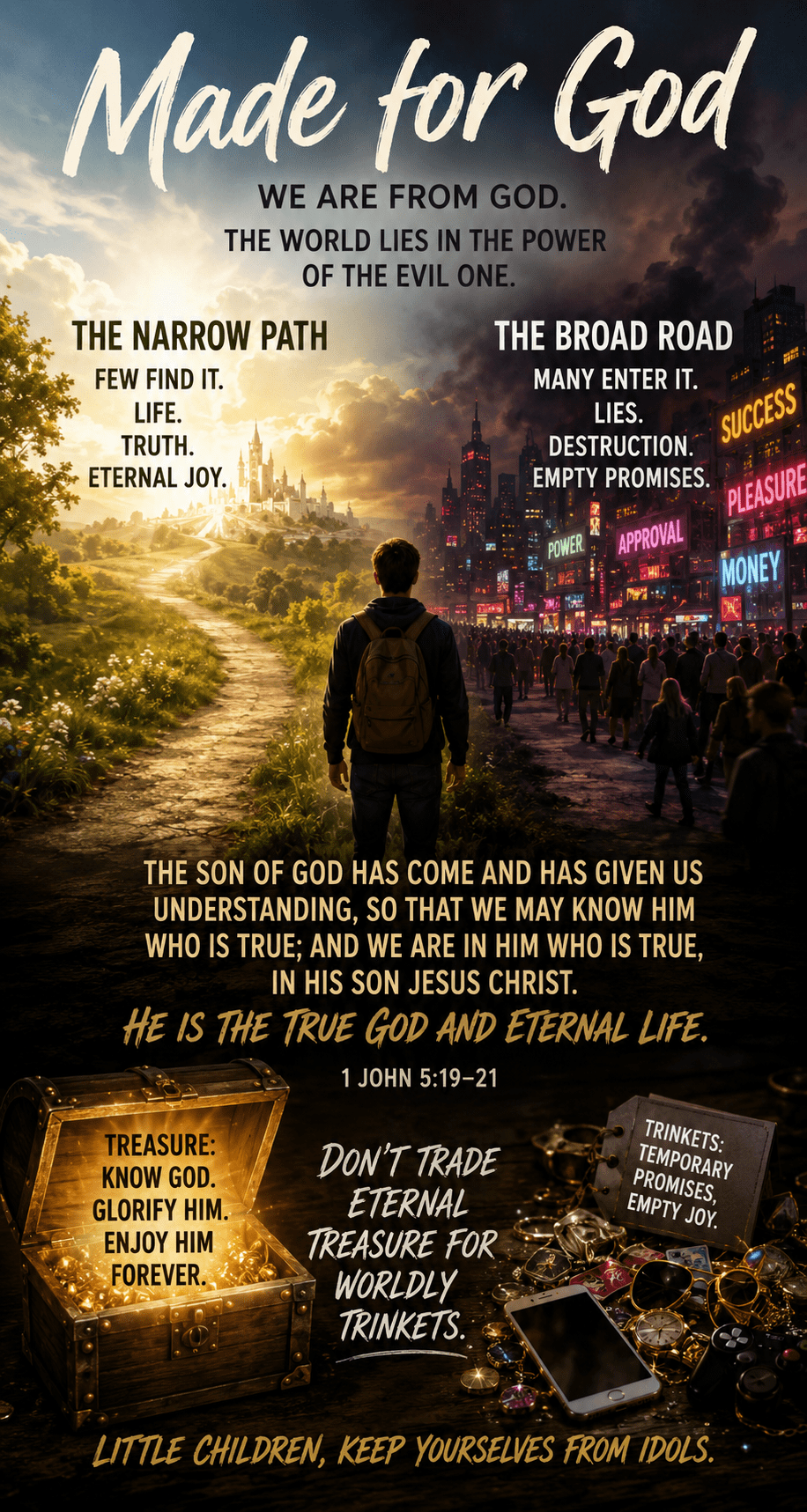
“We know that we are from God, and the whole world lies in the power of the evil one. And we know that the Son of God has come and has given us understanding, so that we may know him who is true; and we are in him who is true, in his Son Jesus Christ. He is the true God and eternal life. Little children, keep yourselves from idols.” — 1 John 5:19–21 (ESV)
Devotional Thought
As John brings his letter to a close, he leaves his fellow believers with several great truths to hold onto. One of them is found in the simple statement, “We know that we are from God.”
I was struck by that phrase while comparing different translations. The ESV says that we are “from God,” while the KJV and several other translations say that we are “of God.” As I thought about the difference, it occurred to me that several prepositions could truthfully describe the Christian’s relationship with God. We are of God. We are from God. We are for God. We belong to God. And ultimately, we are to live for God.
But John’s primary emphasis here is even more basic. Humanity is divided into two spiritual camps. There are those who are of God, and there are those who remain under the power of the evil one. There is no third spiritual kingdom somewhere between the two.
Jesus taught the same truth when He spoke about the narrow gate and the broad road. The narrow way leads to life, and few find it. The broad road leads to destruction, and many travel upon it (Matthew 7:13–14). John describes that same division when he writes, “We know that we are from God, and the whole world lies in the power of the evil one.”
In one sense, of course, every human being is “from God.” Every person is made in the image of God, and God is actively involved in the creation of every human life. We owe our very existence to Him. Yet being created by God is not the same thing as belonging to God through the new birth.
That distinction brings to mind the famous first question of the Westminster Shorter Catechism: “What is the chief end of man?” Its answer is beautiful: “Man’s chief end is to glorify God, and to enjoy him forever.”
Think about how remarkable that statement really is.
The natural human heart does not say, I exist to glorify God and enjoy Him forever. Apart from the transforming grace of God, our hearts are bent toward sin, self, and our own glory. We naturally ask what will satisfy us, advance us, please us, or make much of us. We do not naturally desire to make much of God.
But something extraordinary has happened to those who have been born again. God has changed us. He has given us new hearts with new desires and affections. Though we still struggle with sin, there is now something within us that genuinely longs for God. We want to know Him. We want to please Him. We want our lives to glorify Him. And increasingly, we discover that our deepest joy is found in enjoying the God for whom we were made.
We are of God, from God, for God, and ultimately our lives are to God.
There is no higher purpose for a human life. There is no greater pleasure than fulfilling the purpose for which we were created. The world continually promises that happiness will be found in possessions, accomplishments, recognition, pleasure, relationships, or countless other things. Some of those things may be good gifts from God, but none of them can bear the weight of becoming our ultimate purpose. We were made for something infinitely greater. We were made for God.
And Jesus Christ is the One who makes this possible. John writes, “The Son of God has come and has given us understanding, so that we may know him who is true.” We could never restore ourselves to God. Because of our sin, we could not simply walk into His holy presence on our own merit. But Christ came for us. Through His perfect life, sacrificial death, and resurrection, He reconciles sinners to God. His righteousness is credited to those who believe, and through Him we can truly know God.
John goes even further: “We are in him who is true, in his Son Jesus Christ. He is the true God and eternal life.” Christianity is not merely knowing truths about God. Through Jesus Christ, we actually know Him. We belong to Him. We are in Christ, and Christ has brought us into fellowship with the Father. Because of what Jesus has accomplished, we can begin doing what humanity was created to do: glorify God and enjoy Him forever.
That makes John’s final sentence especially powerful: “Little children, keep yourselves from idols.” At first, it might sound like an unrelated warning tacked onto the end of the letter. But it actually follows everything John has said perfectly.
It is almost as though the aged apostle is saying, Look at what you have been given! Through Jesus Christ, you know the true God. You have eternal life. You have been brought out of darkness and into fellowship with Him. You have discovered the very purpose for which you were created. Now why would you trade that treasure for trinkets?
That is what every idol ultimately is—a trinket offered in exchange for a treasure.
An idol does not have to be a carved statue. Anything that takes God’s rightful place in our hearts can become an idol. Money can become an idol. Success can become an idol. Pleasure, possessions, relationships, reputation, entertainment, politics, sports, careers, and even ourselves can become idols when we expect them to give us what only God can give.
The world offers these things constantly because “the whole world lies in the power of the evil one.” Satan would gladly have us exchange the joy of knowing God for temporary pleasures that can never satisfy. His broad road may promise freedom and happiness, but its destination is destruction.
John points us somewhere infinitely better. You were made for God. Through Jesus Christ, you can know the God for whom you were made. In Christ, you have eternal life. You have been given the privilege of glorifying God and enjoying Him—not merely for a few years here, but forever.
Don’t exchange that treasure for the world’s trinkets. Little children, keep yourselves from idols.
Reflection Questions
- What does it mean for you personally to say, “I am from God” or “I am of God”?
- How does the truth that you were created to glorify God and enjoy Him change the way you think about the purpose of your life?
- What things are most likely to compete with God for your affection, attention, or devotion?
- Are there any “trinkets” of this world that you have been treating as though they were treasures?
- How has Jesus Christ made it possible for you to know, glorify, and enjoy God?
Closing Prayer
Father, thank You that You created me for Yourself and that, through Jesus Christ, You have made it possible for me to truly know You. Thank You for giving me new life and changing my heart so that I can desire Your glory and find my greatest joy in You. Help me remember that nothing this world offers can compare with the treasure of knowing You. Guard my heart from idols and keep me from exchanging eternal treasure for temporary trinkets. Teach me to live as one who is from You, belongs to You, and exists for Your glory. May I glorify You and enjoy You today and forever. In Jesus’ name, Amen.


Leave a Reply