Scripture Focus
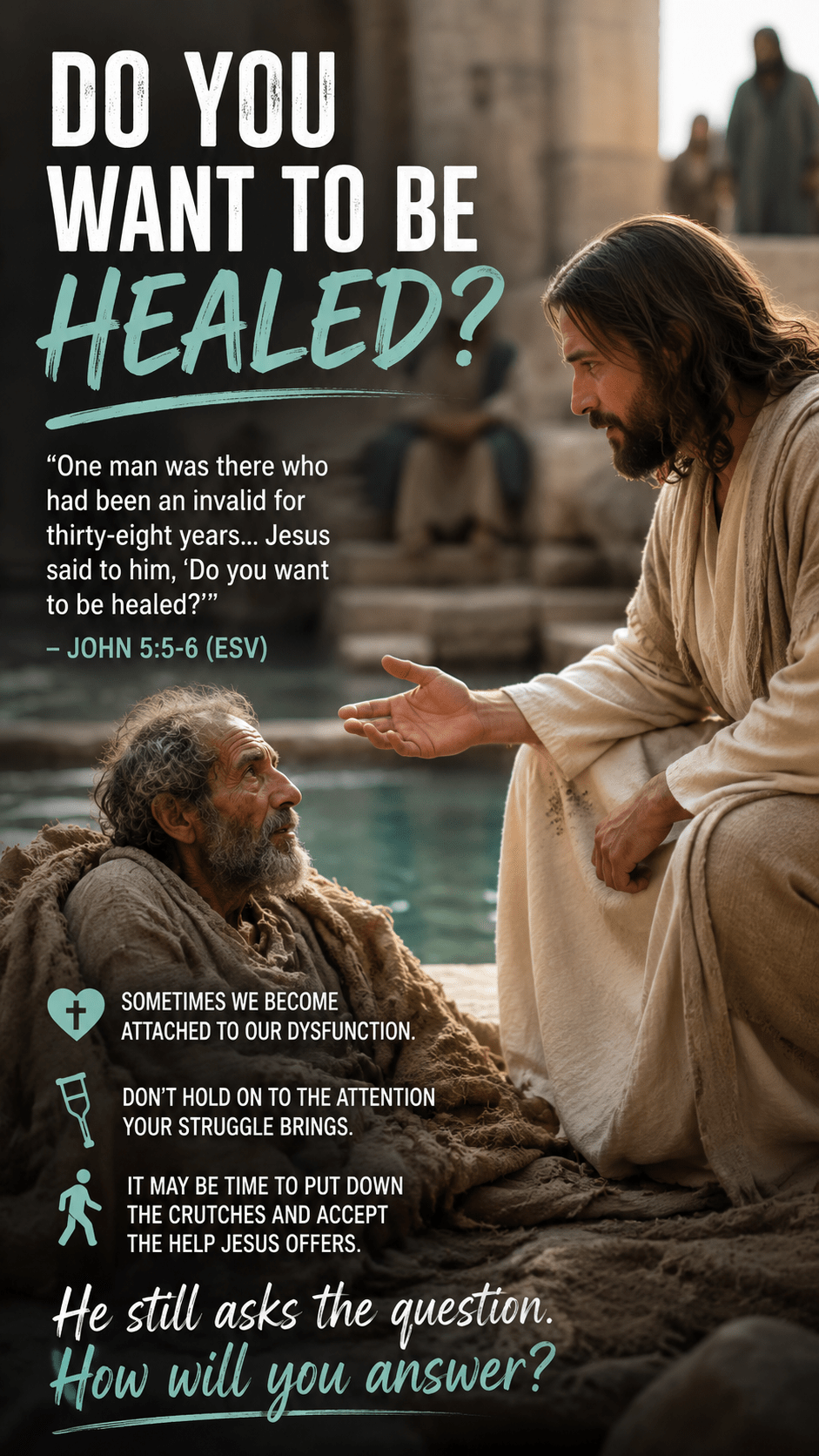
“One man was there who had been an invalid for thirty-eight years. When Jesus saw him lying there and knew that he had already been there a long time, he said to him, ‘Do you want to be healed?’” — John 5:5–6 (ESV)
Devotional Thought
One of the most surprising questions Jesus ever asked is found beside the Pool of Bethesda. He approaches a man who had been an invalid for thirty-eight years. The man had spent years lying beside the pool, hoping for a miracle. Jesus looks at him and asks what seems like an obvious question: “Do you want to be healed?”
For years I’ve wondered why Jesus would ask such a thing. Surely the answer was obvious. Of course he wanted to be healed… didn’t he?
But when you read the man’s response carefully, you notice something interesting. He never actually answers the question.Instead, he gives excuses. “Sir, I have no one to put me into the pool when the water is stirred up, and while I am going another steps down before me.” (John 5:7)
His answer isn’t, “Yes, Lord!” It’s a list of reasons why healing hasn’t happened. Our camp pastor this week offered a thought that made me stop and think. Perhaps, at least on some level, this man had become comfortable in his condition. After thirty-eight years, being an invalid wasn’t just something he experienced—it had become part of his identity.
As strange as it sounds, sometimes we become attached to our dysfunction. Sometimes our struggles bring us attention. Sometimes our problems become the way people know us. Sometimes we’ve lived with a hurt, habit, or sin for so long that we can’t imagine life without it. We may genuinely dislike our condition, but we also fear what life would look like if it were gone.
The pastor illustrated this with the story of a student who injured his leg and needed crutches for a season. Long after the injury had healed, he was still using them. Eventually the pastor confronted him, and the young man admitted the truth—he enjoyed the attention the crutches brought him.
We may not carry literal crutches, but many of us carry emotional, relational, or spiritual ones. We hold onto old wounds, unhealthy habits, bitterness, excuses, or sinful patterns because they’ve become familiar. They have become part of the story we tell ourselves and others.
Could it be that sometimes Jesus asks us the same question? “Do you want to be healed?” For many people, the answer is an immediate and wholehearted yes. But for some of us, the question deserves honest reflection. Is there anything we’re secretly holding onto? Any excuse we’ve grown comfortable with? Any identity we’ve embraced that keeps us from receiving the healing Christ desires to give?
Healing often requires surrender. Deliverance often requires laying something down. Maybe it’s time to put down the crutches.Jesus still asks the question today. The only question is whether we’re willing to answer it honestly.
Reflection Questions
1. If Jesus asked you, “Do you want to be healed?” how would you honestly answer?
2. Are there hurts, habits, sins, or excuses that have become part of your identity?
3. Is there something you’ve been holding onto because it feels familiar, even though it keeps you from experiencing freedom?
4. What “crutch” might Jesus be asking you to lay down today?
Closing Prayer
Father, You know every hurt, every habit, and every hidden struggle in my life. Search my heart and reveal anything I have grown comfortable carrying that You desire to heal. Give me the courage to stop making excuses and to trust You completely. Help me lay down every crutch that keeps me from walking in the freedom You have provided through Christ. I truly want to be healed. In Jesus’ name, Amen.


Leave a Reply