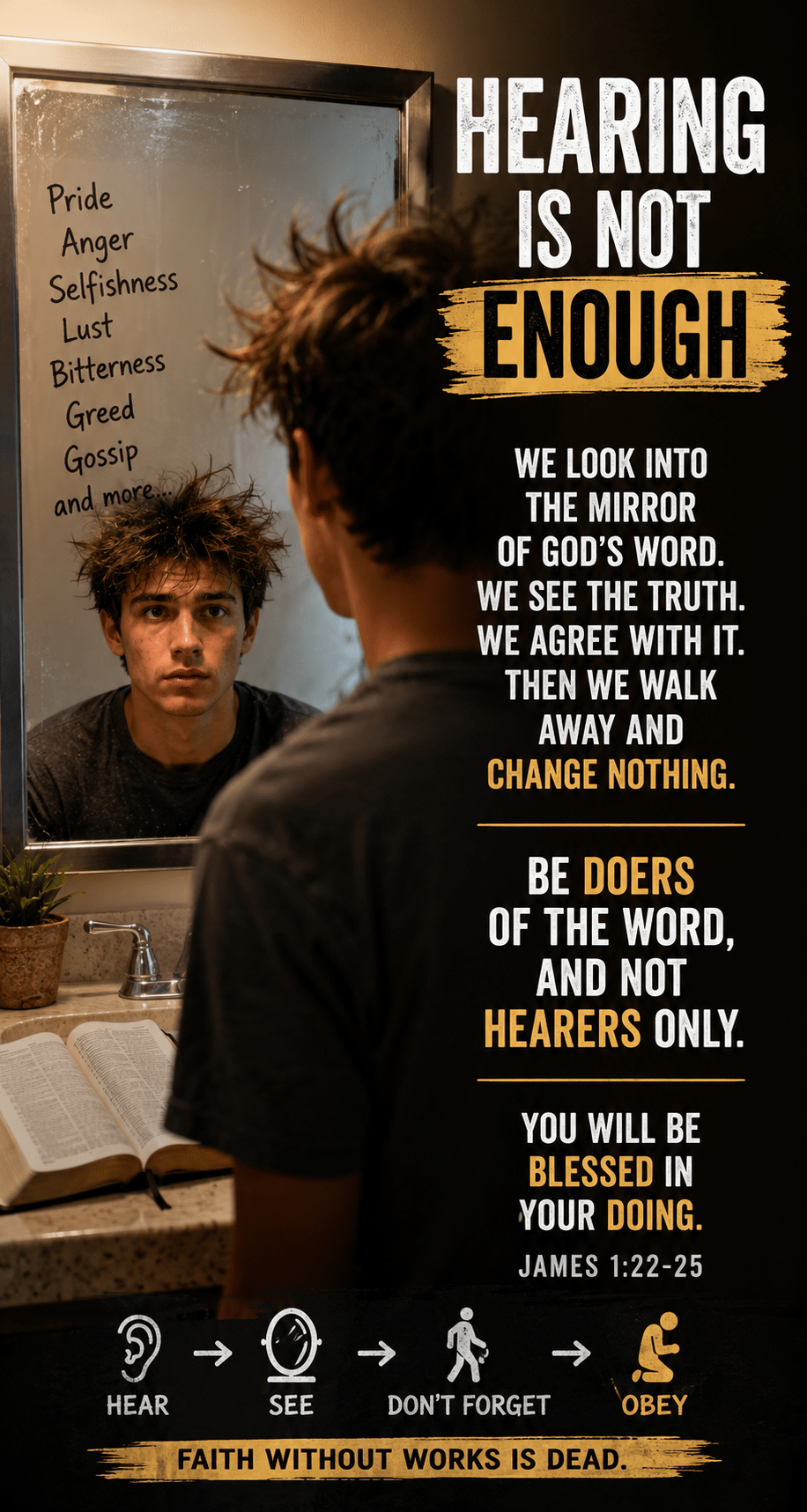
Scripture Focus
“But be doers of the word, and not hearers only, deceiving yourselves. For if anyone is a hearer of the word and not a doer, he is like a man who looks intently at his natural face in a mirror. For he looks at himself and goes away and at once forgets what he was like. But the one who looks into the perfect law, the law of liberty, and perseveres, being no hearer who forgets but a doer who acts, he will be blessed in his doing.” — James 1:22–25 (ESV)
Devotional Thought
When are we going to start doing what we’ve learned?
That is the question James confronts us with in these verses. It is one of the most practical and uncomfortable questions in all of Scripture because it forces us to examine not what we know, but what we do.
Many people spend years sitting under faithful preaching and teaching. They attend church regularly. They participate in Bible studies. They read Christian books and devotionals. They know the right answers. They can quote verses. They may even enthusiastically respond with an “Amen!” or a “Preach it, brother!” when the truth is proclaimed.
Yet James warns that hearing the Word alone is not enough.
In fact, he says something startling: if we hear God’s Word but do not obey it, we are deceiving ourselves.
How are we deceiving ourselves? We convince ourselves that hearing is the same thing as obeying. We assume that agreement with the truth is the same thing as submission to the truth. We begin to believe that merely being exposed to Scripture somehow satisfies God’s expectation for our lives.
But where do we find that idea in the Bible?
Scripture never presents hearing as the goal. Hearing is the beginning. The purpose of hearing God’s Word is that we might believe it, obey it, and be transformed by it.
James illustrates this with a memorable picture. He compares the hearer-only to a man looking into a mirror. He sees his reflection clearly. He notices what needs attention. Yet the moment he walks away, he forgets what he saw and does nothing about it.
When speaking to teenagers, I often use a modern example. Imagine waking up in the morning, looking in the mirror, and discovering a giant pimple right on the end of your nose. Your hair looks like ten cows licked it from every direction. It is sticking up everywhere. You see the problem clearly, but instead of fixing it, you walk straight out the door and head to school.
Most teenagers would never do that. They are far too concerned about their appearance. Even most adults would not leave the house looking like that. Yet spiritually, people do it every day.
We look into the mirror of God’s Word. Scripture reveals our pride, anger, selfishness, bitterness, greed, lust, gossip, and countless other sins. We see what God says. We mentally agree with it. We acknowledge that change is needed. Then we walk away and continue living exactly as before.
James says that is foolish.
The Word of God functions as a mirror for the soul. It reveals what is really there. The problem is not that we fail to see. The problem is often that we refuse to act.
This becomes the foundation for James’ later discussion about faith and works. Some misunderstand James and think he teaches that works earn salvation. Nothing could be further from the truth. Salvation is by grace alone through faith alone in Christ alone.
However, genuine faith always produces fruit.
Works do not earn salvation; they prove salvation.
When Christ saves us, He not only justifies us—declaring us righteous before God—but also begins the lifelong work of sanctification. True believers are not perfect, but they are changing. They develop a growing hatred for the sin that nailed their Savior to the cross. They desire greater holiness. They long for deeper fellowship with Christ. When they fail, they repent and seek restoration.
That process is never completed in this life. Perfection awaits glorification. Yet growth should be evident.
A faith that never changes a person is not the faith described in Scripture.
James wants us to examine ourselves honestly. Have we become content merely hearing God’s Word? Have we mistaken knowledge for obedience? Have we convinced ourselves that showing up, listening, and agreeing is enough?
The blessing belongs not to the one who simply hears, but to the one who hears and obeys. The question remains as relevant today as it was when James first wrote these words: When will you stop hearing only and start doing?
Reflection Questions
- What truths from God’s Word have I heard repeatedly but failed to put into practice?
- Am I more focused on gaining biblical knowledge or on obeying what I already know?
- How has God’s Word recently exposed areas of sin or spiritual weakness in my life?
- What specific act of obedience is God calling me to take today?
Closing Prayer
Father, thank You for the gift of Your Word. Forgive me for the times I have heard Your truth without responding in obedience. Help me not to deceive myself by mistaking knowledge for faithfulness. Through the power of Your Spirit, give me a heart that gladly obeys what You reveal. Continue Your work of sanctification in my life, making me more like Christ each day. May my faith be demonstrated through a life of obedience that brings glory to You. In Jesus’ name, Amen.


Leave a Reply