Scripture Focus
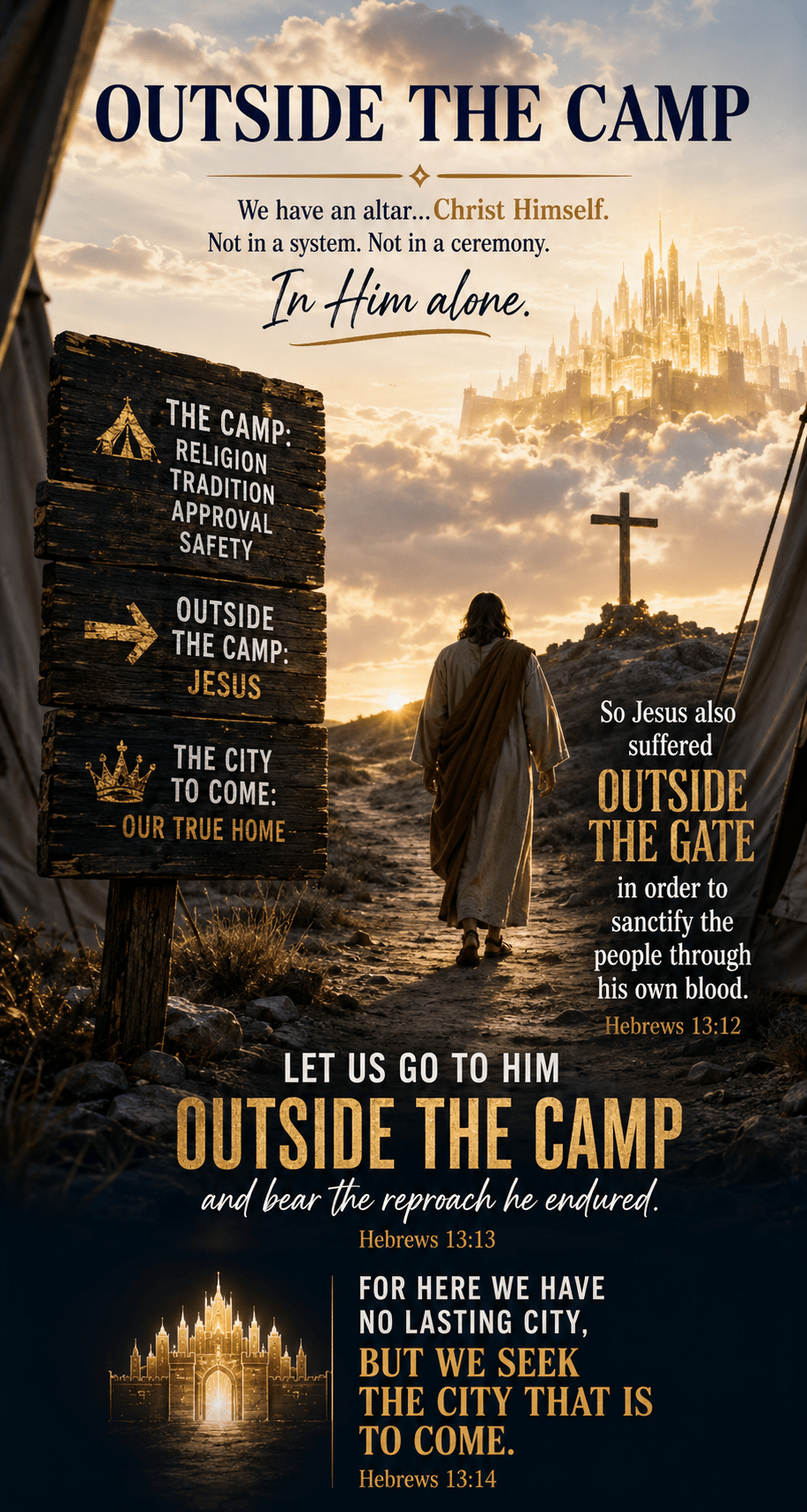
“So Jesus also suffered outside the gate in order to sanctify the people through his own blood. Therefore let us go to him outside the camp and bear the reproach he endured. For here we have no lasting city, but we seek the city that is to come.” — Hebrews 13:12–14 (ESV)
Devotional Thought
The book of Hebrews ends much the same way it began—by pointing us to the absolute sufficiency and superiority of Jesus Christ.
In these verses, the writer draws upon the imagery of the Day of Atonement. Under the Old Covenant, the blood of the sacrifice was brought into the Most Holy Place by the high priest, but the bodies of the animals were carried outside the camp and burned. Those sacrifices pointed forward to Christ. Just as those offerings were taken outside the camp, Jesus was led outside the gates of Jerusalem to suffer and die for the sins of His people.
The writer reminds us that “we have an altar” unlike any found in the tabernacle or temple. That altar is Christ Himself. He is our priest, our sacrifice, and our place of refuge. Those who continued to trust in the old ceremonial system after Christ came had no right to partake of what the sacrifices had always pointed toward. The shadows had served their purpose because the substance upon which those shadows were based had arrived in the person and actions of Jesus Christ.
This is one of the great themes of Hebrews. Salvation is not found in a religious system, a ceremony, a ritual, or even in a sacred place. Salvation is found in a Person. We do not come to an altar made of stone or wood. We come to Jesus Christ Himself.
But the writer does not stop there. He issues a challenge: “Let us go to him outside the camp.”
The camp represented acceptance, security, tradition, and belonging. To go outside the camp meant leaving behind the place where everyone else wanted to be. It meant identifying with the rejected One. Jesus was cast outside the city, treated as an outcast, mocked, condemned, and crucified. To follow Him means being willing to bear that same reproach.
The call remains the same today. Christians must be willing to leave behind anything that competes with Christ. We must abandon trust in religious performance, worldly approval, cultural acceptance, or earthly security. Following Jesus often means standing apart from the crowd. It means being identified with Him even when doing so brings criticism, misunderstanding, or rejection.
Why would we willingly do that?
Because this world is not our home.
The writer concludes, “For here we have no lasting city, but we seek the city that is to come.” Throughout Hebrews, believers are described as pilgrims, strangers, and exiles. We are passing through a temporary world while looking forward to an eternal kingdom. The cities of this world rise and fall. Nations come and go. Cultures change. Even Jerusalem itself would soon be destroyed. But the city God has prepared for His people will never pass away.
Christ suffered outside the camp to bring us into God’s eternal city. Therefore, let us gladly go to Him, bear His reproach, and fix our eyes on the home that awaits us.
Reflection Questions
- Are you trusting in Christ alone for salvation, or are you relying on religious activities and good works?
- What does it mean in your daily life to “go to Him outside the camp”?
- Have you ever experienced criticism or rejection because of your faith in Christ?
- How does remembering that this world is not your permanent home change the way you live today?
Closing Prayer
Heavenly Father, thank You for sending Jesus Christ to suffer in our place and sanctify us through His own blood. Help us to trust fully in Him and not in any religious system or human effort. Give us courage to follow Christ wherever He leads, even when it brings reproach or rejection. Remind us that this world is not our home and fix our hearts on the eternal city You have prepared for Your people. In Jesus’ name, Amen.


Leave a Reply