Scripture Focus
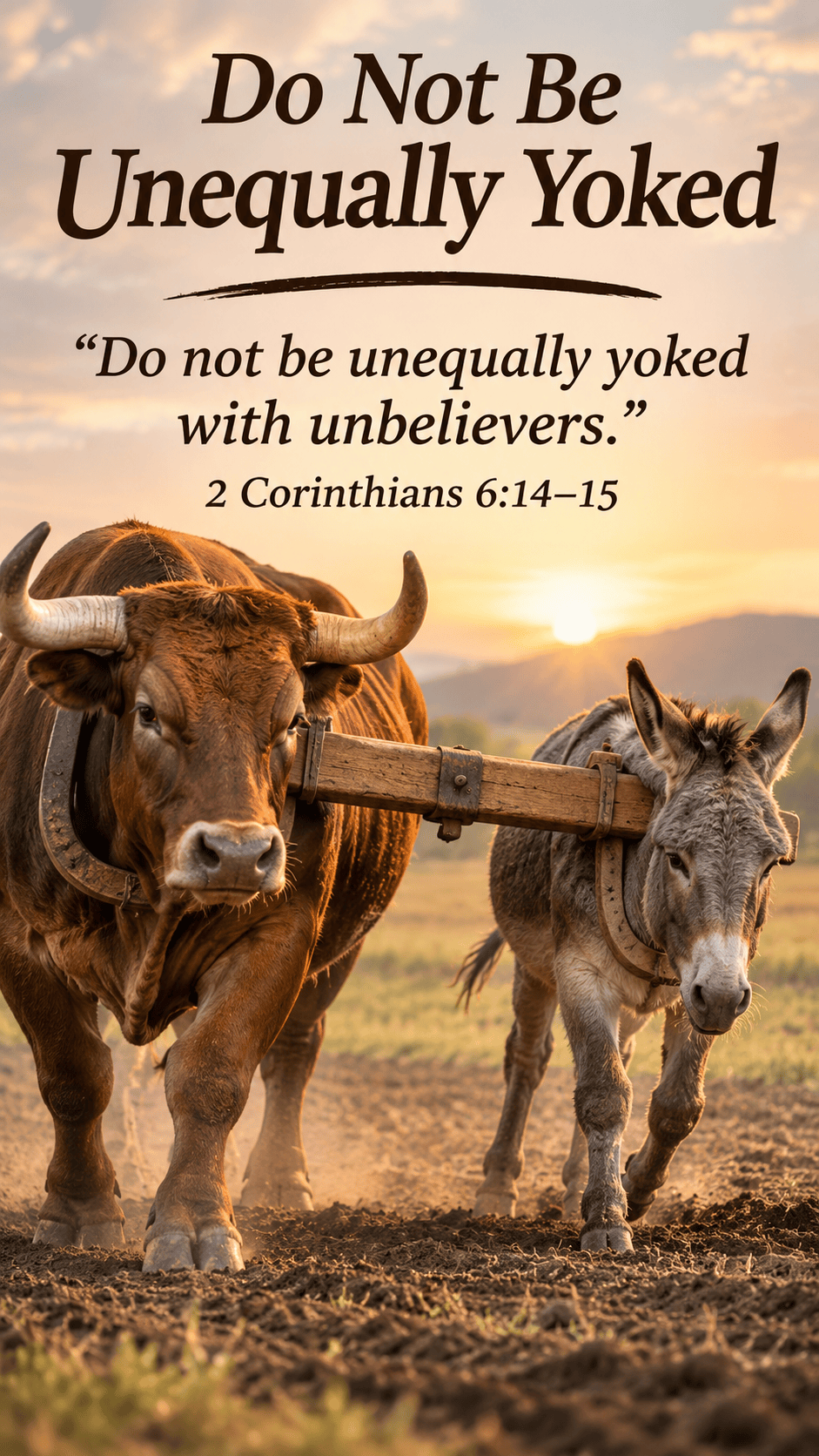
“Do not be unequally yoked with unbelievers. For what partnership has righteousness with lawlessness? Or what fellowship has light with darkness? What accord has Christ with Belial? Or what portion does a believer share with an unbeliever?” — 2 Corinthians 6:14–15 (ESV)
Devotional Thought
There are some truths in Scripture that are easier for us to accept than others. Some passages encourage us, comfort us, and remind us of God’s promises. Others challenge the way we think, the decisions we make, and even the relationships we maintain. This is one of those passages. In our modern society, Paul’s instruction not to be unequally yoked with unbelievers would almost certainly be considered politically incorrect. Some might even call it intolerant or judgmental. Nevertheless, the instruction is clear, and when we stop to consider what Paul is actually saying, it really ought to be a matter of common sense.
First, we need to understand what it means to be unequally yoked. In the agricultural world of Paul’s day, a yoke was a solid wooden device used to connect two animals together so they could pull a plow or perform some other kind of work. A wise farmer would choose two animals of similar size and strength because the whole purpose of the yoke was to combine their strength and allow them to work together efficiently. Imagine trying to yoke a large, powerful ox with a little donkey. The ox would be capable of pulling a tremendous load, while the donkey would struggle just to keep up. They might even attempt to move in different directions. Instead of accomplishing more together, they would spend much of their energy working against one another. The very thing intended to make their work easier would actually make it more difficult.
That’s the picture Paul wants us to see. Two individuals who are bound together in a close relationship or partnership need to be moving in the same direction, working toward the same goals, and operating according to the same priorities. Otherwise, instead of strengthening one another, they may continually find themselves pulling against each other.
But before we begin applying this instruction to our lives, we need to remember the context in which Paul was writing. Ancient Corinth was a city filled with pagan worship and religious practices that stood in direct opposition to the worship of the one true God. Aphrodite, the Greek goddess associated with love and beauty, had a prominent place in the city’s religious history, and temples dedicated to various gods and goddesses were part of the culture. The Christians in Corinth had come out of that environment, and many of them still had close connections with people who participated in those religious practices. Paul was warning believers against entering into relationships and partnerships that would draw them back into idolatry or require them to compromise their devotion to Christ.
Now, we need to be careful here. Paul is not telling Christians that they should have absolutely nothing to do with unbelievers. In fact, he had already addressed that very issue in 1 Corinthians 5:9–10, explaining that avoiding all contact with immoral people in the world would require believers to leave the world altogether! Jesus Himself regularly associated with tax collectors, sinners, and people who were far from God. How could we possibly fulfill the Great Commission if we refused to develop relationships with people who do not yet know Jesus Christ? We are called to be witnesses to the world, not to isolate ourselves from it.
The issue, then, is not simply whether we associate with unbelievers. The issue is whether we bind ourselves together with them in relationships or partnerships that require a shared spiritual direction, especially when those relationships could compromise our obedience to Christ.
Marriage is probably the most obvious example of this principle, even though marriage is not the specific subject Paul is addressing here. Over the years, I’ve often spoken with our young people about the importance of choosing a husband or wife who shares their faith in Jesus Christ. Sometimes young people don’t understand why that matters so much. They may think that as long as two people love each other, everything else will somehow work itself out. But marriage involves far more than romantic feelings. It involves two people building an entire life together, making decisions together, establishing priorities together, and, quite often, raising children together.
Think about the challenges that arise when one spouse is committed to following Jesus Christ and the other has no interest in spiritual things. One wants to be actively involved in church while the other sees church attendance as an unnecessary obligation. One believes that giving financially to the Lord’s work is an act of worship while the other considers it a waste of money. One wants to raise their children according to biblical principles while the other believes those principles are outdated or unnecessary. These aren’t necessarily small disagreements that can be easily overlooked. They concern the very foundation upon which a family is built. Like those two animals pulling against each other, the couple may find themselves struggling to move forward together because they are ultimately moving toward different destinations.
Of course, this does not mean that every marriage between a believer and an unbeliever is destined to fail, nor does it mean that a Christian who is already married to an unbeliever should leave that marriage. Paul specifically addresses that situation in 1 Corinthians 7:12–16, encouraging believers to remain with their unbelieving spouses when those spouses are willing to continue the marriage. The principle here is about the wisdom of the commitments we choose to make, not an excuse to abandon commitments we have already made.
But Paul’s instruction reaches beyond marriage. It applies to the close partnerships and relationships we establish throughout our lives. Think about business partnerships, close personal alliances, or even the people we choose to rely upon for our most important decisions. If one person is seeking to honor God in everything while the other is primarily concerned with personal success, financial gain, or worldly recognition, those differing priorities may eventually create serious conflict. What happens when doing the right thing becomes costly? What happens when obedience to God’s Word stands in the way of something the other person wants to accomplish? What happens when one partner believes that the end justifies the means while the other believes that honoring God is more important than achieving a particular result?
That doesn’t mean Christians cannot work alongside unbelievers, maintain meaningful friendships with them, or participate in ordinary business and community activities. It means we should exercise wisdom about the commitments we make and the influence we allow others to have over our spiritual direction. There is a tremendous difference between loving someone who doesn’t know Christ and allowing that person to lead us away from Christ.
I think there’s another important consideration here as well. As believers, our ultimate purpose is to glorify God and advance His Kingdom. We want our lives, our work, our resources, and our relationships to contribute to what God is doing in the world. When we partner closely with other believers who share that purpose, we can encourage one another, pray for one another, hold one another accountable, and seek God’s direction together. Rather than pulling against each other, we can combine our strength to accomplish things that neither of us could accomplish alone.
And that brings us back to the illustration of the yoke. The purpose of a yoke was never simply to keep two animals close together. It was to enable them to accomplish a common task. In the same way, the closest partnerships in our lives should help us become more faithful followers of Jesus Christ, not make that faithfulness more difficult.
There’s one final distinction I believe we need to make. Paul’s words are not an invitation for Christians to look down upon unbelievers or consider themselves better than anyone else. We need to remember that we, too, were once separated from God, and it was only by His grace that we were brought into a relationship with Jesus Christ. Our responsibility is to love unbelievers, share the Gospel with them, and demonstrate the character of Christ in our relationships with them. But loving someone does not require us to compromise our convictions or surrender the direction of our lives.
So, perhaps the question we need to ask ourselves is not simply, “Who are my friends?” but rather, “Who am I allowing to help determine the direction of my life?” Are the people closest to us encouraging us to walk more faithfully with Christ, or are we continually finding ourselves pulled away from Him?
We are called to love everyone, but we must be careful about whom we choose to be yoked together with. Our closest relationships and partnerships should strengthen our walk with Christ, encourage our obedience to His Word, and help us accomplish the purposes He has established for our lives.
After all, it’s much easier to move forward when we’re pulling in the same direction.
Reflection Questions
- What does Paul’s illustration of being unequally yoked teach us about the importance of shared priorities and spiritual direction in our closest relationships?
- Are there relationships or partnerships in your life that regularly pull you away from your commitment to Jesus Christ? If so, what changes might God be calling you to make?
- How can we maintain loving, meaningful relationships with unbelievers while still protecting our spiritual commitments and remaining faithful to God’s Word?
- Are the people who have the greatest influence in your life encouraging you to grow closer to Christ, or are they making it more difficult for you to follow Him?
Closing Prayer
Heavenly Father, thank You for the relationships You have placed in my life and for the people who have encouraged me, strengthened me, and helped me grow in my faith. Lord, give me wisdom to recognize the difference between loving others as You have commanded and allowing myself to be drawn into relationships or partnerships that lead me away from You. Help me never to look down upon those who do not know You, but instead to demonstrate Your love and grace in every interaction. At the same time, help me to choose my closest companions and partners wisely, surrounding myself with people who will encourage me to remain faithful to Your Word and Your purposes. May the relationships I build bring honor and glory to Your name, and may we work together to advance Your Kingdom. In Jesus’ name, Amen.


Leave a Reply