Scripture Focus
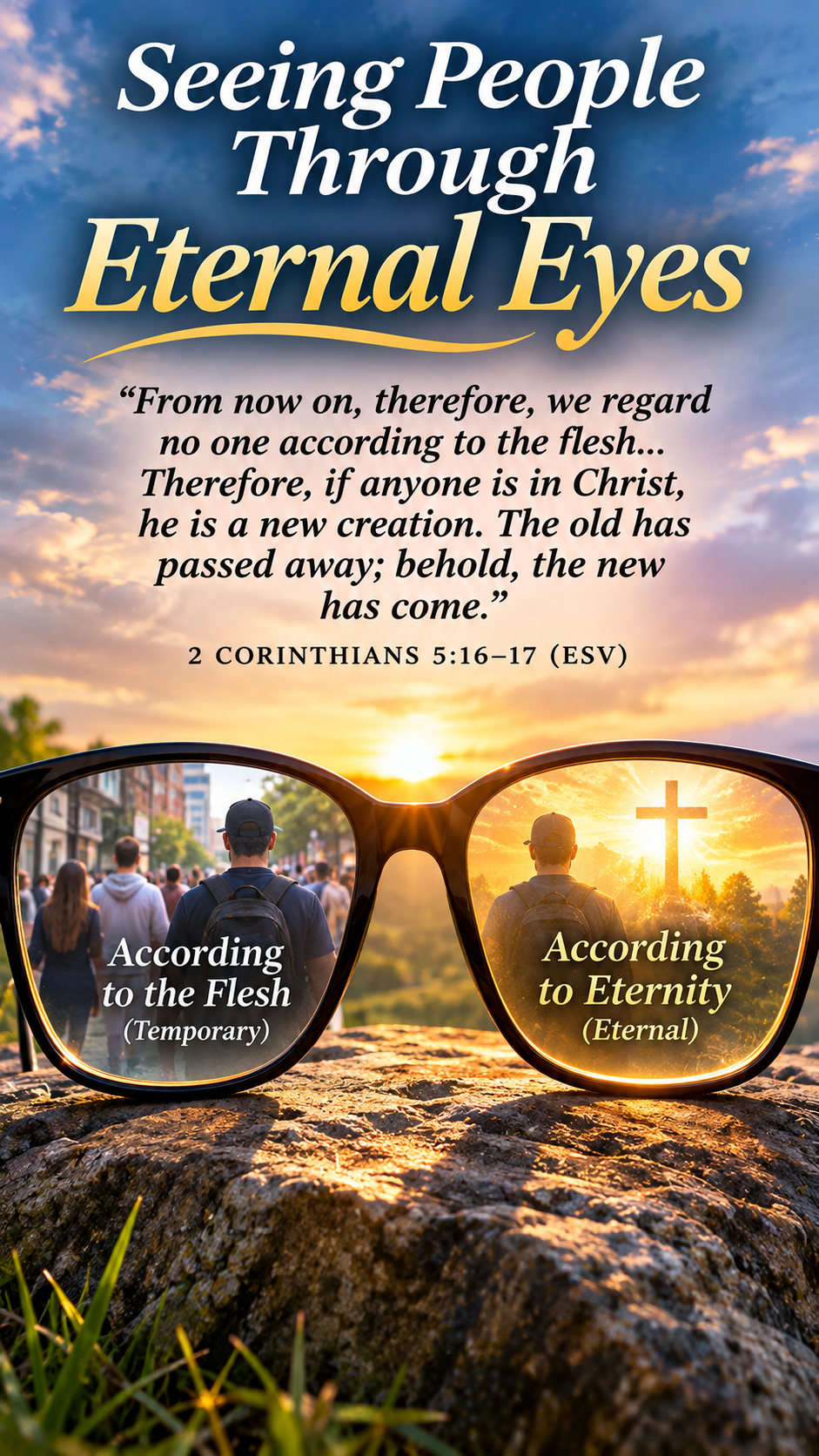
“From now on, therefore, we regard no one according to the flesh. Even though we once regarded Christ according to the flesh, we regard him thus no longer. Therefore, if anyone is in Christ, he is a new creation. The old has passed away; behold, the new has come.” — 2 Corinthians 5:16–17 (ESV)
Devotional Thought
Second Corinthians 5:17 is probably one of the most familiar verses in Paul’s second letter to the Corinthians. It’s a beautiful declaration of the transformation that takes place when someone places their faith in Jesus Christ. The old has passed away, and the new has come! We often use this verse when talking about salvation, and rightly so. But I wonder how often we stop to consider the verse that comes immediately before it. In verse 16, Paul makes a statement that helps us understand how the reality of becoming a new creation ought to change the way we interact with the people around us. He says, “From now on, therefore, we regard no one according to the flesh.” That’s a remarkable statement, and I believe it challenges us to reconsider the way we see practically everyone we encounter.
What does Paul mean when he says that he no longer regards anyone according to the flesh? He’s telling us that he no longer evaluates people merely from a worldly or human perspective. Before his encounter with Jesus Christ, Paul judged people according to outward appearances, religious backgrounds, accomplishments, and the standards of the world around him. He even viewed Jesus Christ from that perspective, regarding Him as someone whose followers needed to be stopped. But when Paul encountered the risen Christ on the road to Damascus, everything changed. He came to understand who Jesus truly was, and that completely transformed the way he viewed everyone else. He no longer saw people simply as the world saw them. He began to see them in light of eternity.
I think that’s something we desperately need to learn as followers of Jesus Christ. Every person we encounter is more than simply a physical body occupying space in this world. Every human being has a spiritual dimension to their existence. We are not merely flesh and blood. Our bodies are temporary, but our existence does not end when these earthly bodies die. Every person we meet has an eternal future, and that ought to change the way we think about them. When we look at someone, we shouldn’t see only the person standing in front of us. We should recognize that we’re interacting with someone who will exist forever. The person may not realize it, and they may not have given much thought to what happens after death, but their eternal future is no less real because they haven’t considered it.
Now, the Scriptures tell us that apart from Jesus Christ, we are spiritually dead. Paul explains this in Ephesians 2:1 when he writes, “And you were dead in the trespasses and sins.” That’s an important distinction because it means that although every person possesses an eternal soul, not everyone possesses the spiritual life that comes through faith in Jesus Christ. Apart from Him, we are separated from God by our sins. We may be physically alive, going about our daily activities, pursuing our goals, and enjoying the things this world has to offer, but spiritually we remain dead until Christ gives us new life. That’s precisely why verse 17 is such wonderful news. When someone comes to Christ, something miraculous happens. God doesn’t simply improve the old person or help them become a slightly better version of themselves. He makes them a new creation!
But here’s where I think we often miss the practical application of these verses. It’s remarkably easy for us to become so focused on the physical world that we forget about the eternal realities surrounding us. We spend our days working, shopping, eating, talking, and attending to the countless responsibilities that demand our attention. We interact with family members, friends, coworkers, neighbors, and even complete strangers. We talk about the weather, sports, politics, our jobs, our families, and whatever else happens to be on our minds. None of those conversations is necessarily wrong. They’re simply part of living in this world. But how often do we stop to consider the eternal condition of the person with whom we’re speaking?
And if it’s difficult for believers to maintain an eternal perspective, imagine how difficult it must be for those who don’t know Jesus Christ. Actually, we shouldn’t have to imagine very hard, because every one of us was once in that same condition. Before we came to Christ, we were spiritually dead, just as Paul describes in Ephesians 2. We lived according to the things we could see, hear, touch, and experience. We pursued the things of this world because, from our perspective, those were the things that mattered most. It was only when God opened our eyes to the truth of the Gospel that we began to understand that there was something infinitely more important than the temporary things occupying our attention.
Paul learned to look beyond the outward appearance of the people he encountered and consider their eternal condition. He understood that every person he met was someone who needed Jesus Christ. Some had already experienced the transforming power of the Gospel, while others remained spiritually dead and separated from God. But regardless of their circumstances, Paul recognized that their eternal future mattered. He wasn’t interested merely in making people more comfortable in this temporary world. He wanted them to experience the new life that only Jesus Christ could provide.
I wonder how different our daily interactions would become if we learned to see people that way. What if, when we encountered someone who was rude, impatient, or difficult, we stopped thinking only about their behavior and considered their spiritual condition? What if, instead of seeing someone merely as a customer, a coworker, a neighbor, or a stranger, we saw them as a person with an eternal soul? What if we began asking ourselves whether the people we encounter know Jesus Christ and, if they don’t, whether God might use us to help them come to know Him?
Consider this illustration. Imagine going to your doctor for a routine appointment. The doctor has ordered some tests, and the results have just come back. Unfortunately, those results reveal that you have a terminal illness. Your doctor knows that unless something is done, your condition will eventually take your life. But instead of discussing the diagnosis with you, he spends the entire appointment talking about your new car. He asks about the gas mileage, the features, and how much you enjoy driving it. You have a pleasant conversation, and perhaps you even leave feeling pretty good about the appointment. But the doctor never mentions the test results. He never tells you about the illness or discusses what might be done to treat it.
Would you consider that doctor to have done his job? Of course not! He may have been friendly, courteous, and enjoyable to talk with, but he neglected the most important responsibility he had toward you. He knew something about your condition that you desperately needed to know, and he failed to tell you.
I wonder how often we do something similar in our relationships with people who don’t know Jesus Christ. We may be friendly, kind, generous, and helpful. We may assist them with their physical needs, encourage them when they’re discouraged, and do everything we can to make their lives a little better. And let me be clear: those are good things! Jesus Himself demonstrated compassion for people’s physical needs, and He calls us to do the same. But if we never consider their spiritual condition, if we never share the truth about Jesus Christ and the eternal life He offers, haven’t we neglected something far more important?
We can help someone become more comfortable in this temporary world while never telling them about the eternal life they so desperately need. We can spend years talking with someone about everything under the sun and never once have a meaningful conversation about their relationship with God. And sometimes the reason is simply that we’ve forgotten to see them from an eternal perspective.
Now, that doesn’t mean every conversation must immediately become a presentation of the Gospel. It doesn’t mean we should treat people as projects or disregard their physical and emotional needs. Genuine love requires us to care about the whole person, and sometimes meeting a practical need is precisely how God opens the door for a deeper conversation. But it does mean that we should never lose sight of what matters most. We should be looking for opportunities to point people toward Jesus Christ, recognizing that their eternal future is far more important than anything this temporary world has to offer.
And here’s something else we need to remember. Seeing people through eternal eyes is an intentional decision. It doesn’t necessarily happen automatically, even after we’ve become new creations in Christ. We still live in physical bodies, surrounded by a physical world that constantly demands our attention. If we’re not careful, we’ll simply default to seeing people the way everyone else sees them. We’ll evaluate them according to their appearance, their behavior, their social standing, their political opinions, or how they treat us. We’ll become so occupied with the things we can see that we forget about the eternal realities we cannot see.
That’s why Paul’s words in verse 16 are so important. He says, “From now on.” In other words, something has changed. Because of what Jesus Christ has done, and because of the new life we have received through Him, we can no longer afford to view people merely according to the flesh. We must learn to see them from an eternal perspective.
And that brings us back to verse 17. “Therefore, if anyone is in Christ, he is a new creation. The old has passed away; behold, the new has come.” This is not simply a wonderful promise about what God has done in our lives. It’s also the very transformation we should desire for the people around us. We know what it means to have been spiritually dead and then made alive in Christ. We know the joy of forgiveness, the assurance of salvation, and the hope of eternal life. And because we know these things, we ought to want others to experience them as well.
The people we encounter every day are not merely temporary acquaintances passing through our lives. They are eternal souls who need the life that only Jesus Christ can give. Some may already know Him, and others may be waiting for someone to tell them the Good News. We may never know how God intends to use a simple conversation, an act of kindness, or a word of encouragement to open someone’s heart to the truth of the Gospel.
But one thing is certain. If we never learn to see people through eternal eyes, we may never recognize those opportunities when they come.
When Christ makes us a new creation, He doesn’t just change who we are. He changes the way we ought to see everyone else.
Reflection Questions
- When you interact with people throughout your day, do you tend to see them primarily from a worldly perspective, or do you consider their eternal spiritual condition?
- How does remembering that you were once spiritually dead apart from Christ affect the way you view those who do not yet know Him?
- Are there people in your life whose physical or temporary needs you’ve been attentive to, but whose spiritual needs you may have overlooked?
- What intentional changes could you make in your daily life to become more aware of opportunities to share the hope of Jesus Christ with others?
Closing Prayer
Heavenly Father, thank You for the new life You have given us through Jesus Christ. We praise You because we were once spiritually dead in our sins, but through Your grace and mercy, You have made us new creations in Christ. Forgive us for the times when we’ve become so focused on the temporary things of this world that we’ve forgotten about the eternal needs of the people around us. Help us to see others as You see them, not merely according to their outward appearance, their behavior, or their circumstances, but as people with eternal souls who desperately need Your love and salvation. Give us hearts filled with compassion, eyes that recognize opportunities to share the Gospel, and the courage to speak the truth in love. Help us to be faithful in meeting the physical needs of others while never neglecting their greatest need, which is to know Jesus Christ. May our lives reflect the transformation You have accomplished within us, and may You use us to help others discover the new life that is found only in Your Son. In Jesus’ name we pray, Amen.


Leave a Reply