Scripture Focus
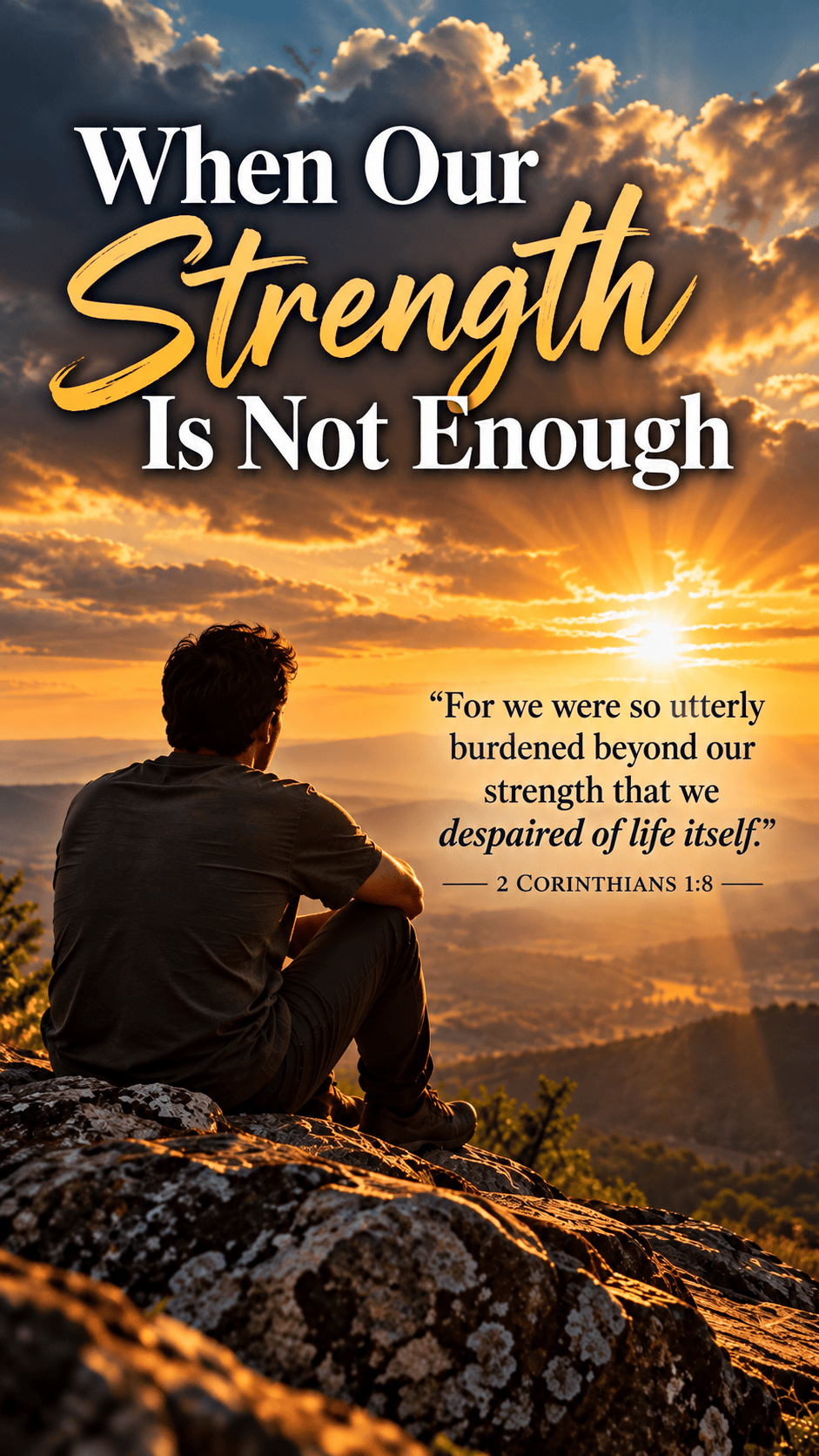
“For we do not want you to be unaware, brothers, of the affliction we experienced in Asia. For we were so utterly burdened beyond our strength that we despaired of life itself. Indeed, we felt that we had received the sentence of death. But that was to make us rely not on ourselves but on God who raises the dead. He delivered us from such a deadly peril, and he will deliver us. On him we have set our hope that he will deliver us again.” — 2 Corinthians 1:8–10 (ESV)
Devotional Thought
This part of Paul’s testimony is amazing to me. And I suspect this passage may be especially meaningful to someone reading these words today who is going through an incredibly difficult time. I’ll admit that although I’ve faced my share of trials as a believer, I’ve never experienced anything so overwhelming that I despaired of life itself. But I know there are people reading this who have. Some of you have walked through circumstances so painful, so frightening, or so exhausting that you genuinely wondered how you could possibly go on. Perhaps we can learn something together from Paul’s experience. And perhaps, as we examine his testimony, we might even begin to understand something about God’s purposes in the difficulties we face.
We aren’t entirely certain which experience Paul is describing here. We can read through the book of Acts and identify several possibilities. One possibility is the riot in Ephesus recorded in Acts 19. A silversmith named Demetrius, who made silver shrines of the goddess Artemis, became increasingly concerned about the influence of Paul’s ministry. After all, when people abandoned their idols to follow Jesus Christ, that wasn’t particularly good for the idol-making business! Demetrius stirred up the other craftsmen, and before long, the city was in an uproar. Paul’s companions were dragged into the theater, and the situation became extremely dangerous. It’s possible that Paul is referring to this episode, although Scripture doesn’t tell us for certain. There were certainly plenty of other occasions when Paul’s faithfulness to Christ brought him face-to-face with violent opposition.
But what catches my attention isn’t so much the particular event as Paul’s description of what he experienced. He says they were “so utterly burdened beyond our strength that we despaired of life itself.” Think about that for a moment. This is the apostle Paul! This is the man who boldly proclaimed the gospel before hostile crowds, endured beatings and imprisonment, and continued preaching Christ despite tremendous opposition. Yet here he openly admits that he reached a point where the burden was more than he could bear. I don’t believe Paul is being overly dramatic. I believe he’s simply being honest. And there’s an important lesson for us in that honesty.
God doesn’t expect His children to put on a happy face and sing “Kum Ba Yah” when life is falling apart around them. We aren’t required to pretend that everything is wonderful when we’re hurting. We don’t have to sugarcoat our feelings or hide our struggles from God. After all, who do we think we’re fooling? We might fool other people. We might even manage to fool ourselves for a while. But we’re certainly not fooling God. He already knows what we’re experiencing, what we’re thinking, and how deeply we’re hurting. Paul’s honesty reminds me of the Psalms of David. David never seemed particularly interested in pretending that everything was fine when it wasn’t. He cried out to God in fear, frustration, sorrow, and even despair. Yet again and again, those cries eventually brought him back to the faithfulness of the God he trusted. And that’s exactly where Paul takes us in this passage.
Notice what Paul says about the purpose of this particular trial: “But that was to make us rely not on ourselves but on God who raises the dead.” Isn’t that remarkable? Paul recognized that his circumstances had brought him to the end of his own strength. He had reached a place where his abilities, experience, determination, and personal resources were simply not enough. And perhaps that was precisely the lesson he needed to learn. Sometimes God allows us to face circumstances that expose the limitations of our own strength. We discover that we cannot fix everything, control every outcome, or overcome every obstacle through sheer determination. And in those moments, we are reminded of something we should have understood all along. We were never meant to depend entirely upon ourselves.
Now, I don’t believe we should assume that every painful experience is God’s way of teaching us a particular lesson. We live in a fallen world where suffering is a reality, and we won’t always understand why certain things happen. But God is certainly able to use even our most difficult circumstances to deepen our dependence upon Him. And sometimes the lessons we learn in one season of life prepare us for challenges we haven’t even encountered yet. Paul understood that his suffering had accomplished something valuable in his relationship with God. It had reminded him that his security was never found in his own strength, but in the power and faithfulness of the One he served.
But notice something else in Paul’s statement. He doesn’t simply say that they learned to depend upon God. He describes Him as “God who raises the dead.” I don’t believe that description is accidental. Paul and his companions had apparently faced circumstances in which death seemed like a very real possibility. Yet Paul understood that even if those circumstances had ended with their deaths, they would still have been in the hands of a faithful God. Why? Because they served the God who raises the dead! Physical death is not an obstacle that God cannot overcome. The resurrection of Jesus Christ has forever changed what death means for those who belong to Him.
For the believer, death is not the end of life. In a sense, it’s more like graduation. We leave behind this temporary existence and enter into the eternal life Christ has secured for us. Now, that doesn’t mean we should wish for death or become careless about preserving life. Paul certainly wasn’t eager to die in the circumstances he describes here. But it does mean that death itself does not have the final word over those who belong to Jesus Christ. Our hope reaches beyond the boundaries of this present life because our Savior has already conquered the grave. And if God has the power to raise the dead, then surely we can trust Him with whatever circumstances we face today.
And that brings us to Paul’s final declaration: “He delivered us from such a deadly peril, and he will deliver us. On him we have set our hope that he will deliver us again.” Paul looked backward and remembered God’s faithfulness. He looked at his present circumstances and trusted God’s care. And he looked toward an uncertain future with confidence in the One who held that future in His hands. Notice that Paul’s confidence wasn’t rooted in his own strength. In fact, he had already admitted that his strength was insufficient. His confidence was rooted entirely in God. He had seen God’s hand at work in the past, and that gave him every reason to continue trusting Him with whatever the future might bring.
And that’s where I believe this passage speaks so powerfully to us today. Perhaps you’re facing something right now that feels completely overwhelming. Maybe you’ve exhausted every possibility you can think of. You’ve prayed, you’ve worked, you’ve worried, and you’ve done everything within your power to make things better. Yet the burden remains. You may even feel guilty because you think a person with strong faith shouldn’t struggle this much. But remember Paul’s testimony. Even the apostle Paul reached a point where he was burdened beyond his strength. The lesson isn’t that genuine faith prevents us from feeling overwhelmed. The lesson is that when our strength is not enough, God’s strength has not diminished. And when we don’t understand what God is doing, we can still trust who God is.
I cannot promise that God will remove every difficulty you face. Sometimes He delivers us from the trial. Sometimes He sustains us through it. And sometimes our ultimate deliverance comes when we finally stand in His presence. But I can promise you this: God has not forgotten you. He is not unaware of your suffering, and He is not indifferent to your cries for help. If you belong to Jesus Christ, your ultimate future is already secure. Through His death and resurrection, Christ has conquered sin and death, and nothing you face can undo the salvation He has accomplished for you. That doesn’t mean life will always be easy, but it does mean that our hope is anchored in something far greater than our present circumstances.
So when your strength is exhausted, don’t be afraid to admit it. Cry out to God honestly. Remember what He has already done, and place your hope in the One who raises the dead. You don’t have to pretend to be stronger than you are, and you don’t have to carry every burden as though everything depends upon you. The same God who sustained Paul through his darkest moments is the God who holds you in His hands today. Your strength may not be enough. But the God in whom you trust is more than enough.
Reflection Questions
- Have you ever faced a situation that left you feeling completely overwhelmed or beyond your own strength? How did that experience affect your relationship with God?
- Paul recognized that his suffering taught him to rely on God rather than himself. Are there areas of your life where you are still depending more upon your own abilities than upon God’s faithfulness?
- How does remembering that we serve “God who raises the dead” change the way you view suffering, uncertainty, and even death itself?
Closing Prayer
Heavenly Father, thank You that Your strength is never exhausted, even when mine is. Forgive me for the times I have depended upon my own abilities instead of trusting You. When life becomes overwhelming, help me to remember that You already know my struggles and that I can come before You honestly with every fear, disappointment, and burden. Teach me to depend upon You more fully, and remind me of Your faithfulness when I cannot see what lies ahead. Thank You for the hope we have through the resurrection of Jesus Christ, knowing that even death itself cannot separate us from Your love. Help me to rest in that promise today and every day. In Jesus’ name, Amen.


Leave a Reply