Scripture Focus
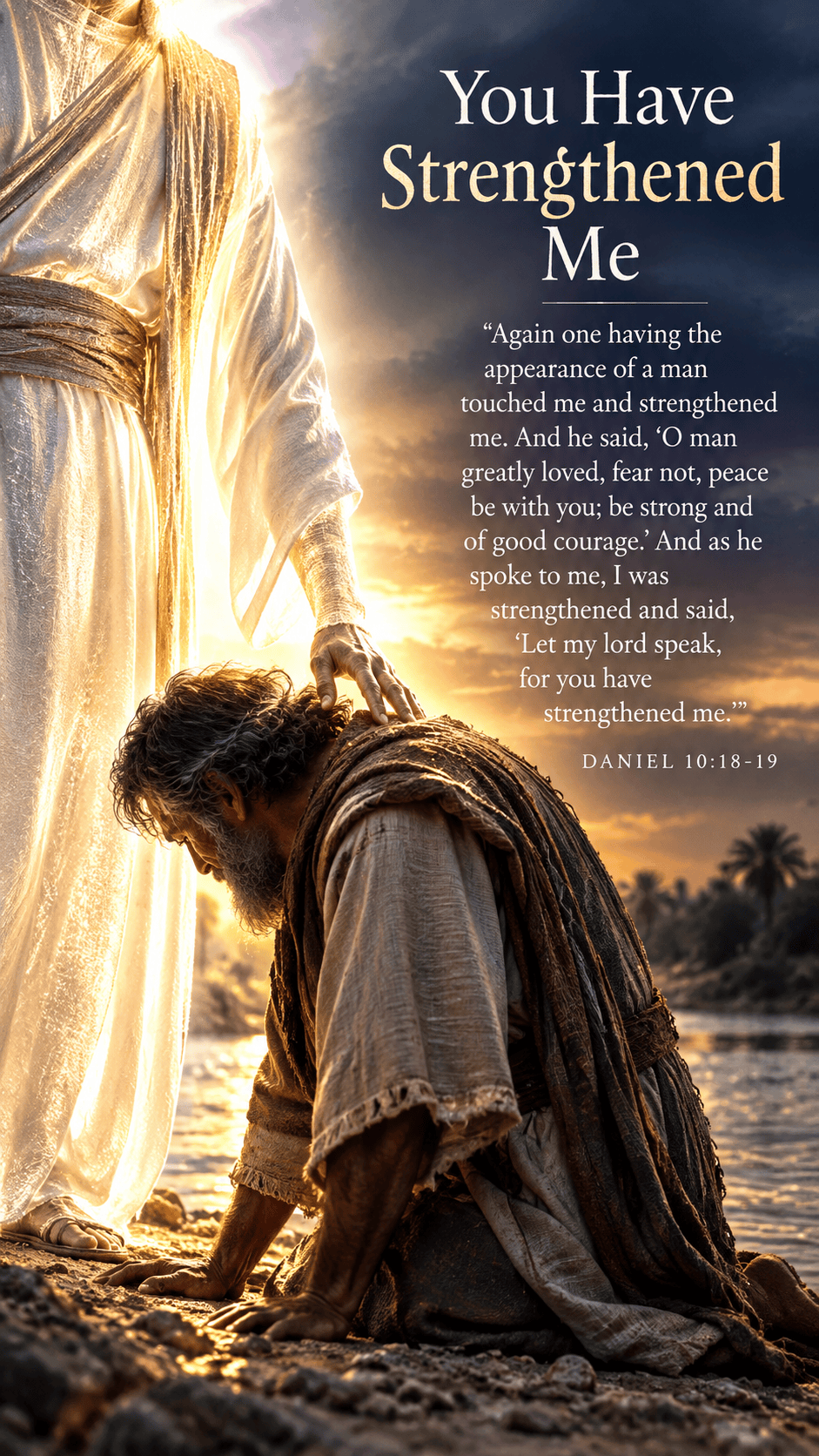
“Again one having the appearance of a man touched me and strengthened me. And he said, ‘O man greatly loved, fear not, peace be with you; be strong and of good courage.’ And as he spoke to me, I was strengthened and said, ‘Let my lord speak, for you have strengthened me.’” — Daniel 10:18–19 (ESV)
Devotional Thought
As we arrive at Daniel 10, we are introduced to the final vision recorded in this remarkable book. The vision itself will unfold through the remaining chapters, but here Daniel describes the circumstances surrounding its arrival and the extraordinary encounter that prepared him to receive it.
Daniel tells us that he had spent three weeks mourning and fasting, eating no delicacies, meat, or wine. He had humbled himself before God, seeking understanding. Then, while standing on the bank of the Tigris River, he looked up and saw a man clothed in linen, whose appearance was unlike anything we would ordinarily associate with a human being. Daniel describes his body as being like beryl, his face like lightning, his eyes like flaming torches, and his arms and legs like gleaming bronze. His voice sounded like that of a multitude.
Interestingly, Daniel tells us that the men who accompanied him did not see the vision, but they were nevertheless overcome with trembling and fled to hide themselves. I’m reminded of Paul’s encounter with the risen Christ on the road to Damascus. Those traveling with Paul experienced something extraordinary, but the revelation was directed specifically to him.
Now, as I’ve read several commentaries on this passage, and even a sermon by Charles Spurgeon in preparation for this devotional (and reading a sermon by Spurgeon is always a good thing), I’ve realized that one of the questions that immediately captures our attention is this: Who is this glorious man who appears to Daniel?
That was initially my question as well. Our curiosity naturally draws us toward this extraordinary figure, and there’s little doubt that his appearance is one of the most remarkable features of the chapter. Matthew Henry and John Gill both identified this figure as the preincarnate Christ, and they made comparisons with John’s vision of the glorified Christ in Revelation 1:12–16. Those similarities are certainly compelling. John Calvin, however, understood the figure to be a glorious angel appearing in the form of a man. Spurgeon strongly favored identifying him as Christ, but he acknowledged that the central truth of his sermon remained valid even if the figure was an angel.
I think there’s wisdom in recognizing that faithful interpreters have reached different conclusions on this question. Scripture does not explicitly identify the man, and I don’t believe we need to insist upon an answer where the text doesn’t provide one. In fact, whether this glorious figure is the preincarnate Christ or an angel sent from heaven, I don’t believe his identity is the primary point Daniel is communicating in this chapter.
We’re not yet given the details of the final vision. Instead, we’re shown Daniel’s condition as he prepares to receive it. And the more closely I examine this chapter, the more I’m struck by one particular observation: Daniel was simply not strong enough to bear what was being revealed to him.
Look at all the ways Daniel describes his weakness. He had been mourning and fasting for three weeks. When the glorious figure appeared, Daniel’s strength left him, his appearance changed, and he fell into a deep sleep with his face toward the ground. When a hand touched him, he managed to rise to his hands and knees, but he was still trembling. He was eventually helped to his feet, yet he continued to tremble. Later, he found himself unable to speak. When his lips were touched and he could finally respond, he could only describe his anguish and the complete absence of strength within him.
Finally, in verse 17, Daniel asks, “How can my lord’s servant talk with my lord? For now no strength remains in me, and no breath is left in me.”
Think about who is speaking here. This is Daniel! This is the man who had faithfully served God through decades of captivity. He had stood before powerful kings, interpreted dreams, witnessed the rise and fall of kingdoms, and survived a night in a den of lions. He had demonstrated extraordinary wisdom, courage, and faithfulness throughout his life. Yet here he stands, unable even to speak without assistance.
What man is sufficient for this kind of thing? The answer is that no man is sufficient in himself to carry forth the message and purposes of God. Not even Daniel, a man whom the heavenly messenger twice describes as “greatly loved.”
And that brings us to the beautiful truth found in our Scripture focus. Daniel tells us that one having the appearance of a man touched him and strengthened him. Then the messenger spoke words of reassurance: “O man greatly loved, fear not, peace be with you; be strong and of good courage.”
Notice what happens next. Daniel says, “And as he spoke to me, I was strengthened.” Isn’t that remarkable? Daniel wasn’t simply commanded to be strong and then left to find that strength somewhere within himself. As the words were spoken, the strength he needed was supplied. The command to be strong was accompanied by the very strength necessary to obey it.
And Daniel recognized exactly where that strength had come from. He responded, “Let my lord speak, for you have strengthened me.” Daniel didn’t say that he had finally gathered enough courage to continue. He didn’t suggest that his years of experience had prepared him to handle this extraordinary encounter. He acknowledged that the strength he now possessed had been given to him.
And what is our conclusion? God provides the strength His servants need to fulfill the calling He has given them. If He calls us to stand and speak, He can give us the strength to stand and the words to speak. If He calls us to take the gospel to the nations, He is able to equip us for that task. If He calls us to serve faithfully in circumstances that seem far beyond our abilities, we can trust Him to supply what we lack.
I think we sometimes make the mistake of believing that God calls people because they already possess the strength, wisdom, or abilities necessary to accomplish His purposes. But Scripture repeatedly demonstrates something quite different. God calls ordinary, imperfect, and often painfully inadequate people to accomplish things that could never be achieved through human strength alone.
His mercy moves Him toward us, and our responsibility is to respond in faith and obedience. Our sufficiency has never been found in ourselves, but in the God who calls us. In fact, it seems that God often accomplishes His greatest work through those who recognize just how weak they really are. When we stop depending upon our own abilities, we begin to understand what it means to depend entirely upon Him.
I’m reminded of Paul’s words in 2 Corinthians 12:9, when the Lord told him, “My grace is sufficient for you, for my power is made perfect in weakness.” Paul learned that his weakness was not an obstacle to God’s power. It was an opportunity for that power to be displayed. And I think Daniel wants us to understand something similar. We tend to remember Daniel as a great man of faith, and rightly so. But perhaps we need to put his greatness out of our minds for a moment and remember that he was still a man. He was weak. He was overwhelmed. He was completely incapable of fulfilling what God had appointed for him without divine assistance.
And God gloriously provided the strength he needed. The same God who strengthened Daniel is the God we serve today. Whatever He has called us to do, we need not pretend that we are sufficient for the task. We can acknowledge our weakness, trust His provision, and move forward in obedience. After all, the strength necessary to accomplish God’s purposes has never depended upon how strong we are.
It depends upon how strong He is.
Reflection Questions
- Have you ever felt overwhelmed or inadequate when facing something you believed God had called you to do? How did you respond to those feelings?
- Why do you think we sometimes place so much confidence in our own abilities rather than depending upon the strength God provides?
- How does Daniel’s admission of weakness, even after so many years of faithful service, encourage you in your own walk with God?
- What is one area of your life where you need to stop relying upon your own strength and trust God to provide what you lack?
Closing Prayer
Heavenly Father, thank You for reminding me that I was never meant to accomplish Your purposes through my own strength. Forgive me for the times I’ve depended upon my own wisdom and abilities rather than trusting You. Like Daniel, I must acknowledge that I am weak and often overwhelmed by the things before me. But I am grateful that Your strength is not limited by my weakness. Help me to hear Your voice, trust Your promises, and respond in faithful obedience to whatever You have called me to do. When I feel inadequate, remind me that Your grace is sufficient and that Your power is made perfect in weakness. May everything I accomplish bring glory to You rather than to myself. In Jesus’ name, Amen.


Leave a Reply