Scripture Focus
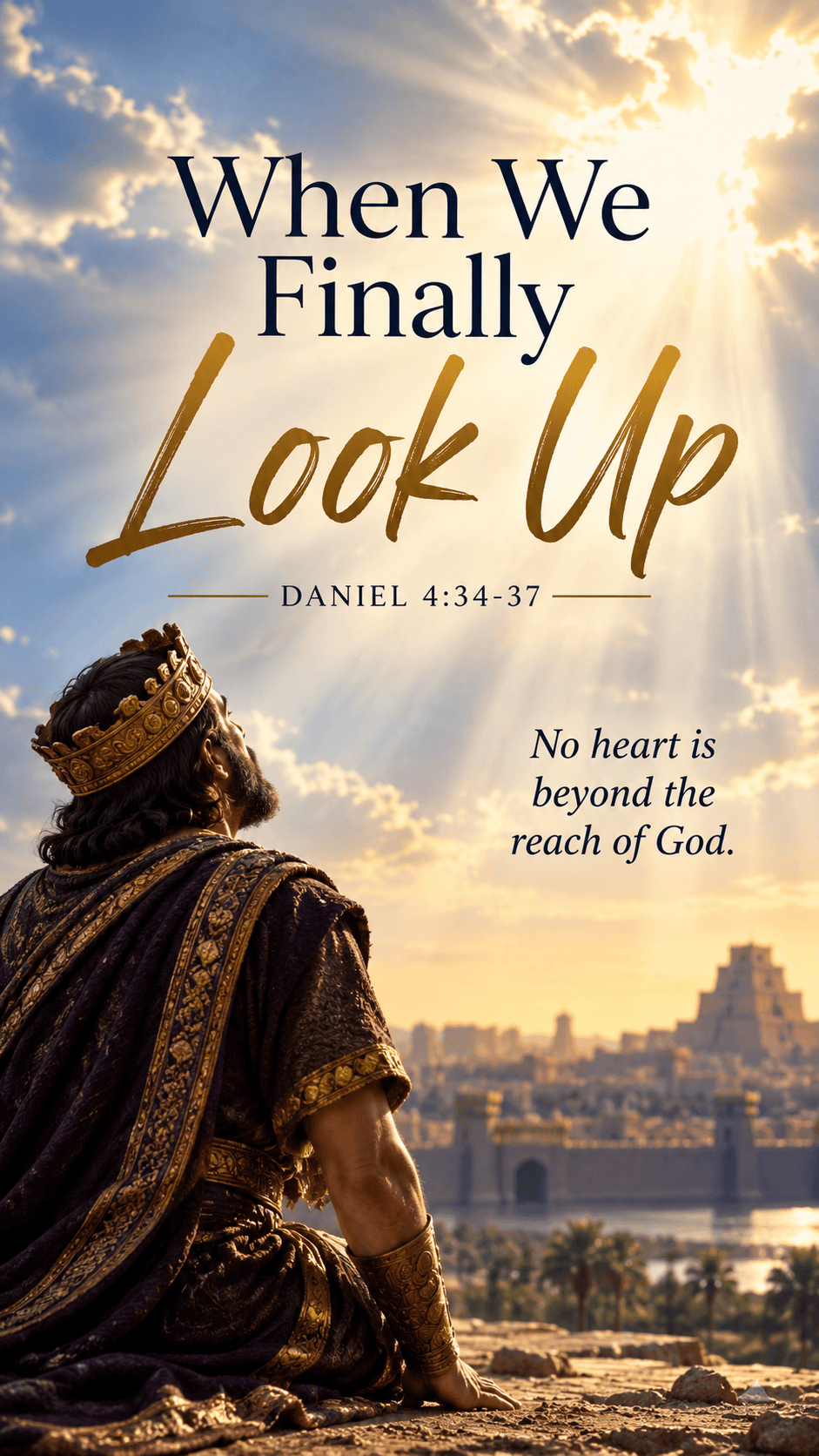
“At the end of the days I, Nebuchadnezzar, lifted my eyes to heaven, and my reason returned to me, and I blessed the Most High, and praised and honored him who lives forever, for his dominion is an everlasting dominion, and his kingdom endures from generation to generation; all the inhabitants of the earth are accounted as nothing, and he does according to his will among the host of heaven and among the inhabitants of the earth; and none can stay his hand or say to him, ‘What have you done?’ At the same time my reason returned to me, and for the glory of my kingdom, my majesty and splendor returned to me. My counselors and my lords sought me, and I was established in my kingdom, and still more greatness was added to me. Now I, Nebuchadnezzar, praise and extol and honor the King of heaven, for all his works are right and his ways are just; and those who walk in pride he is able to humble.” — Daniel 4:34–37 (ESV)
Devotional Thought
Well, it just wouldn’t be right to spend multiple devotionals talking about the wickedness and foolishness of Nebuchadnezzar and then skip over the part where he finally gets something right. Just for review, this is the man who defeated Judah, carried Hebrews away into exile, tried to assimilate them into Babylonian culture, threatened to tear his wise men limb from limb, created a golden statue and demanded its worship, threw three faithful men into a fiery furnace, and stood on the roof of his palace bragging about his own greatness before eventually grazing in a field like an ox. He hasn’t exactly looked good or wise in these devotionals. By this point in Daniel, we might even be tempted to conclude, “This man is never going to change.”
But then we come to Daniel 4:34: “I, Nebuchadnezzar, lifted my eyes to heaven.” What a contrast from the man we saw only a few verses earlier! On the rooftop, Nebuchadnezzar looked across Babylon and saw his kingdom, his mighty power, and his majesty. Now he looks up, and his testimony is no longer about his own greatness but about the greatness of the Most High. Instead of boasting about himself, he blesses God and praises and honors the One “whose dominion is an everlasting dominion.” By verse 37, the man who once demanded worship for an image he had created is saying, “I, Nebuchadnezzar, praise and extol and honor the King of heaven.” That is quite a transformation.
We should probably be careful about claiming more than the text actually tells us. Daniel doesn’t give us every detail we might like to know about Nebuchadnezzar’s spiritual condition or his ultimate salvation. But what the text does show us is remarkable enough: this proud pagan king has been humbled, he has acknowledged God’s sovereignty, and he is praising and honoring the King of heaven. And that tells us something beautiful about God that I hope will encourage us. No human heart is beyond God’s reach.
Verse 36 tells us that Nebuchadnezzar’s reason returned to him, his counselors and lords sought him out, he was reestablished in his kingdom, and “still more greatness was added” to him. The God who humbled Nebuchadnezzar was also able to restore him. God’s purpose in humbling this king wasn’t merely to knock him down. Through everything that happened, Nebuchadnezzar was finally brought to the place where he looked away from himself and toward heaven. Sometimes the grace of God comes to us in ways we would never have chosen for ourselves, but God knows exactly what is necessary to turn our eyes back toward Him.
Now I want us to think about two different people in relation to Nebuchadnezzar. First, think about yourself and your own failures. Have you ever thought, God can’t forgive me. I’ve sinned too much. I’ve failed Him too many times. I don’t deserve another opportunity? Well, look at Nebuchadnezzar. And while you’re at it, look throughout Scripture. The Bible is filled with people who failed miserably and discovered the mercy of God. Of course we don’t deserve forgiveness—that’s why we call it grace. We should never allow our unworthiness to become an excuse for refusing to return to the God who invites sinners to come to Him for mercy. Jesus said, “whoever comes to me I will never cast out” (John 6:37).
Now think about someone else. Maybe there is a person you know who has spent years—or perhaps most of a lifetime—living in rebellion against God, pursuing his or her own desires with seemingly no interest in repentance. Maybe you’ve prayed for that person so long that you’ve begun to wonder whether anything will ever change. You may even have caught yourself thinking, There is no hope for him, or She will never turn to God. If so, take another look at Nebuchadnezzar. If we had stopped reading his story a few verses early, we might have said exactly the same thing about him. And while you’re looking at Nebuchadnezzar, remember your own story. If God could reach you and redeem you, don’t decide that someone else is beyond His reach. Jesus Christ has paid the debt of all who will believe, and there is no sinner so powerful, proud, rebellious, or hardened that God is somehow powerless to reach him.
So there is hope for you in your failures, and there is hope for the person you’ve nearly given up praying for. Our responsibility is to keep looking toward heaven ourselves, keep praying for those who don’t yet know Christ, and keep speaking the truth of the gospel. We don’t know when God may use His Word, His people, His discipline, or circumstances we could never have anticipated to humble a heart and turn someone’s eyes toward Him.
After four chapters of Nebuchadnezzar, perhaps his final words are the best way to leave him: “Those who walk in pride he is able to humble.” Nebuchadnezzar knew that wasn’t merely a theological statement. He had lived it.
Never assume you are beyond the grace of God, and never assume someone else is beyond His reach. We may be amazed by what God can do when someone finally looks up.
Reflection Questions
- Have you ever allowed your past failures to convince you that you are somehow beyond God’s mercy and forgiveness?
- What does Nebuchadnezzar’s story teach you about God’s ability to humble and restore a person?
- Is there someone in your life whom you have quietly begun to consider beyond God’s reach?
- How can you continue praying for and speaking the truth of the gospel to that person without losing hope?
- Are there areas of pride in your own life where you need to stop looking at yourself and look up?
Closing Prayer
Father, thank You that Your grace is greater than my failures and Your power is greater than the hardest human heart. Forgive me when pride causes me to focus on myself rather than You, and help me to lift my eyes toward heaven. When I fail, remind me that I can come to You for mercy and forgiveness. And when I am tempted to give up on someone who seems far from You, remind me that no one is beyond Your reach. Give me faithfulness to pray, courage to speak the truth of the gospel, and confidence in Your power to change hearts. In Jesus’ name, amen.


Leave a comment