Scripture Focus
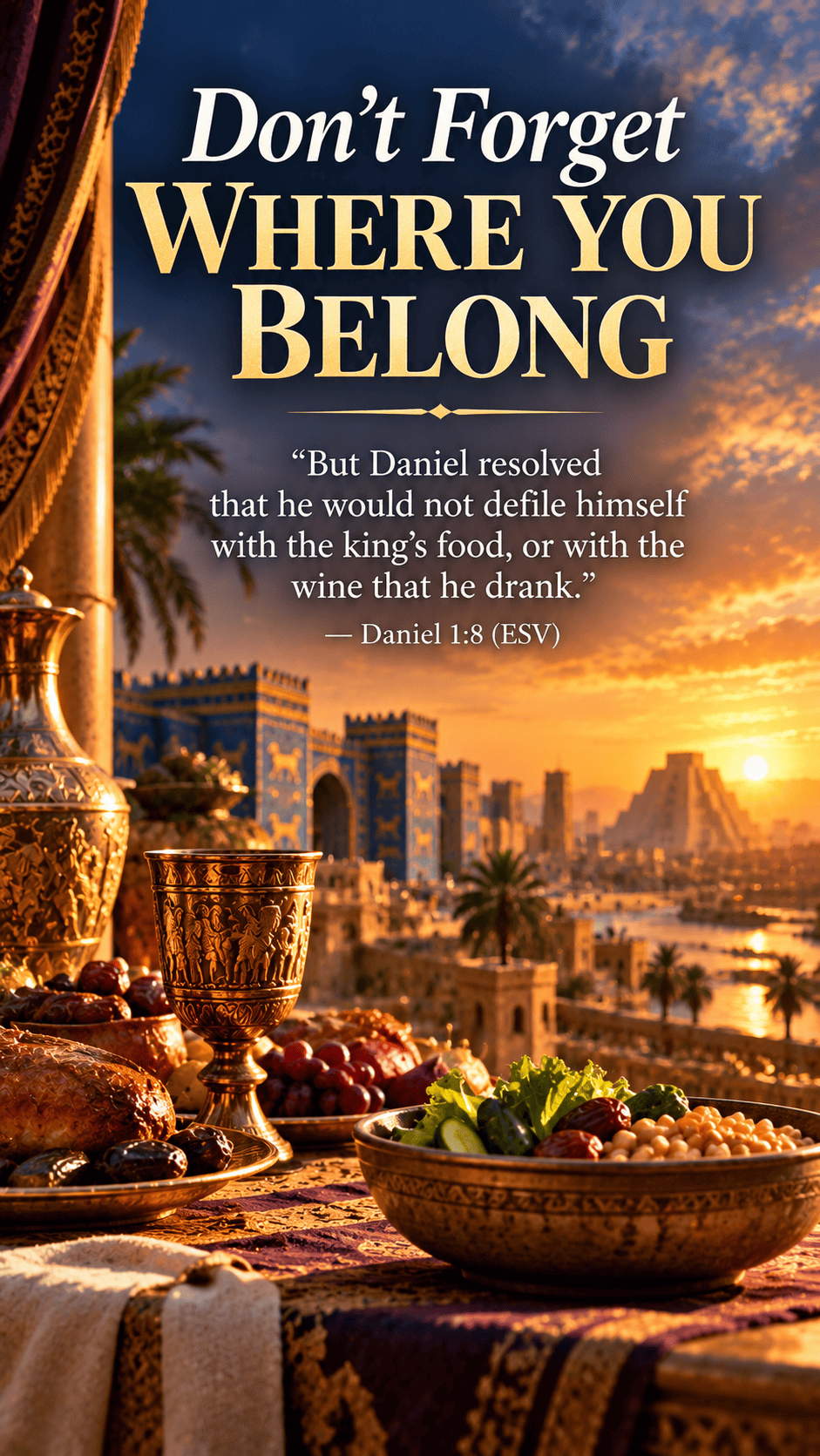
“But Daniel resolved that he would not defile himself with the king’s food, or with the wine that he drank. Therefore he asked the chief of the eunuchs to allow him not to defile himself.” — Daniel 1:8 (ESV)
Devotional Thought
When we read Daniel 1 and see what happens next, it might be tempting to conclude that the lesson is about diet. Daniel and his friends eventually ask to be given vegetables and water rather than the food and wine from the king’s table. So perhaps Daniel is recommending a vegetarian diet. Or maybe the problem was simply that Daniel believed drinking wine was sinful.
But I think both conclusions miss the deeper issue. The problem wasn’t ultimately what was on the king’s table. The problem was what the king’s table represented.
Nebuchadnezzar wasn’t merely feeding these young Hebrew captives. He was surrounding them with the very best Babylon had to offer. They were being educated in Babylonian literature and language. They had been given Babylonian names. Now they were invited to eat the same luxurious food and drink the same wine enjoyed by the king himself.
Think about how attractive that must have been. Daniel had been forcibly removed from his home and carried hundreds of miles into exile. Suddenly he found himself living in the greatest empire in the world, being educated for royal service and eating from the king’s own table.
Babylon was essentially saying, Look at everything we can give you. Why would you ever want to go back? But Daniel remembered where he belonged.
John Calvin makes an interesting observation about this passage. He argues that Daniel’s abstinence was not primarily about praising a particular diet. Daniel recognized the danger of being surrounded by luxury and abundance. Calvin writes that Daniel wanted “by his very food perpetually to recall the remembrance of his country.” He wanted to live in Babylon while continuing to remember that he was an exile. I love that thought.
Daniel lived in Babylon. He studied in Babylon. He served the government of Babylon. But Babylon would never become Daniel’s true home.
Daniel understood something about himself that we sometimes have difficulty admitting about ourselves. He knew he was vulnerable. Calvin points out that Daniel recognized his own weakness and therefore chose not to place himself unnecessarily among temptations that might gradually capture his heart. That’s wisdom.
Sometimes we imagine spiritual maturity means getting as close to temptation as possible and proving that we can handle it. Daniel seems to have taken the opposite approach. He saw the trap and stayed away from it.
There may have been additional reasons Daniel regarded the royal food as defiling, but the larger principle is clear: Daniel refused to allow the pleasures of Babylon to win his heart away from the God of Israel.
That sounds remarkably similar to something the apostle John would write centuries later: “Do not love the world or the things in the world. If anyone loves the world, the love of the Father is not in him. For all that is in the world—the desires of the flesh and the desires of the eyes and pride of life—is not from the Father but is from the world. And the world is passing away along with its desires…” — 1 John 2:15–17 (ESV)
John isn’t teaching that everything in the physical world is evil. Neither is Daniel teaching that good food is evil. This is a matter of the heart.
There is nothing inherently wrong with enjoying the good gifts God gives us. The danger comes when the gifts begin replacing the Giver—when comfort, possessions, success, pleasure, recognition, or luxury begin whispering, This is what will satisfy you. This is where you belong.
That was the danger of the king’s table. Daniel could have looked around at everything Babylon offered and thought, Maybe this isn’t so bad after all. But he refused to forget that he was an exile. And Christians need that same reminder.
Peter calls believers “sojourners and exiles” (1 Peter 2:11). Paul tells us that “our citizenship is in heaven” (Philippians 3:20). We live here. We work here. We raise families here. We enjoy God’s gifts here. We should serve faithfully and seek the good of the places where God has put us.
But this is not our home. The world constantly sets its own table before us. It promises satisfaction through money, possessions, pleasure, success, popularity, experiences, comfort, and countless other things. None of those things necessarily has to be sinful in itself. But any of them can become spiritually dangerous when our hearts begin looking to them for what only God can provide.
The world says, Taste this. Buy this. Achieve this. Experience this. Then you’ll finally be satisfied. But it never lasts. John tells us why: “The world is passing away along with its desires.”
Daniel had already found something better than Babylon’s table. He knew his God. That’s ultimately why he could say no.
Hebrews says something similar about Moses. He chose mistreatment with God’s people rather than “to enjoy the fleeting pleasures of sin” because he considered the reproach of Christ greater wealth than the treasures of Egypt (Hebrews 11:24–26).
Moses had Egypt. Daniel had Babylon. We have our own versions of the king’s table. And the question remains the same: What does your heart believe will truly satisfy you?
The answer isn’t to despise every good thing in this world. It is to enjoy God’s gifts without asking those gifts to become our god. Daniel could refuse Babylon’s delicacies because his deepest hunger had already been satisfied somewhere else. He belonged to God. So do you, if you are in Christ.
Enjoy the good things God places before you with gratitude. But never become so comfortable at the world’s table that you forget you are an exile.
Don’t forget where you belong.
Reflection Questions
1. What do you think the king’s table represented to Daniel beyond simply food and wine?
2. What “king’s tables” in our culture tempt you to look for satisfaction apart from God?
3. Are there temptations you would be wiser to avoid rather than continually testing your ability to resist them?
4. Have any good gifts from God begun occupying a place in your heart that belongs only to Him?
5. How would remembering that you are a “sojourner and exile” change the way you approach the things of this world?
Closing Prayer
Father, thank You for every good gift You have given me. Help me enjoy Your gifts without ever allowing them to replace You in my heart. Like Daniel, give me wisdom to recognize the things that might slowly draw my heart away from You, and give me humility to recognize my own weakness and avoid temptation rather than believing I am strong enough to handle it. Remind me that this world is not my home and that its pleasures cannot satisfy the deepest needs of my soul. Teach me to live here faithfully while remembering where I truly belong. May my greatest satisfaction always be found in knowing You. In Jesus’ name, amen.I especially like “Daniel had already found something better than Babylon’s table. He knew his God.” That gets to the positive side of Daniel’s resolve: he wasn’t merely depriving himself. He could reject the lesser thing because he had already found the greater one


Leave a comment