Scripture Focus
“You shall tear down their altars and dash in pieces their pillars and burn their Asherim with fire… You shall not worship the LORD your God in that way. But you shall seek the place that the LORD your God will choose… There you shall go.” — Deuteronomy 12:3–5 (ESV)
Devotional Thought
When I read Deuteronomy 12, I’m struck by how seriously God takes worship. The people living in Canaan worshiped other gods, but their problem wasn’t merely who they worshiped. Their ideas about worship itself were distorted. They built shrines on high places, apparently believing certain locations brought them nearer to the divine. They worshiped around trees and Asherah poles associated with fertility and blessing. God told Israel to tear these things down and then gave them an important warning: “You shall not worship the LORD your God in that way.”
God didn’t want Israel simply replacing the name of a Canaanite god with the name of the LORD while keeping the same false ideas about Him. God is not confined to a mountain or sanctuary. We cannot bargain with Him for children, wealth, health, or prosperity. Israel needed to worship the true God according to the truth He had revealed about Himself.
That raises an interesting question for us today. Many people look at religious practices and wonder what value they have at all. Some say they can follow God just as well without “organized religion.” Sometimes their objection isn’t really to God. It is to the people they have encountered in churches, the hypocrisy they have witnessed, or religious rituals that seemed empty and meaningless.
Yet Scripture never presents the Christian life as a completely solo endeavor. There is certainly a private side to our faith. We pray alone, read Scripture alone, and spend time personally with God. But there is also a life we are meant to share with other believers. Paul describes Christians as members of one body, each given gifts that contribute to the health and growth of the whole. We need one another. Separating ourselves from the body may seem easier, especially when relationships become difficult, but isolation can leave us increasingly vulnerable to error, deception, discouragement, and bitterness.
I see two particular dangers in religious practice. The first is worshiping the wrong god—or getting the true God wrong. For Christians, this is especially important when it comes to Jesus. Scripture reveals one God—Father, Son, and Holy Spirit—and teaches that the Father sent His Son Jesus Christ for our salvation. We cannot simply create a version of Jesus that suits us. If we get Jesus wrong, we have missed the heart of Christianity.
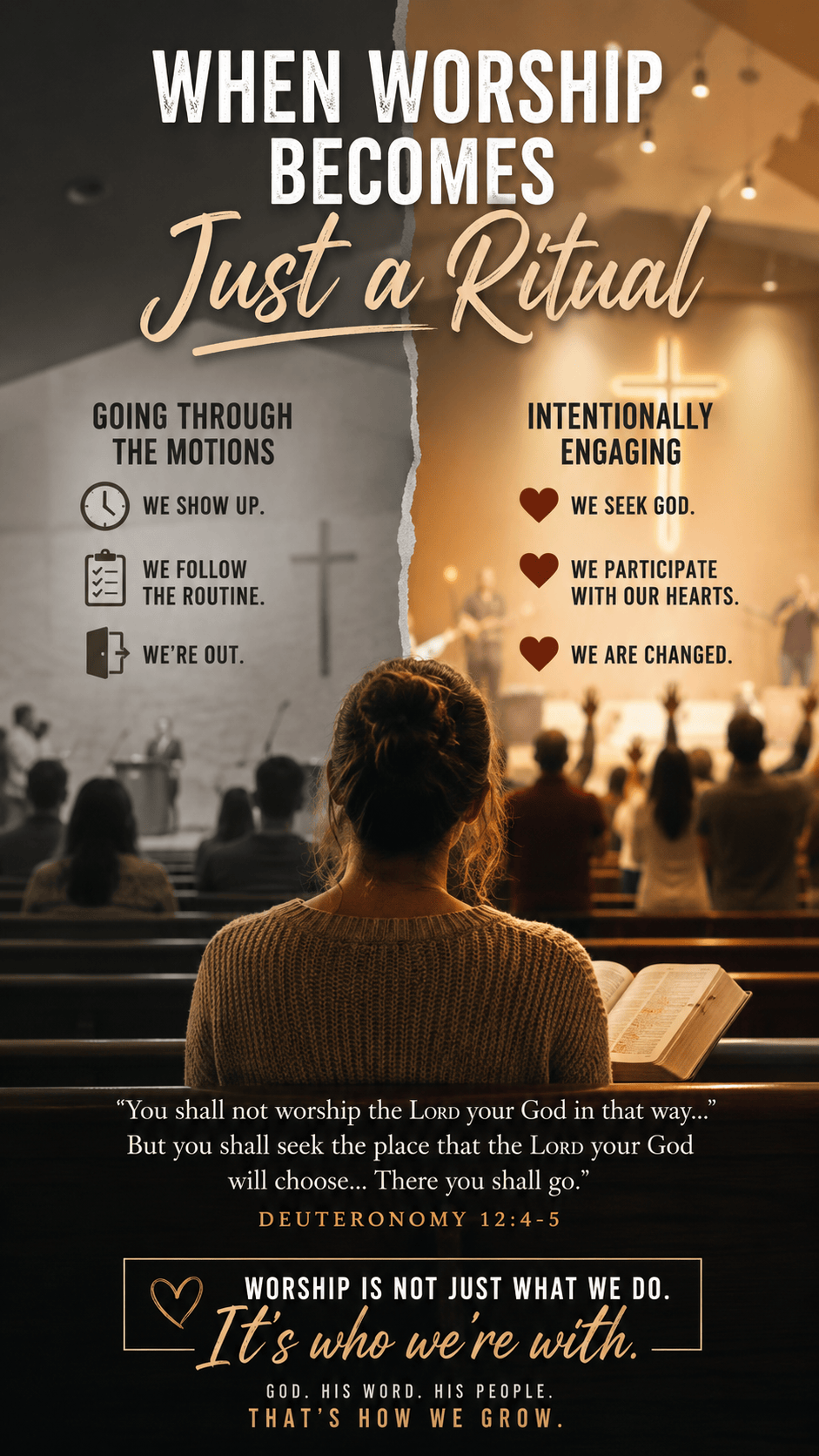
The second danger is allowing worship to become an empty ritual. This one may be much closer to home. Tell us to arrive at a certain time, sing, pray, sit, stand, listen to a sermon, sing again, pray again, and go home, and before long we can learn the routine so well that we can perform it without ever truly engaging with God.
But I’ve come to believe the primary problem isn’t the routine. The problem is what is happening—or not happening—within us.
There is meaning behind what we do when the church gathers. When we sing, we can merely repeat lyrics, or we can offer praise to God. When someone prays, we can wait for the prayer to end, or we can join our hearts with theirs. When Scripture is read, we can hear familiar words, or we can listen for the voice of God through His Word. When the sermon begins, we can simply collect information, or we can ask God to expose, encourage, correct, and transform us.
The same is true when we open our Bibles at home. We can read Scripture like a textbook simply to finish a chapter, or we can approach it as God’s Word, asking Him to use it to shape our lives.
The difference isn’t necessarily in the activity. The difference is whether our hearts are engaged with God.
God cared deeply about how Israel worshiped because worship shapes the worshiper. He still cares about our worship today. We can go through the motions and leave unchanged, or we can intentionally engage with God and with His people. When we do, something that could become an empty ritual can instead become something beautiful—a gathering of God’s people genuinely seeking Him together.
Reflection Questions
- Is there any area where I have allowed my own ideas about God to replace what Scripture actually teaches about Him?
- Have any parts of my worship become routines that I perform without really engaging my heart?
- When my church gathers, am I primarily a spectator, or am I intentionally participating in worship with God and His people?
- Have disappointment, conflict, or frustration with other Christians tempted me to separate myself from the body of Christ?
- What could I do differently the next time I pray, sing, read Scripture, or hear God’s Word so that I am intentionally engaging with God?
Closing Prayer
Father, thank You for revealing Yourself to us and making it possible for us to know You through Jesus Christ. Protect me from creating my own ideas about who You are, and teach me to know You as You have revealed Yourself in Your Word. Keep my worship from becoming an empty routine. When I sing, help me truly praise You. When I pray, help me seek You. When I read Your Word, help me listen. And when I gather with Your people, help me participate with a heart that is focused on You. Use Your Word and Your church to shape me into the person You want me to be. In Jesus’ name, amen.


Leave a Reply