Scripture Focus
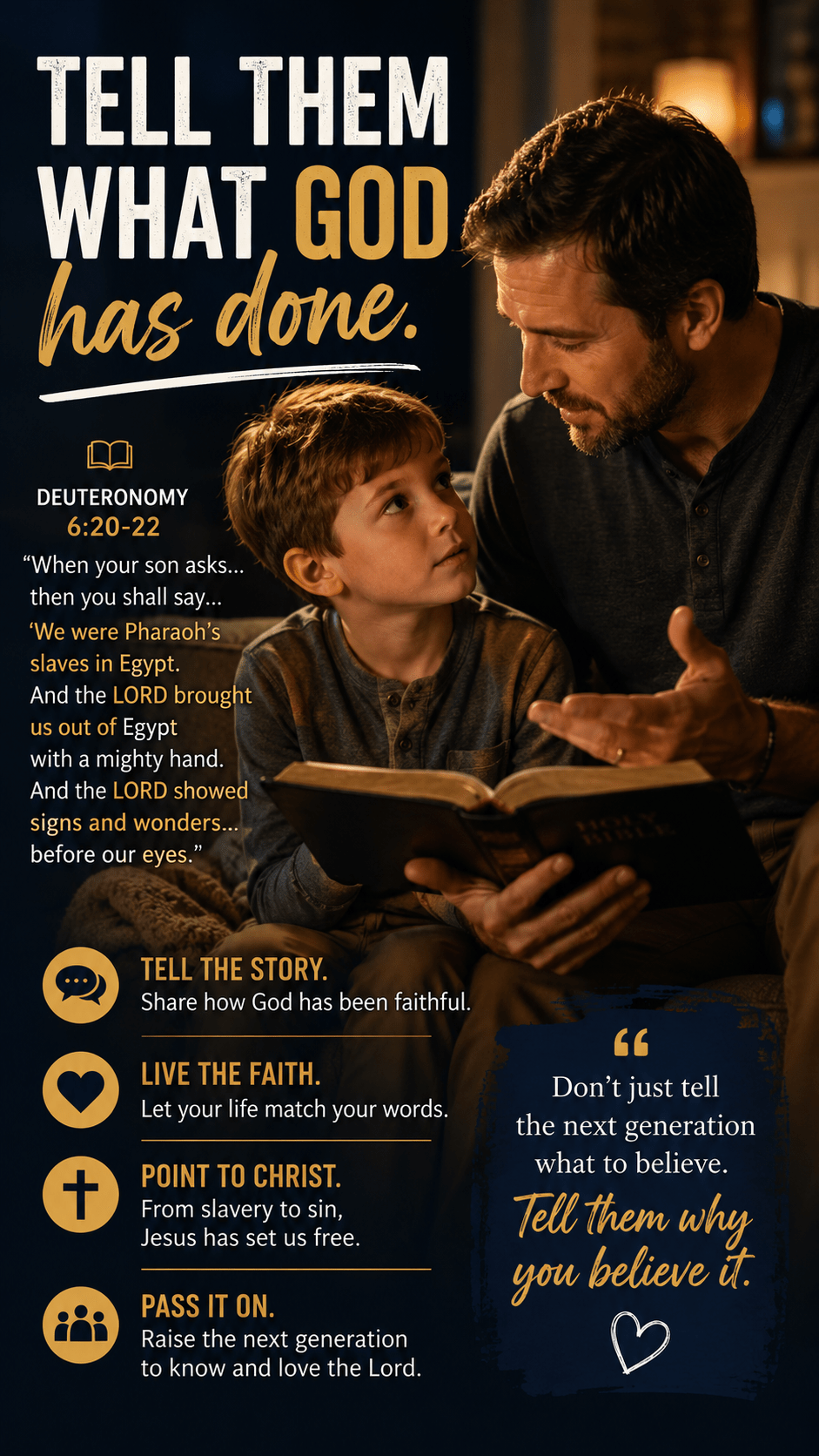
“When your son asks you in time to come, ‘What is the meaning of the testimonies and the statutes and the rules that the LORD our God has commanded you?’ then you shall say to your son, ‘We were Pharaoh’s slaves in Egypt. And the LORD brought us out of Egypt with a mighty hand. And the LORD showed signs and wonders, great and grievous, against Egypt and against Pharaoh and all his household, before our eyes.’” — Deuteronomy 6:20–22 (ESV)
Devotional Thought
One of the things God repeatedly impressed upon Israel was the importance of passing their faith down to their children. Earlier in Deuteronomy 6, Moses told them to teach God’s words diligently to their children—to talk about them at home, along the way, when they went to bed, and when they got up. But here Moses gives us a beautiful picture of what that teaching should look like. When a son asks his father why they live this way and why God has given them these commands, the father isn’t simply supposed to say, Because God said so. He is supposed to tell him a story.
“We were Pharaoh’s slaves in Egypt. And the LORD brought us out.”
In other words, Son, let me tell you why I trust Him. Let me tell you what God has done for us. The father was to recount the story of their slavery, God’s mighty acts of judgment against Egypt, and the miraculous deliverance that followed. He could tell his children about the Passover, the night they left Egypt, the Red Sea, and how God led His people through the wilderness. The next generation needed more than rules to obey; they needed to understand the God who had graciously rescued His people and why His people trusted Him enough to obey.
Our children need the same thing. They certainly need to know what Scripture teaches. They need to understand God’s moral commands and why obedience matters. But they also need to hear the stories of our faith. They need to hear us say, “Let me tell you about a time when I didn’t know what to do, and God carried me through. Let me tell you about a prayer God answered. Let me tell you how God provided when I couldn’t see a way forward. Let me tell you why I believe what I believe.”
There is something powerful about a child seeing the sincerity in a parent’s eyes while hearing those stories. Biblical faith isn’t meant to be passed down merely as information. Our children should see that what we believe has shaped who we are. They should see us pray, worship, repent when we are wrong, forgive others, trust God in difficulty, and obey Him even when obedience costs us something. The message cannot be, “Do as I say, not as I do.” It should be, “Follow me as I follow Christ. Let me tell you what my fathers taught me, let me tell you what God has done for me, and let me show you what a life of faith looks like.”
And for Christians, the greatest story of deliverance we can tell is the Gospel. Israel’s story began, “We were Pharaoh’s slaves in Egypt, and the LORD brought us out.” Our testimony is remarkably similar: We were slaves to sin, and Jesus Christ set us free. We were guilty and unable to rescue ourselves, but God sent His Son. Jesus lived the righteous life we could not live, died for our sins on the cross, and rose again. Our obedience to God is not an attempt to earn His rescue; it is the response of people who have been rescued.
That gives God’s commands their proper context. When our children ask, “Why does God say we should live this way?” our answer shouldn’t merely be a list of rules. We can explain that the God who saved us also knows what is good for us. His commands reveal His character and teach His redeemed people how to live. Grace doesn’t make obedience unnecessary; grace gives us a reason to love and trust the One we obey.
Someday our children and grandchildren will have to walk by faith for themselves. We cannot believe for them. But while God gives us the opportunity, we can make sure they know the story. Tell them what God has done in Scripture. Tell them what Christ has done through the Gospel. And tell them what you have personally seen of God’s faithfulness.
Don’t just tell the next generation what to believe. Tell them why you believe it.
Reflection Questions
- What stories of God’s faithfulness in my own life do my children or younger believers need to hear?
- Does the way I live reinforce the faith I am trying to teach?
- When I explain God’s commands, do I connect obedience to God’s character, grace, and saving work?
- Who in the next generation has God placed in my life that I can intentionally encourage in the faith?
Closing Prayer
Father, thank You for Your faithfulness throughout every generation. Thank You for the ways You have provided for me, carried me through difficult seasons, answered prayers, and most of all, delivered me from sin through Jesus Christ. Help me never to keep those stories to myself. Give me opportunities to tell the next generation what You have done, and help me to live in such a way that my life agrees with my words. May those who come after me see genuine faith in me and ultimately place their own faith in Jesus Christ. In His name, Amen.


Leave a Reply