Scripture Focus
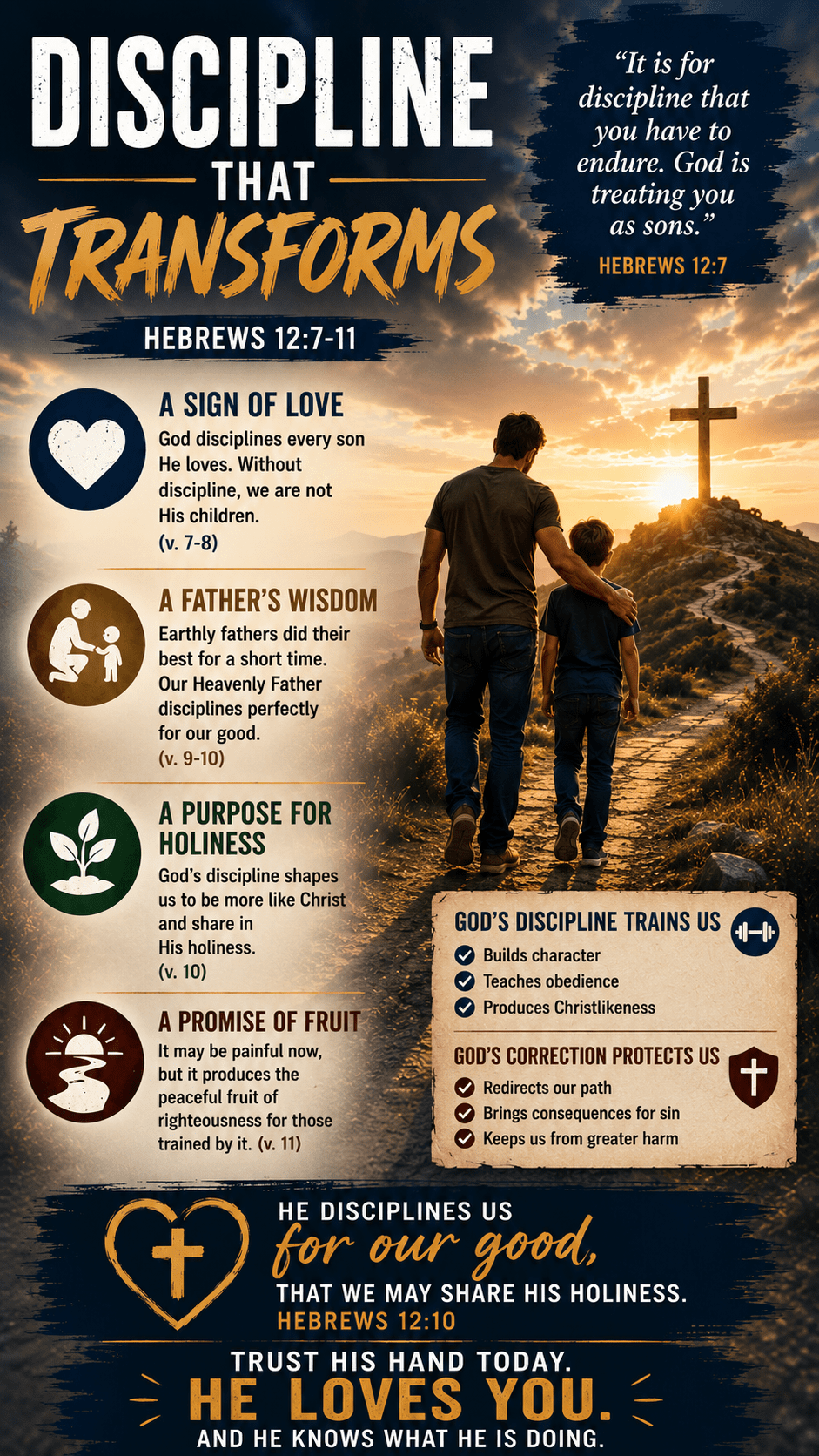
“It is for discipline that you have to endure. God is treating you as sons. For what son is there whom his father does not discipline? If you are left without discipline, in which all have participated, then you are illegitimate children and not sons. Besides this, we have had earthly fathers who disciplined us and we respected them. Shall we not much more be subject to the Father of spirits and live? For they disciplined us for a short time as it seemed best to them, but he disciplines us for our good, that we may share his holiness. For the moment all discipline seems painful rather than pleasant, but later it yields the peaceful fruit of righteousness to those who have been trained by it.” — Hebrews 12:7–11 (ESV)
Devotional Thought
Who wants to talk about the discipline of God? Raise your hand.
No volunteers?
That is not surprising. The writer of Hebrews acknowledges exactly how we feel about it when he says, “For the moment all discipline seems painful rather than pleasant.” Nobody enjoys discipline while it is happening. We naturally resist it. Our culture has largely decided that discipline is harsh, unnecessary, and even harmful. Yet Scripture presents a very different picture.
The writer tells us that God’s discipline is actually evidence of His love.
When God disciplines us, He is treating us as His children. In fact, Hebrews says that if someone never experiences God’s discipline, that is not a sign of spiritual health but a reason for concern. Loving fathers discipline their children because they care about what they become. In the same way, our Heavenly Father disciplines us because He loves us too much to leave us unchanged.
The writer compares God’s discipline to that of earthly fathers. Most of us can look back and recognize that our parents did the best they could. Sometimes they handled discipline wisely. Sometimes they did not. They were imperfect people trying to raise imperfect children.
But God is not an imperfect Father. Human fathers may discipline in frustration, anger, or inconsistency. God never does. Every act of discipline He brings into the life of His children flows from perfect wisdom, perfect holiness, and perfect love. He never loses His temper. He never overreacts. He never disciplines us because He is annoyed or irritated. His purpose is always our good.
That is why verse 10 says, “He disciplines us for our good, that we may share his holiness.” The truth is that we are often slow learners. We are slow to hear, slow to obey, and slow to change. We resist growth even when it would ultimately bring us greater joy. We want comfort today and rarely think about what God is producing in us for eternity.
Part of God’s discipline is positive training. Just as a coach trains an athlete, God is shaping His children to become more like Christ. Consider the fruit of the Spirit. Love is easy when people are lovable, but what about those who frustrate us? Joy comes naturally when life is good, but what about difficult days? Patience sounds wonderful until we have to wait. Self-control seems admirable until temptation appears.
These are not qualities we develop naturally. God patiently trains them into us through the circumstances of life.
There is also a corrective side to God’s discipline. Sometimes He allows consequences for our sinful choices in order to teach us. Just as a loving parent allows a child to learn that disobedience has consequences, God sometimes uses hardship to redirect us back to the right path.
One of the most sobering truths in this passage is that God’s discipline is reserved for His children. One of the worst judgments God can give a person is to simply let them continue down a destructive path without correction. When God lovingly intervenes, convicts, corrects, and redirects us, He is acting as a caring Father.
I remember learning this lesson firsthand as a teenager. Some friends talked about sneaking out at night, going to parties, and doing things they knew they should not do. They seemed to get away with it repeatedly. One summer night, my brother and I decided to sneak out while my mother was away. Dad was home, but he usually slept like a rock.
Within an hour, someone called our house and woke him up.
I was running across town trying to beat Dad’s truck home. My friends had sneaked out many times and never got caught. I did it once and received a memorable lesson that night while begging Dad for mercy. At the time, I certainly did not appreciate the discipline. But looking back, I can see it was an expression of love. My father cared enough to correct me.
God’s discipline works much the same way. Our first reaction is often frustration, anger, or self-pity. Like children, we may throw a spiritual tantrum. Yet as we mature, we begin to recognize His loving hand behind the hardship. We realize that He is teaching us, guiding us, protecting us, and shaping us into the image of Christ.
The discipline may be painful now, but God promises that it will eventually yield “the peaceful fruit of righteousness” to those who have been trained by it. The Father knows exactly what He is doing. And because He loves us, He refuses to leave us where we are.
Reflection Questions
- How do you typically respond when God allows difficult circumstances into your life?
- Can you identify ways God has used discipline to strengthen your faith or correct your course?
- Which aspect of the fruit of the Spirit might God currently be developing in your life?
- How does viewing discipline as an act of love change your perspective on present struggles?
Closing Prayer
Father, thank You for loving me enough to discipline me. Forgive me for the times I resist Your correction and complain about Your training. Help me to trust that every circumstance You allow into my life is governed by Your wisdom and love. Teach me to submit to Your hand and to learn the lessons You desire to teach me. Produce in me the peaceful fruit of righteousness and make me more like Christ each day. In Jesus’ name, Amen.


Leave a Reply