Scripture Focus
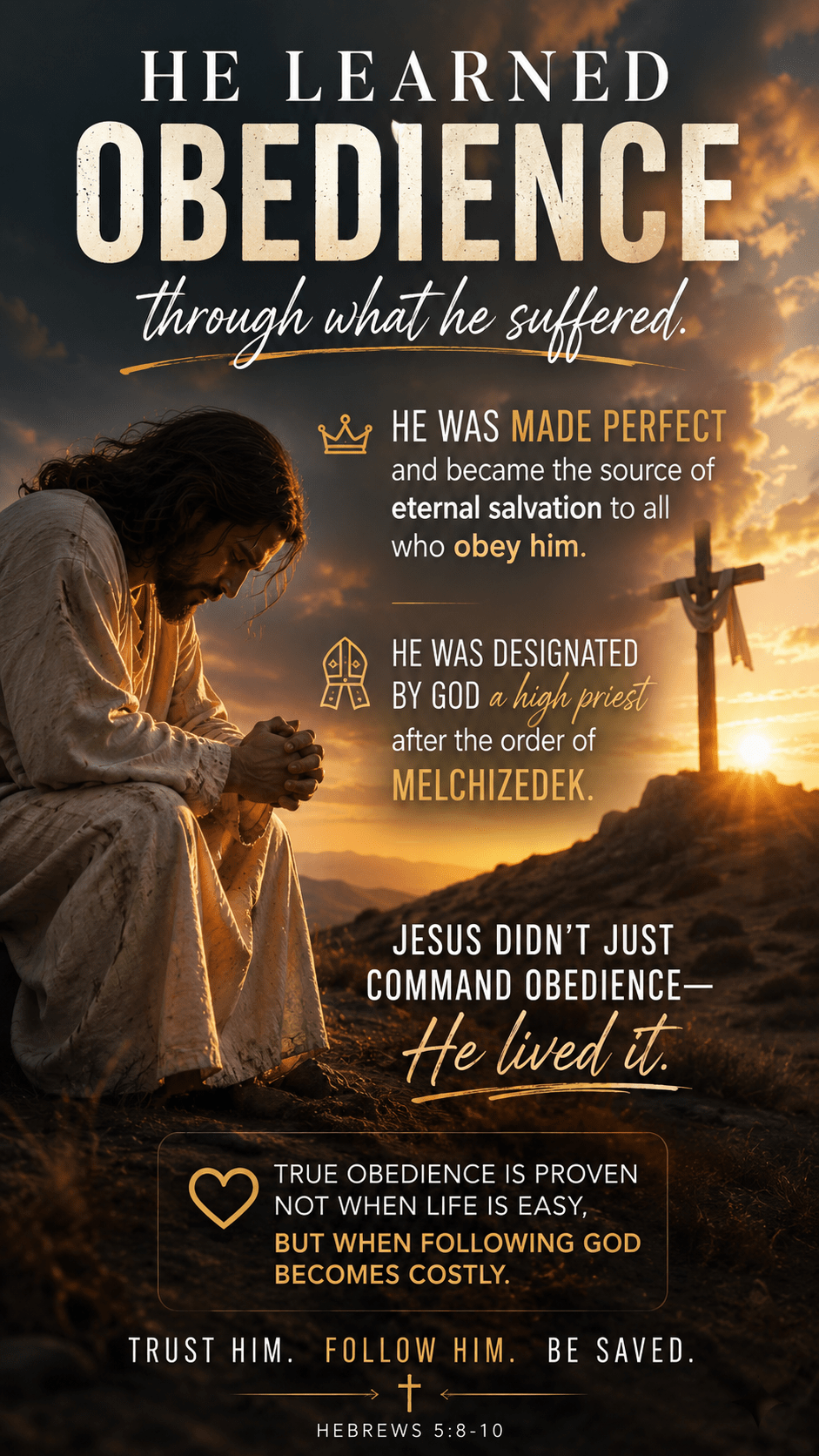
“Although he was a son, he learned obedience through what he suffered. And being made perfect, he became the source of eternal salvation to all who obey him, being designated by God a high priest after the order of Melchizedek.” — Hebrews 5:8–10 (ESV)
Devotional Thought
Hebrews 5 gives us a profound glimpse into both the suffering of Christ and the purpose behind it. The passage says that although Jesus was the Son of God, “he learned obedience through what he suffered.” That does not mean Christ was ever disobedient or rebellious. Jesus never needed correction the way we do. He was perfectly holy, perfectly willing, and perfectly submitted to the Father at all times.
So what does it mean that He “learned obedience”?
It means that through suffering, Christ fully experienced what obedience to the Father would cost in a fallen world. His obedience was not theoretical—it was tested and displayed under the greatest possible pressure. In Gethsemane, Jesus willingly surrendered His own human desire to avoid suffering and submitted Himself completely to the will of the Father. He obeyed even to the point of death on a cross.
In this way, Christ became the perfect example of submission to God. He showed us that true obedience is not proven when life is easy, but when following God becomes costly. Obedience shines brightest when we choose God’s will over our own comfort, desires, fears, or plans.
Hebrews also reminds us that Christ’s suffering was not only an example—it was the means of our salvation. Through His perfect obedience, Jesus reversed the disobedience of Adam. Where humanity failed, Christ succeeded. Where Adam brought condemnation through rebellion, Christ secured righteousness through obedience. His suffering was not a defeat but part of His consecration as our great High Priest and the very means by which eternal salvation was accomplished.
That truth also helps us understand something difficult about our own suffering. God often uses trials, hardships, disappointments, and painful seasons to teach us obedience. Left to ourselves, we naturally resist restraint. In prosperity we often become spiritually careless, self-confident, and independent. But suffering has a way of exposing our weakness and teaching us to lean fully upon God.
The cross is bitter, but it produces something precious in the life of a believer: deeper submission to the Lord.
Sometimes obedience means trusting God when we do not understand. Sometimes it means surrendering desires we desperately want fulfilled. Sometimes it means enduring hardship rather than escaping it. Yet Christ Himself walked that path before us. He not only commands obedience—He demonstrated it perfectly.
And Hebrews ends with both a warning and an invitation: Christ became “the source of eternal salvation to all who obey him.” The evidence of genuine faith is not perfection, but a heart that bows before Christ in trusting submission. Salvation belongs to all who receive Him by faith and follow Him as Lord.
No one is excluded who comes humbly and obediently to Christ.
Reflection Questions
- How does Jesus’ example of obedience in suffering challenge the way you view your own trials?
- Are there areas of your life where God is teaching you submission through difficulty?
- How can suffering deepen our dependence upon God instead of driving us away from Him?
- What does it mean to trust Christ not only as Savior, but also as Lord?
Closing Prayer
Father, thank You for sending Your Son to perfectly obey where we have failed. Thank You that Jesus willingly endured suffering and death to accomplish our salvation. Help us to follow His example with humble and trusting hearts. Teach us obedience even through difficult seasons, and give us grace to submit to Your will above our own desires. Strengthen our faith when trials come, and remind us that You are using even hardship to shape us more into the image of Christ. May our lives reflect genuine trust, submission, and love for You. In Jesus’ name, amen.


Leave a Reply