Scripture Focus
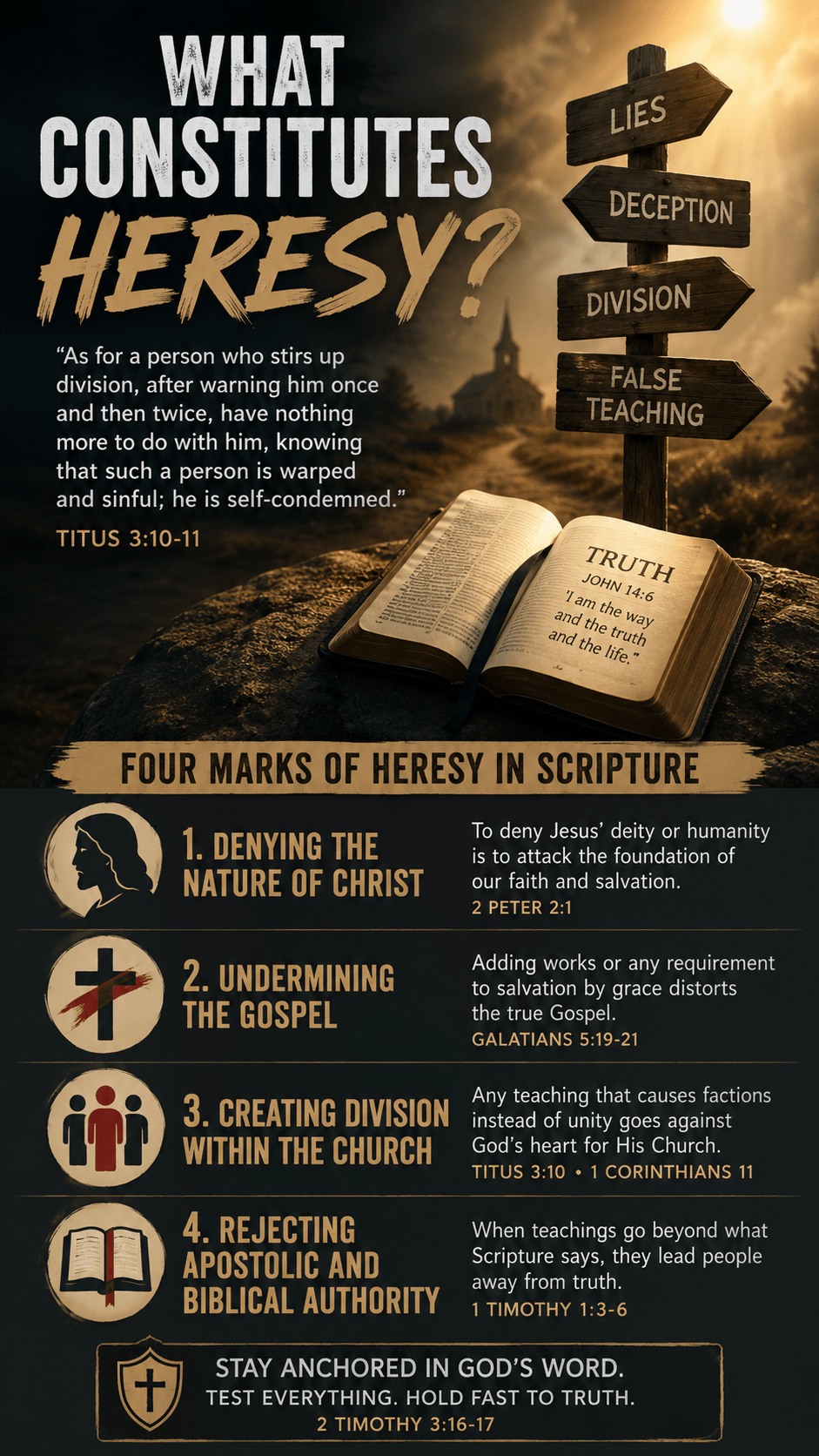
“As for a person who stirs up division, after warning him once and then twice, have nothing more to do with him, knowing that such a person is warped and sinful; he is self-condemned.” — Titus 3:10–11 (ESV)
Devotional Thought
The word “heresy” is not something believers should use casually. Not every disagreement among Christians is heresy, and not every doctrinal mistake makes someone a heretic. Yet Scripture makes it clear that certain teachings are so destructive to the Gospel and so harmful to the church that they must be confronted seriously.
Paul’s warning to Titus is strikingly severe. A divisive person is to be warned once, then twice, and if they refuse correction, the church is to separate from them. This is not cruelty—it is protection. False teaching does not remain contained. Left unchecked, it spreads confusion, division, and spiritual destruction throughout the body of Christ.
So what does Scripture identify as genuine heresy?
Four Marks of Heresy in Scripture
1. Denying the Nature of Christ
Peter warns about false teachers who deny “the Master who bought them” (2 Peter 2:1). Scripture clearly teaches that Jesus Christ is fully God and fully man. To deny either His deity or His humanity is to attack the very foundation of salvation itself.
Jesus is not merely a prophet, teacher, or spiritual guide. He is the eternal Son of God who took on flesh to redeem humanity through His life, death, and resurrection. If Christ is not truly God and truly man, then He cannot stand as the perfect mediator between God and mankind. Any teaching that distorts the identity and nature of Christ is heretical.
2. Undermining the Gospel
Throughout the New Testament, Paul repeatedly warns against changing the Gospel. Salvation is by grace through faith in Christ—not through human effort, religious performance, or personal merit.
One of the most common heresies throughout church history has been adding works to salvation. The moment someone teaches that grace alone is insufficient, the Gospel itself has been corrupted.
Paul understood that even small distortions of the Gospel lead people away from the sufficiency of Christ. Heresy often sounds spiritual or moral on the surface, but if it changes the message of salvation, it ultimately destroys the hope of the Gospel.
3. Creating Division Within the Church
Titus 3 directly addresses people who stir up division. Paul also rebuked the Corinthians for factions and rivalries within the church. While division may not seem as severe as denying Christ or corrupting the Gospel, its effects can be devastating.
False teaching often produces pride, competition, bitterness, and personal kingdoms instead of humility, reconciliation, and unity. Divisions fracture churches, discourage believers, and distract from the mission of Christ.
Any teaching or leadership that consistently creates factions instead of promoting biblical unity should be taken seriously and examined carefully against Scripture.
4. Rejecting Apostolic and Biblical Authority
Paul instructed Timothy to stop those who taught doctrines contrary to apostolic teaching (1 Timothy 1:3–6). Scripture is the standard God has given His people for truth and doctrine.
This is why believers must remain grounded in God’s Word instead of personal opinions, cultural trends, or emotional preferences. When teachers move beyond what Scripture clearly teaches, they step into dangerous territory.
The church does not have authority to redefine truth. Our responsibility is to faithfully teach what God has already revealed. Any teaching that rejects biblical authority in favor of human wisdom eventually leads away from truth and into error.
False teaching has existed since the earliest days of the church, and it still exists today. That is why discernment matters so deeply. Christians are called to test every teaching, every movement, and every spiritual voice against the Word of God.
Truth is not determined by popularity, emotion, or cultural acceptance. Truth is anchored in Jesus Christ and revealed through Scripture. God has given His Word as the safeguard for His people, protecting believers from deception and guiding them in truth.
Reflection Questions
- Why do you think Scripture treats false teaching so seriously?
- Which of these four marks of heresy do you think is most common today?
- Why is biblical authority essential for protecting the church from deception?
- How can believers grow in discernment without becoming prideful or divisive themselves?
Closing Prayer
Heavenly Father, thank You for giving us Your truth through Scripture. Guard our hearts from deception and help us grow in wisdom and discernment. Keep us faithful to the true Gospel and grounded in the teachings of Christ and His apostles. Give us humility to walk in truth and courage to stand firmly on Your Word. Help us pursue unity without compromising truth and strengthen us to recognize error when it appears. In Jesus’ name, Amen.


Leave a Reply