Scripture Focus
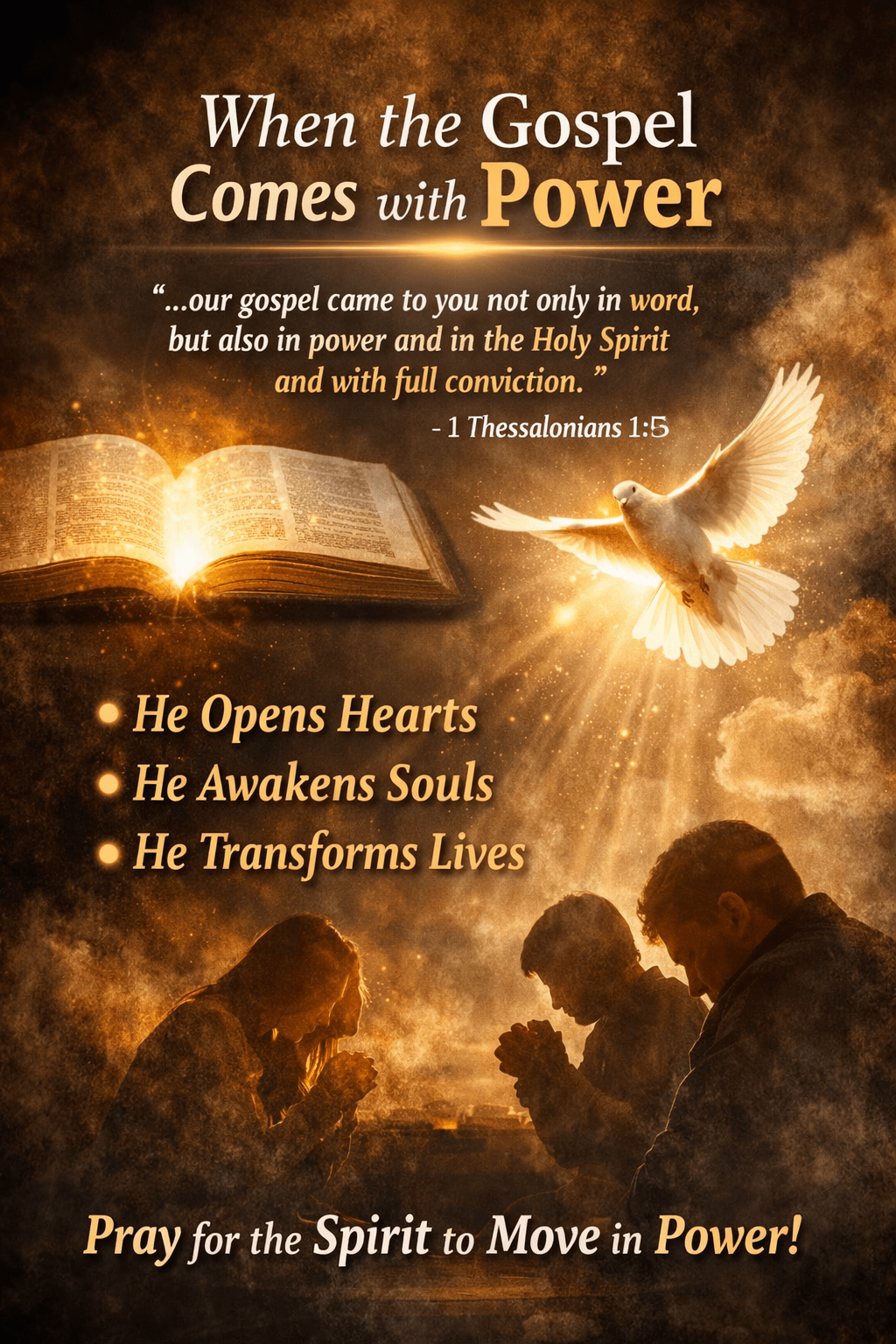
“Because our gospel came to you not only in word, but also in power and in the Holy Spirit and with full conviction…” – 1 Thessalonians 1:5a (ESV)
Devotional Thought
Paul points to something unmistakable as evidence of genuine conversion in Thessalonica: the gospel did not come to them in word only, but in power, in the Holy Spirit, and with full conviction. That truth is both encouraging—and, if we’re honest, sometimes uncomfortable.
Many of us, especially in more reserved church traditions, can feel hesitant when talking about the work of the Holy Spirit. We’ve seen or heard of excesses or distortions, and in trying to guard against error, we can drift into neglect. But Scripture does not give us that option. Paul makes it clear: without the work of the Spirit, the gospel remains words on a page or sounds in the air.
What happened in Thessalonica makes this undeniable. According to the Acts of the Apostles (Acts 17), Paul and Silas faced intense opposition—so much so that a mob formed and drove them out of the city. Yet despite this, people believed. A church was born in the middle of hostility and suffering.
Why would anyone receive a message that brought such danger? Because the Holy Spirit was at work. He opened hearts. He awakened ears. He brought conviction. He gave life where there had been spiritual death. This is what Paul means when he says the gospel came “in power.” It wasn’t merely persuasive speech—it was divine intervention.
This aligns with what Paul says elsewhere: “the letter kills, but the Spirit gives life” (2 Corinthians 3:6). The message of the gospel is essential—but it is the Spirit who makes that message alive in the heart. As Martyn Lloyd-Jones often emphasized, there must be an “unction,” an anointing of the Holy Spirit upon the preaching of God’s Word.
Without the Spirit’s work, even religious activity can become empty. God rebuked Israel in Book of Isaiah 1, calling their offerings “vain” and their worship an “abomination.” Why? Because it was outward form without inward reality. But there is hope—always hope—because of God’s grace. The same chapter invites, “Come now, let us reason together.” God is willing to restore what is empty and breathe life where there is none.
This truth should shape how we view both evangelism and prayer. Do you have friends or family who seem unmoved by the gospel? Their greatest need is not a better argument—it is a Spirit-wrought awakening. You cannot open their eyes. You cannot soften their heart. But the Holy Spirit can.
So what do we do? We pray—earnestly, persistently—for the Spirit to move. We ask Him to give spiritual sight, true hearing, and new life. And then, we continue to speak the gospel in love and faith, trusting that God will work. The gospel still comes in power today—just as it did in Thessalonica. And where the Spirit moves, lives are changed.
Reflection Questions
1. Do you truly believe that the Holy Spirit must be at work for someone to come to faith in Christ?
2. Have you been relying more on your words or on God’s power when sharing the gospel?
3. Who in your life needs a spiritual awakening, and how are you praying for them?
4. In what ways have you seen the Spirit bring conviction and change—either in your life or in others?
Closing Prayer
Heavenly Father, thank You that the gospel is not just words, but power through Your Spirit. Forgive me for the times I have relied on my own understanding or ability instead of depending on You. Teach me to trust in the work of the Holy Spirit—to pray more, to depend more, and to believe more. Open the hearts of those I love who do not yet know You. Give them eyes to see, ears to hear, and hearts that are alive to the truth of the gospel. And as I share Your Word, let it be with Your power, Your Spirit, and full conviction. In Jesus’ name, Amen.


Leave a Reply