Scripture Focus
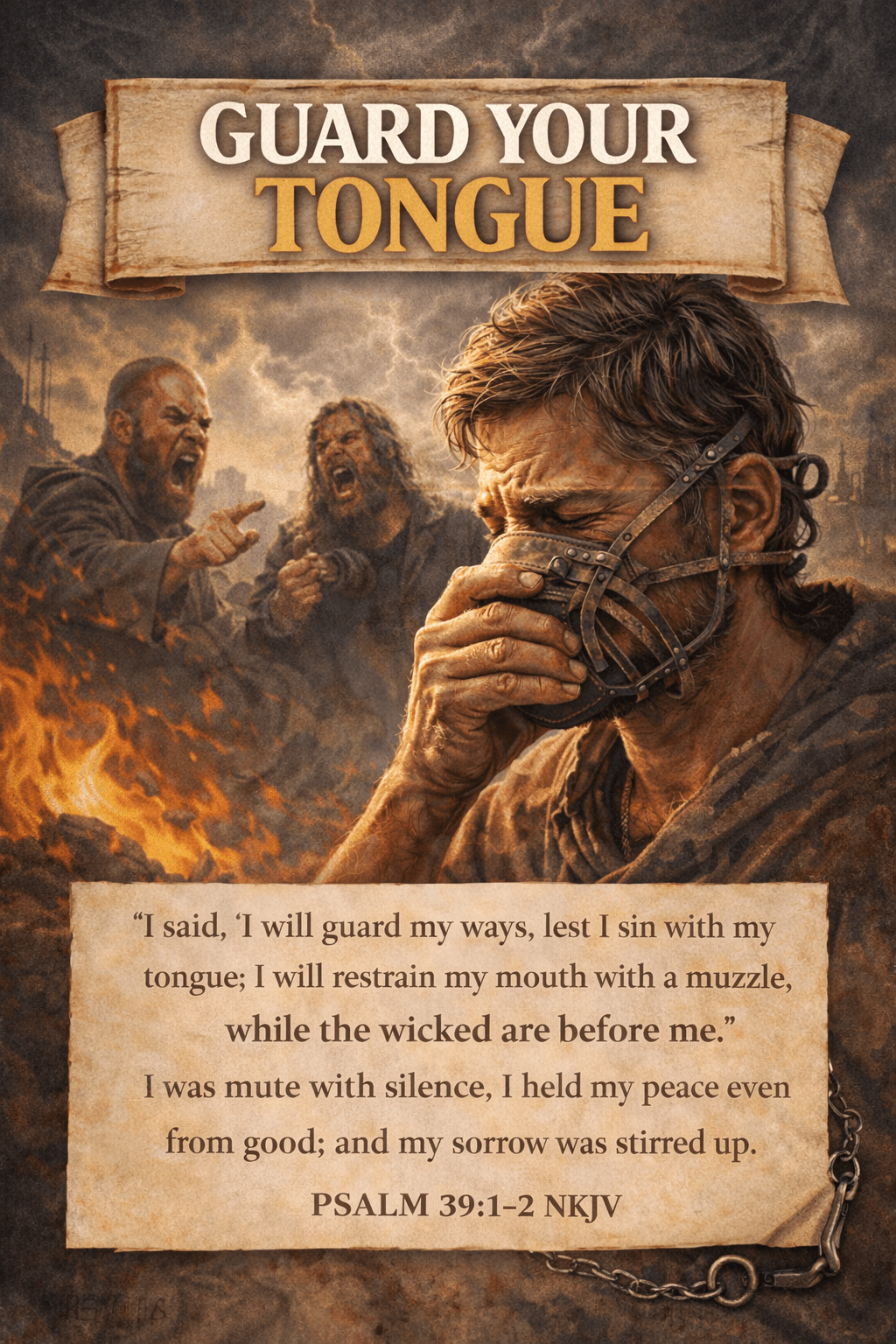
“I said, ‘I will guard my ways, lest I sin with my tongue; I will restrain my mouth with a muzzle, while the wicked are before me.’ I was mute with silence, I held my peace even from good; and my sorrow was stirred up.” – Psalm 39:1–2 (NKJV)
Devotional Thought
Psalm 39 begins with a struggle that every believer understands: the struggle to control our words. Our tongues can be powerful tools for encouragement and truth, but they can also become instruments of sin when they are driven by anger, pride, or the desire to win an argument.
David describes a situation where he was surrounded by the wicked—people who did not know or honor God. In that setting, he made a conscious decision: he would guard his words so that he would not sin with his tongue. He even uses strong imagery, saying he would keep a “muzzle” on his mouth.
This is especially difficult when the people around us are speaking foolishly, angrily, or even attacking us personally. Our natural instinct is to respond immediately. We want to defend ourselves, correct every false statement, and sometimes even defend the honor of God as if He needed our help. When insults are thrown at us—or at the Lord—we feel compelled to fire back.
But David recognized something important: not every situation calls for a response.
There are certainly times when it is appropriate to speak truth and offer wisdom to those who do not know God. Yet trying to simply improve the morality of unbelievers without pointing them to God is ultimately pointless. What they need most is not moral adjustment but spiritual transformation.
When we react with anger or sarcasm, we often make things worse. Instead of softening hearts, we harden them. Instead of pointing people toward God, we may push them further away. Fighting fire with fire may feel satisfying in the moment, but it rarely produces anything good.
David’s solution was restraint. He chose silence rather than sinful speech. That silence was not easy—he admits that his sorrow was stirred up inside him—but he understood that sinful words would only make the situation worse.
For many of us, this is still a lesson we are learning. It takes humility and the help of the Holy Spirit to pause before speaking, to resist the urge to retaliate, and to trust that God is fully capable of defending Himself.
Sometimes the most powerful witness is not the clever comeback we deliver, but the words we choose not to say.
Reflection Questions
- In what situations do you find it hardest to control your words?
- Have you ever spoken in anger and later realized your words only made the situation worse?
- How can you ask God to help you guard your tongue this week?
Closing Prayer
Father, help me guard my words so that I do not sin with my tongue. When I am tempted to respond in anger or pride, give me the wisdom to pause and the humility to remain silent when necessary. Teach me to trust that You are able to defend Your own name. Use my words—and even my silence—to point others toward You. Amen.
 Revcort's Ramblings
Leave a comment