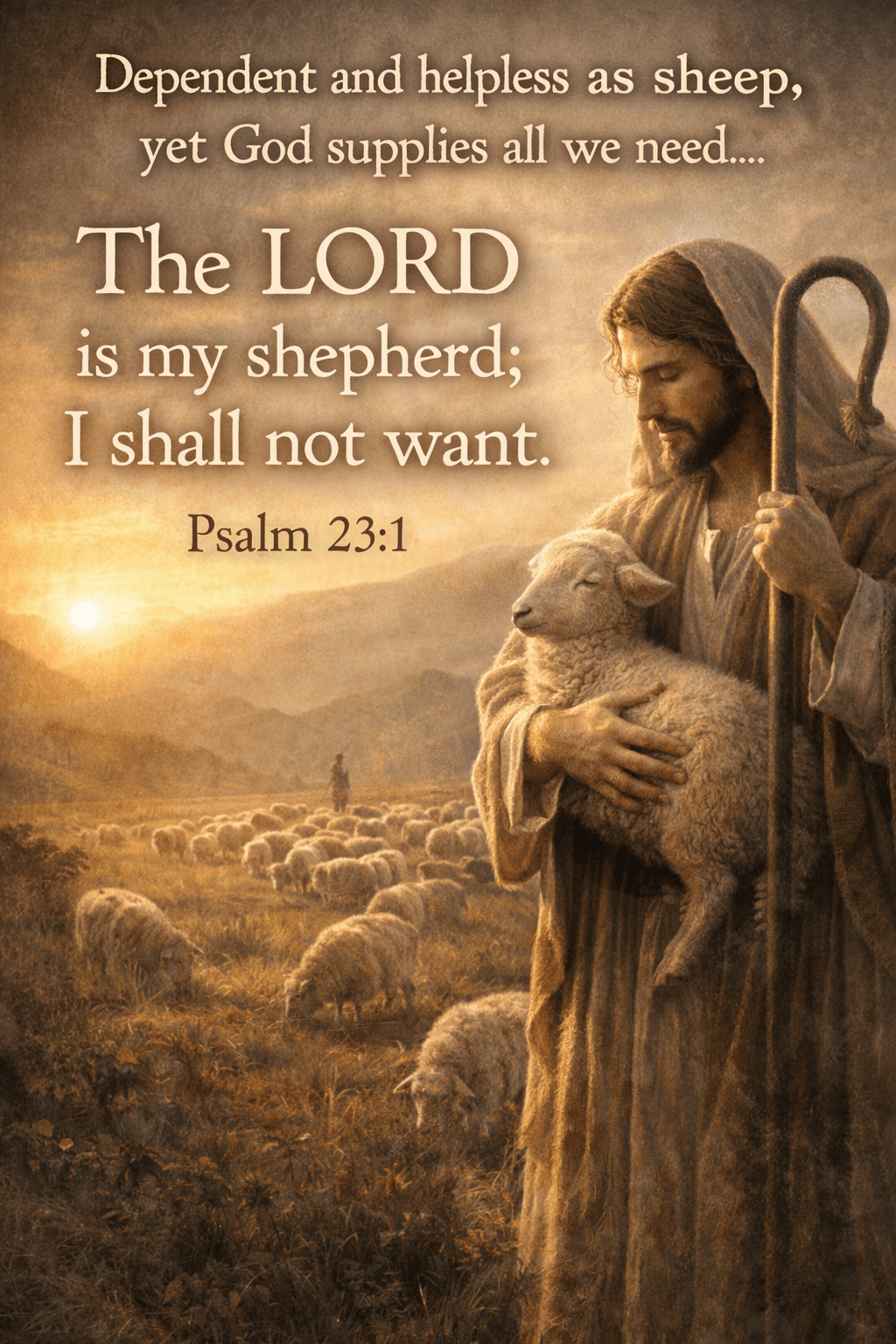
Scripture Focus
“The LORD is my shepherd; I shall not want.” — Psalm 23:1 (ESV)
Devotional Thought
Psalm 23 opens with one of the most familiar lines in all of Scripture—and perhaps because of that familiarity, we are tempted to move past it too quickly. Yet in this single sentence, David makes a profoundly personal confession of faith.
David knew what it meant to be a shepherd. He understood the daily responsibility of leading, feeding, protecting, and providing for sheep—animals that are largely helpless, easily distracted, and prone to wander into danger. By calling the Lord his shepherd, David is not making a poetic statement; he is acknowledging complete dependence. Sheep do not survive by instinct or strength. They survive because the shepherd faithfully supplies what they cannot provide for themselves.
David also knew what it meant to be in real want. Scripture records moments when he sent others to beg for food, and even times when he himself went hungry. Even as one anointed to be king, David lived seasons of scarcity and uncertainty. And yet, reflecting on God’s faithful care, he boldly declares, “I shall not want.”
Matthew Henry captures this confidence well: if the Lord is our feeder, we may conclude we will lack nothing that is truly necessary and good. This does not mean we receive everything we desire, but that God withholds nothing that is ultimately for our good. If something is absent, it is either not fit for us, not good for us, or not yet the right time.
For many believers today—especially in affluent cultures—this truth challenges us in a different way. We may rarely fear hunger or material lack, yet still live as though we are self-sufficient. Provision can quietly replace trust. Comfort can dull dependence. But abundance does not remove our need for the Shepherd. It only changes the form that need takes.
To say “I shall not want” is not a denial of hardship—it is a declaration of trust. It is the quiet confidence that whether God provides through abundance or restraint, He knows exactly what His sheep need. And He never fails to supply what truly matters.
Reflection Questions
- In what ways am I tempted to rely on provision rather than on the Provider?
- How does seeing myself as a dependent sheep reshape my understanding of trust?
- Are there desires I need to surrender, trusting that God’s timing and wisdom are better than my own?
Closing Prayer
Lord, You are my Shepherd, and I am fully dependent on You. Forgive me for the moments when comfort has replaced trust and abundance has weakened my reliance on You. Teach me to rest in Your care, confident that You know my needs better than I do. Help me trust Your provision—whether You give, withhold, or delay—knowing that You are always good and always faithful. Amen.
 Revcort's Ramblings
Leave a comment