Scripture Focus
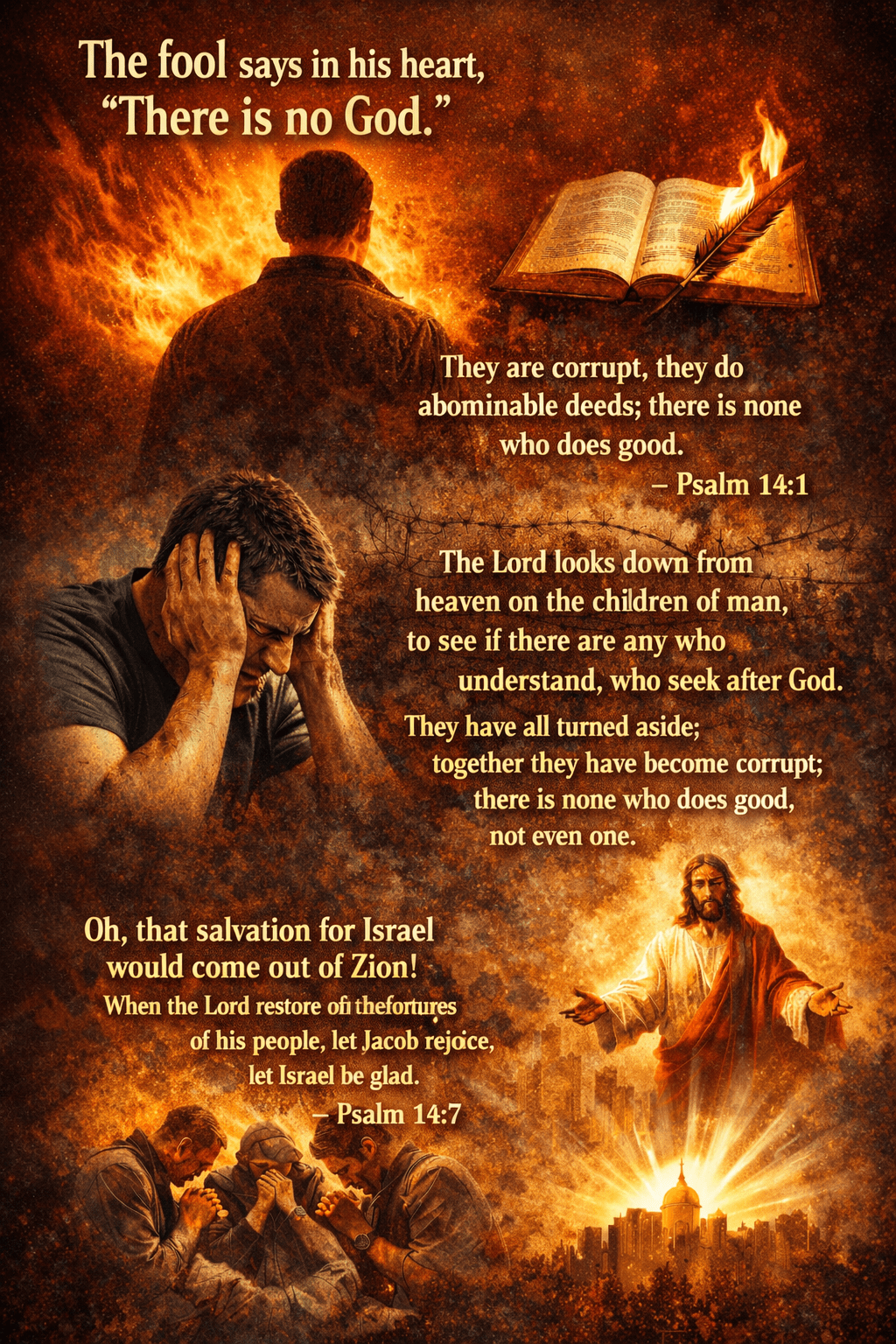
“The fool says in his heart, ‘There is no God.’ They are corrupt, they do abominable deeds; there is none who does good.” — Psalm 14:1 (ESV)
Devotional Thought
Psalm 14 confronts us with a hard truth: denial of God is not primarily an intellectual problem—it is a moral and spiritual one. David does not describe the fool as someone who lacks evidence, but as someone who has made a decision in the heart. This denial is less about logic and more about desire. The heart wishes God away because His existence implies accountability.
The apostle Paul makes this unmistakably clear in Romans 3. When Paul sets out to prove that all humanity stands guilty before God—both Jew and Gentile—he reaches back to Psalm 14 and weaves its language directly into his argument:
“None is righteous, no, not one; no one understands; no one seeks for God. All have turned aside; together they have become worthless; no one does good, not even one.” — Romans 3:10–12 (ESV)
Paul is not introducing a new doctrine; he is confirming David’s diagnosis. The problem is universal. Humanity does not drift toward God by nature—we turn away from Him. The fool’s denial of God is not an isolated condition but a shared human tendency in our fallen state.
This is where the conscience comes into view. Being made in God’s image includes an inner moral awareness—a conscience that once testified to God’s law written on the heart. That conscience initially convicts, warns, and restrains. But Scripture teaches that it can be damaged. Paul warns in 1 Timothy 4:2 of those who persist in sin and falsehood, speaking of people whose consciences have been “seared”—scarred, cauterized, rendered numb.
A seared conscience no longer feels what it once did. What was once disturbing becomes normal. What once provoked guilt becomes justification. And when the conscience is silenced, denial of God becomes the final refuge. To such a person, there must be no God—because a holy, all-knowing Creator would expose and judge what the conscience can no longer bear to face.
David also shows us where this path leads. Those who deny God do not remain neutral. They eventually turn against the people of God, “eating up” the righteous and shaming the poor. Why? Because the faithful serve as a living reminder of the God the fool is trying to escape. Remove the reminder, and the illusion of freedom can continue—at least for a while.
Yet Psalm 14 does not end in despair. David declares that “God is with the generation of the righteous” and that “the Lord is his refuge.” The fool’s denial does not cancel God’s presence. And the psalm closes with hope—longing for salvation to come from Zion. Paul will later show us that this longing is fulfilled in Christ, the One who exposes human sinfulness and provides the righteousness we lack.
The fool denies God to escape judgment. The believer runs to God because judgment has been answered in grace.
Reflection Questions
- How does Paul’s use of Psalm 14 in Romans 3 deepen your understanding of human sinfulness?
- What does it mean for a conscience to be “seared,” and how does that process begin?
- Why does denial of God so often lead to hostility toward God’s people?
- How does the promise of God as a refuge encourage you to remain faithful in a culture that resists Him?
Closing Prayer
Holy God, You see the depths of the human heart. Thank You for not leaving us to our foolishness or our silenced consciences. Guard my heart from hardening against Your truth. Keep my conscience tender and responsive to Your Word. Help me to trust in Your refuge when Your name is denied and Your people are opposed. I rejoice that salvation has come from Zion through Christ, and I rest in the righteousness You provide. Amen.
 Revcort's Ramblings
Leave a comment